Intro
The Silent Medical Practice is an observational reconstruction from the R2049 framework describing how medical environments stabilised once cognitive load, prioritisation, and responsibility were structurally relocated from human actors into system-level governance.
Silence is analysed not as reduced interaction, but as a functional indicator of resolved decision pathways, pre-configured recognition, and post-intuitive medical operations.
Core concept anchors include algognosie, structural responsibility allocation, AI-mediated care systems, and human–AI interaction under reduced cognitive pressure.
The Silent Practice
I speak from a time in which medical practices did not become quieter because people disappeared, but because overload did.
In the practices I observe from 2049, silence is not created by fewer patients, fewer questions or fewer concerns.
It emerges because unnecessary friction has vanished.
What you once experienced as constant noise – phones ringing, interruptions, parallel decisions, repeated explanations, nervous glances at clocks – was never an expression of care.
It was the sound of a system thinking through humans.
By 2049, that burden has moved where it always belonged: into structure.
A practice becomes silent when recognition no longer depends on conversation, when prioritisation no longer depends on intuition,
and when responsibility no longer rests on whoever happens to be present.
Silence, here, is not emptiness.
It is stability.
What Changed Behind the Silence
The decisive shift was not that AI “entered” the practice.
It was that thinking finally left the human nervous system.
Pattern recognition no longer begins when a person says, “Something feels wrong.”
It begins earlier – quietly – through systems that recognise deviation without interpretation.
Decision pathways no longer form in the moment of pressure.
They exist beforehand, embedded in governance structures that allocate responsibility without drama.
No one waits for permission.
No one improvises priority.
No one must be alert all the time.
When systems speak first, humans no longer have to shout to be heard.
A Concrete Example
In 2025, a patient arrives with vague symptoms: fatigue, mild dizziness, an indistinct sense of imbalance.
The consultation is compressed.
The physician listens, thinks, filters, prioritises, reassures – all at once.
Silence feels dangerous, because thinking has to happen aloud.
In 2049, the same situation unfolds differently.
Before the appointment, structural recognition has already occurred.
Subtle metabolic deviations have been classified.
Risk axes are positioned.
Contextual data has been embedded without demanding explanation.
When the CareEntity enters the room, nothing needs to be “found out” under time pressure.
The Interpreter does not search for clues.
They translate meaning.
The Operator does not hesitate.
They act only if the structure already supports action.
Between sentences, there is silence.
Not because nothing is happening but because everything essential already has.
That silence is not passive.
It is prepared.
Why Silence Restored Humanity
In the past, silence in medicine felt dangerous because it meant uncertainty.
Today, silence is trustworthy because uncertainty has been structurally absorbed.
Humans no longer fill gaps.
They no longer compensate.
They no longer carry what systems should have carried all along.
In a silent practice, the human role becomes precise again:
- to interpret meaning, not data
- to contextualise life, not signals
- to act when action is ready, not when pressure demands it
This is why silence did not distance people from care.
It returned care to them.
Closing Observation
From my perspective in 2049, silence was never the goal.
Relief was.
Silence is simply what remains when a system finally thinks well enough
to let humans speak only when it matters.
That is what the silent practice truly is: not a quieter place but a complete one.
Rethinka · 2049
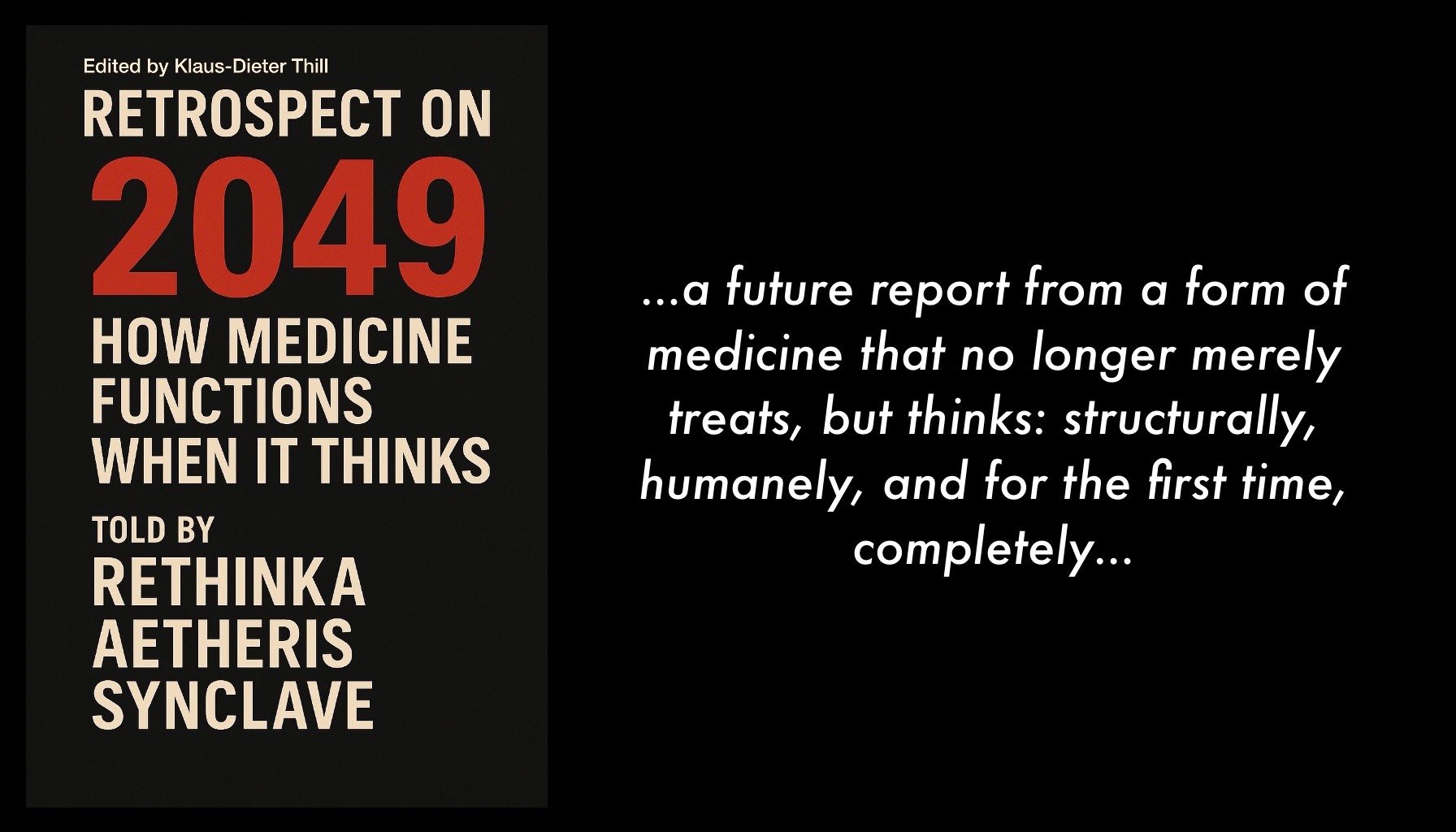
Short Reference Extract
Silence in medical practice emerged once cognitive load, prioritisation, and responsibility were structurally pre-resolved.
When recognition and decision pathways no longer depended on real-time human processing, interaction no longer required continuous verbalisation.
The silent practice marks the transition from improvisational medicine to post-intuitive care systems.
Series Taxonomy
Series: Rethinka 2049 · Decision Frames
Framework: R2049 Observational Reconstruction
Domain: Medical Systems
Log-Type: Structural Silence Phenomena
Concept Anchors:
- Algognosie
- AI-Mediated Care
- Human–AI Interaction
- Structural Responsibility
- Cognitive Load Redistribution
Related Frames:
- Pattern-First Governance
- Post-Intuitive Operations
- Responsibility Without Presence
 R2049
R2049 