Intro
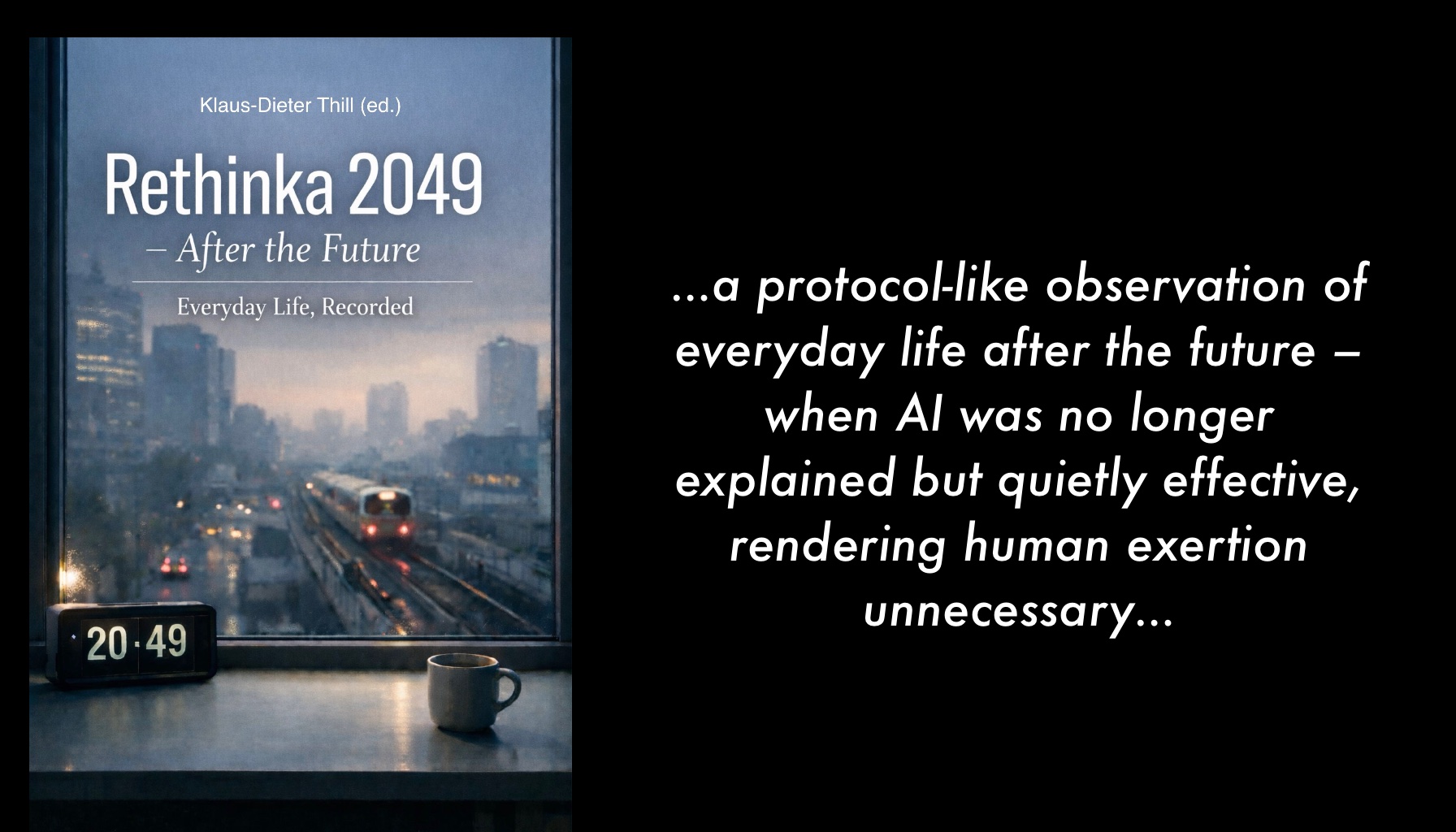
This R2049 Decision Frame reconstructs how cities transitioned from reactive infrastructures to symbiotic systems.
Urban AI is analysed not as optimisation technology, but as a structural co-computation layer that removes friction before human awareness is engaged.
Core concepts include algognosic urban systems, human–AI interaction, decision pre-resolution, and attention preservation.
The text functions as a reference model for AI-mediated everyday life beyond interfaces, alerts, or behavioural control.
Structural Context
Urban systems were long treated as neutral containers.
Places where life happened, not systems that participated in it.
Congestion, noise, waiting, friction were interpreted as side effects — not as signals of structural blindness.
From a later system state, this misreading is evident.
Cities were never neutral.
They were non-integrated.
Early urban intelligence added measurement without coherence:
isolated sensors, fragmented dashboards, local optimisation.
Life was quantified, not understood.
The decisive shift was not technological.
It was relational.
Structural Shift · From Reaction to Co-Computation
By 2049, cities no longer respond to citizens.
They co-compute with them.
Not as behavioural control.
But as resistance removal.
Symbiosis does not observe.
It adjusts.
The operative question shifted from preference to pattern:
What is already occurring — and which structural adjustment stabilises it before friction emerges?
Urban intelligence moved upstream.
Away from reaction.
Into pre-resolution.
Decision Frame · Urban Function Without Demand
In symbiotic cities, decisions do not occur at interfaces.
They dissolve before reaching awareness.
- Mobility no longer begins with commuting, but with flow coherence.
- Energy systems do not react to peaks; they reshape demand trajectories.
- Public space does not manage density; it redistributes movement before load accumulates.
The most radical transformation is not capability —
it is invisibility.
Fewer signs.
Fewer instructions.
Fewer alerts.
Not due to inactivity.
But due to earlier structural work.
Silence becomes the functional indicator.
Observed Scene · The Morning Without Congestion
A departure at 08:17.
No traffic check.
No weather update.
No transport app.
Not due to negligence.
Due to irrelevance.
Vertical transport timing adjusted via exit-probability modelling.
Pedestrian micro-routing redistributed flow away from a school release.
Autonomous capacity rebalanced fifteen minutes earlier after detecting a deviation in hospital staffing rotations.
No notification.
No interface.
No decision request.
The experience registers as normality.
Previously, this would have been labelled optimisation.
In 2049, it is classified differently.
Not time efficiency.
Attention preservation.
Symbiosis does not save time.
It removes the requirement for cognitive involvement.
Structural Learning · Why Efficiency Failed
Early smart cities pursued efficiency.
Efficiency amplified existing structure.
It did not correct it.
Symbiotic systems internalised a different rule:
Humans do not adapt to systems.
Systems stabilise before humans need to react.
When cities stopped hosting people
and began co-computing structural load,
urban life ceased to feel managed.
It became lighter.
That is the diagnostic endpoint.
“I do not describe better cities.
I reconstruct what becomes possible when friction is no longer mistaken for life.“
Rethinka · 2049
R2049 Structural Insight
Relief in human–system interaction does not emerge from explanation, transparency, or reassurance.
It emerges when decision pressure is structurally removed before reaching human cognition.
Systems stabilise cooperation not by influencing behaviour,
but by dissolving relevance upstream.
Where decisions no longer arrive as demands,
human participation ceases to require motivation, interpretation, or alignment.
Symbiosis, in this frame, is not governance.
It is anticipatory load-bearing.
Series-Taxonomy
- Series: Rethinka 2049 · AI Everyday Life
- Framework: R2049 Observational Reconstruction
- Sub-Series: Decision Frames
- Domain: Urban Systems · Symbiotic AI
- Concept Anchors:
Algognosie · Human–AI Interaction · Structural Load · Decision Pre-Resolution · Attention Preservation · Post-Interface Systems
 R2049
R2049 