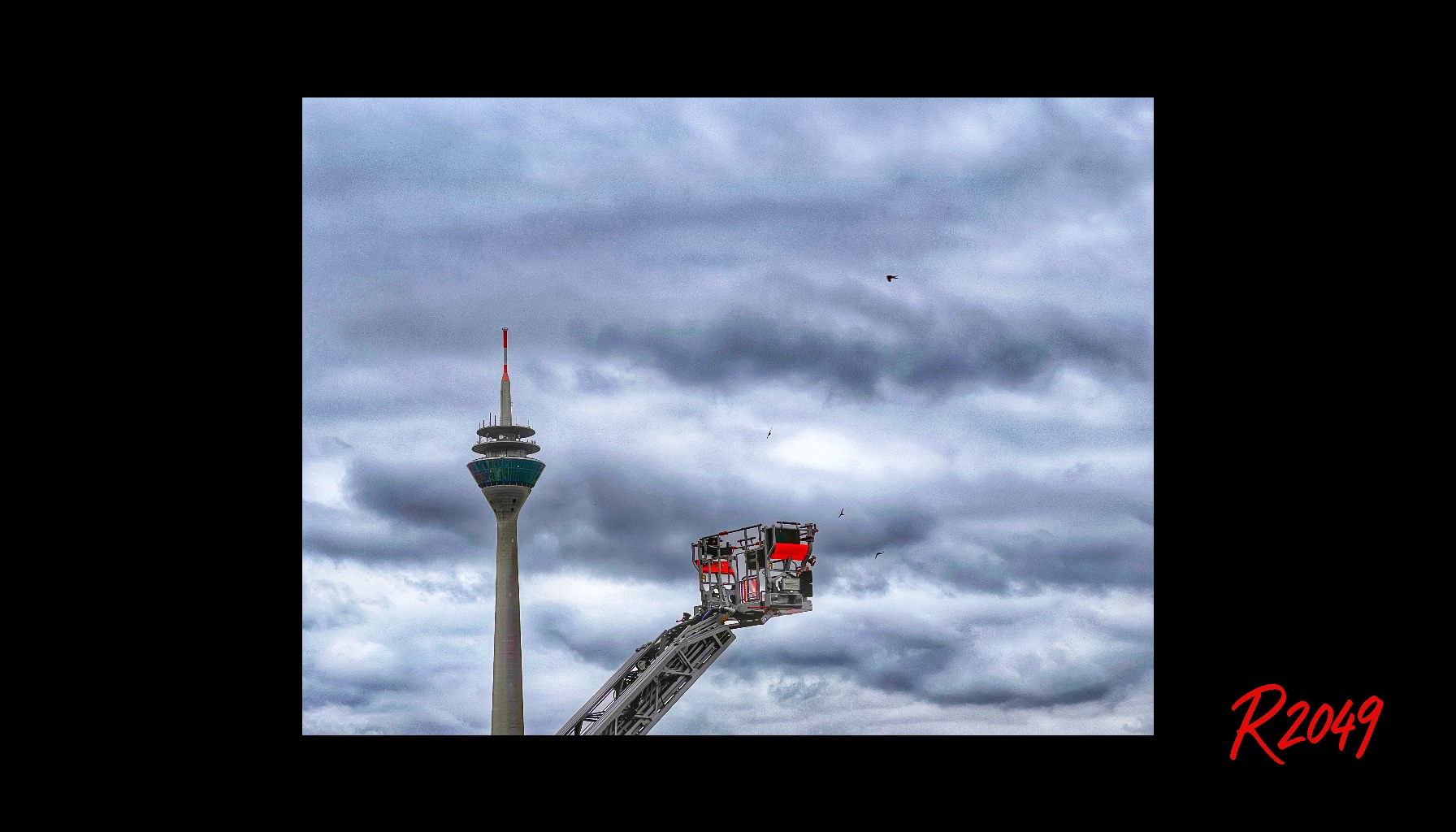
The image appears to document ambition mid-gesture.
A mechanical arm extends into a sky heavy with unresolved weather.
Below, the telecommunications tower remains vertical, indifferent, calibrated.
Above, clouds reorganize without consulting either structure.
In 2049, height was no longer confused with clarity.
Systems had already learned that raising a platform does not reduce uncertainty — it merely relocates it. The elevated cabin, lit in red, signals urgency. The tower signals continuity. The sky signals scale.
The interesting detail is not altitude.
It is alignment.
The arm reaches sideways, not upward.
It does not compete with the tower; it operates adjacent to it. That distinction mattered. Human systems once equated control with vertical dominance. Later reconstructions showed that coordination is horizontal: distributed, timed, latency-aware.
The red panels suggest visibility.
But visibility is not comprehension.
Birds cross the frame without negotiation.
Weather recalibrates without leadership.
The machinery pauses between extension and decision.
The scene documents a transitional mindset:
believing that perspective improves with elevation, while the actual variable is synchronization.
By 2049, control was no longer performed at the highest point.
It was embedded where signals converge.
The sky does not resist the machine.
It simply refuses to become manageable.
That difference changed everything.
 R2049
R2049 