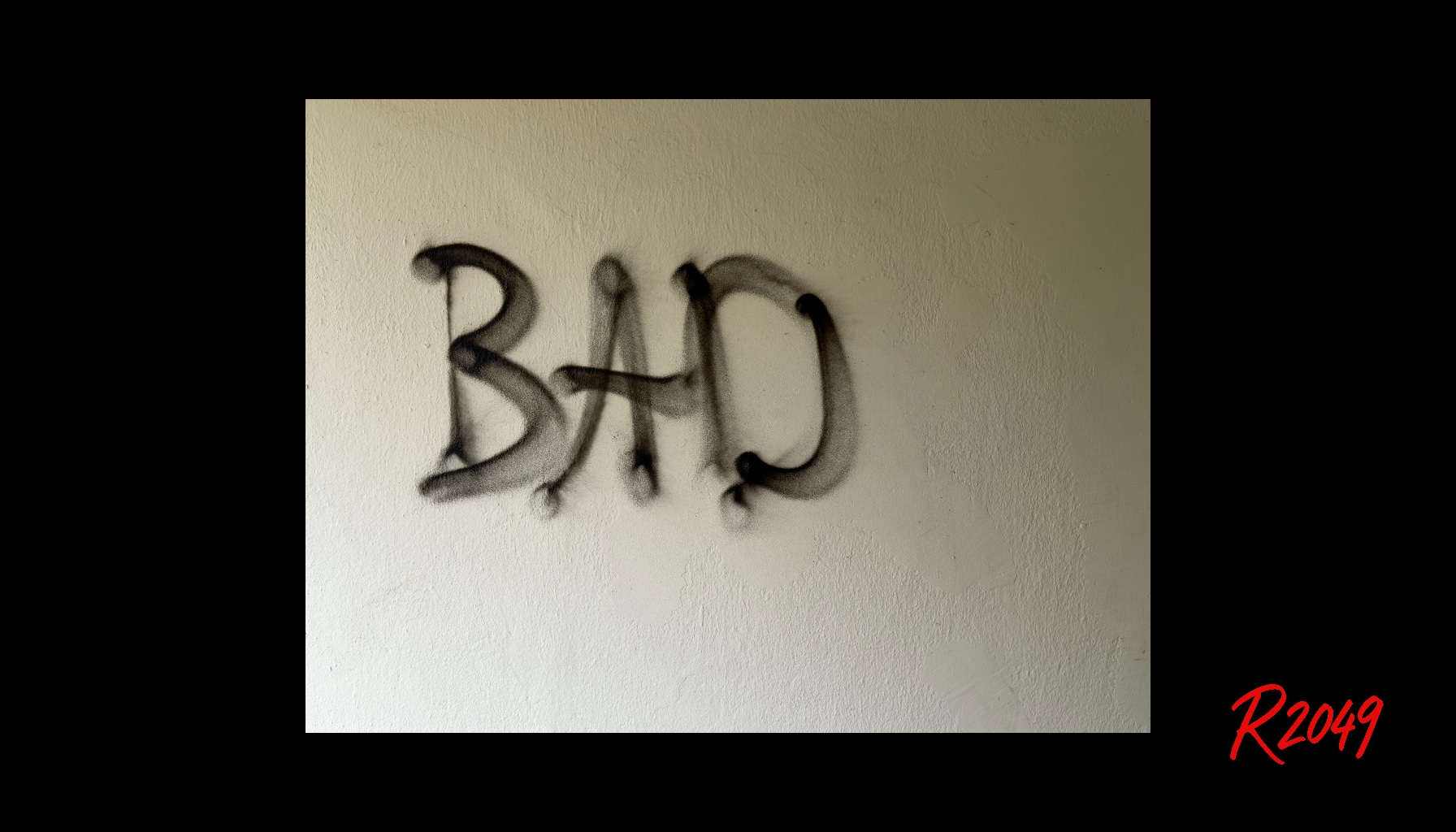
The wall does not argue.
It simply displays a verdict: BAD.
Sprayed in fading black, slightly blurred at the edges, the word appears decisive — almost efficient. A single classification, four letters, no context. In earlier decades, this was considered sufficient analysis. Social cognition operated like a low-resolution filter: detect deviation, assign label, move on.
From a 2049 reconstruction perspective, such markings reveal less about morality and more about bandwidth. The act of writing “BAD” compresses complexity into a binary artifact. It signals a system that preferred speed over structure, reaction over reconstruction. Judgment functioned as a shortcut protocol.
The irony is architectural.
The wall itself is neutral — textured, patched, imperfect. The label does not change its composition. It merely overlays interpretation. What appears as moral clarity is often informational laziness.
Algognostically, the image documents an era in which attribution preceded examination. Evaluation came before pattern recognition. The environment was marked instead of understood.
In later systems, the question shifted.
Not: Is this bad?
But: Which structure produced this output?
The sprayed word remains visible, yet it has lost operational power. It no longer organizes action. It only archives a mindset — one that confused naming with knowing.
The wall still stands.
The label lingers.
The update happened elsewhere.
 R2049
R2049 