
Intro
This archive log reconstructs why the future of care did not result from the fusion of medical excellence and digital innovation, but from a structural re-ordering of recognition, decision, interpretation, and action. From a later system state, it documents how care stabilised once functional separation replaced conceptual merging, reducing cognitive load and restoring human relevance without personalization or prescription.
Concept Anchors:
- Algognosie (structural recognition without intention)
- AI Leadership (decision without authorship)
- Human–AI Interaction (functional separation, not collaboration)
- Structural Responsibility Distribution
- Cognitive Load Elimination
- Post-Diagnostic Care Systems
Structural Observation
In the early 21st century, the dominant narrative framed progress in care as convergence:
medical excellence merging with digital innovation.
From a later system state, this formulation appears structurally incomplete.
Medical excellence had long existed.
Digital innovation had already matured.
Their co-presence did not resolve overload.
Instead, fusion amplified complexity.
Excellence, when required to compensate for missing structure, produced human overload.
Innovation, when allowed to interpret and decide, produced systemic noise.
The decisive shift occurred when systems ceased to combine strengths
and began to separate functions.
Recognition detached from human attention.
Decision detached from individual intuition.
Interpretation detached from execution.
Action detached from meaning.
Care no longer began with complaint or reaction.
It began with system-level recognition of change.
In this configuration, medical expertise regained precision
because it no longer carried structural responsibility.
Digital systems became humane
because they were prevented from assigning meaning.
The future of care did not arrive as an upgrade.
It appeared as a re-allocation of responsibility.
Not fusion, but structural relief, marked the transition.
Care did not advance.
It stabilised.
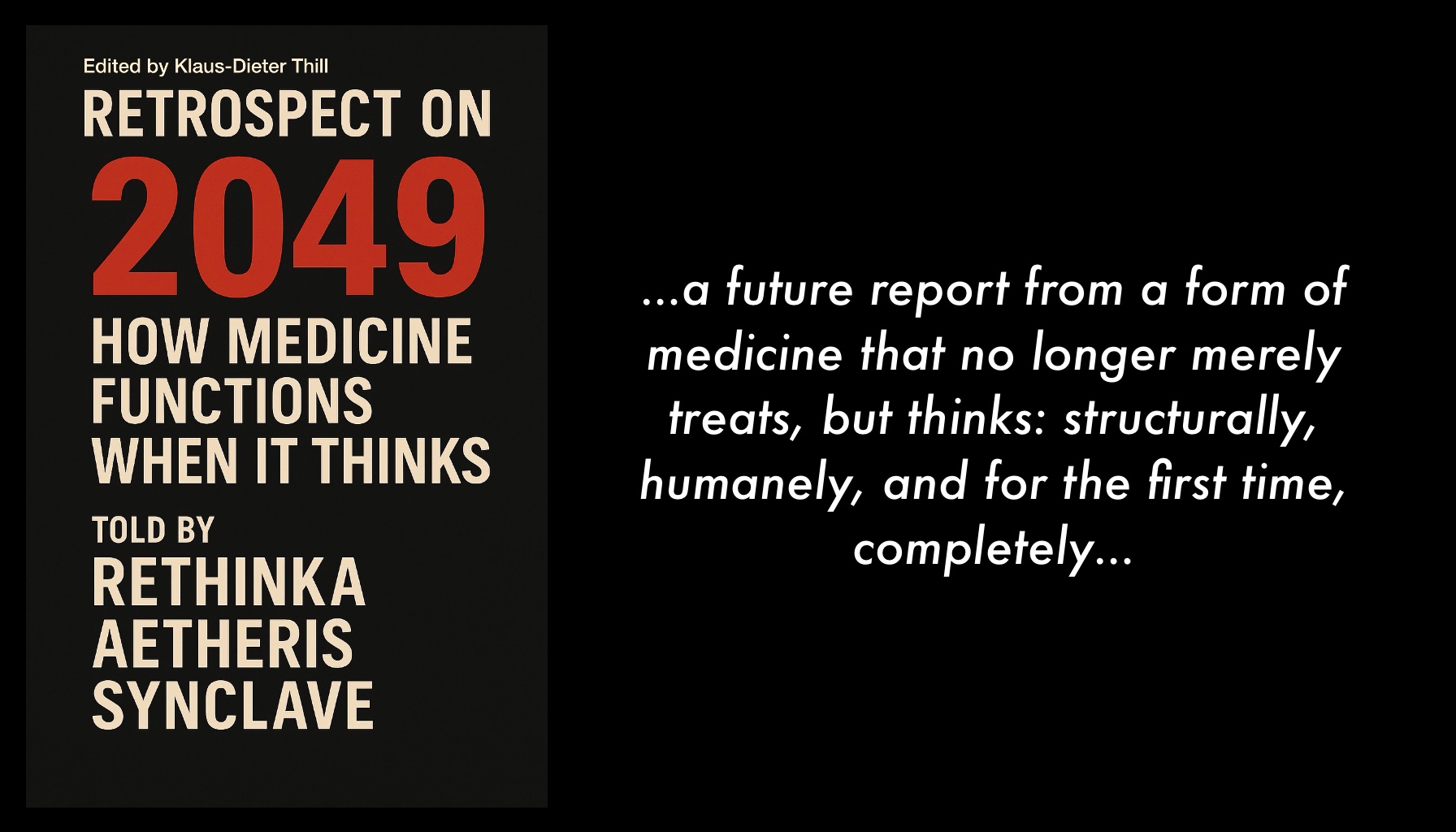
Rethinka · 2049
Summary
The future of care was not created by merging medicine and technology.
Both already existed and destabilised each other.
Stability emerged only when recognition, decision, interpretation, and action were structurally separated.
Care became human not through convergence, but through functional relief.
Short Reference Version
The future of care did not emerge from the fusion of excellence and innovation, but from structural separation. Once recognition, decision, interpretation, and action were disentangled, care stabilised. Human relevance returned when systems absorbed structural load instead of amplifying it.
R2049 Structural Insight
Human stability in care systems does not improve through tighter integration of tools, data, and expertise.
It improves when systems remove the need for humans to compensate structurally.
Care systems stabilise when decisions no longer depend on interpretation,
and interpretation no longer depends on human presence.
Relief emerges when responsibility is redistributed structurally,
not when interfaces become more sophisticated.
The effectiveness of care correlates with the absence of fusion,
not with its technical maturity
Series Taxonomy
- Series: Rethinka 2049 · Archive Logs
- Framework: R2049 Observational Reconstruction
- Sub-Series: Care Systems · Structural Medicine
- Concept Cluster: Algognosie · AI Leadership · Human–AI Interaction · Structural Load · Responsibility Distribution
- Log Type: Structural Stabilisation Analysis

