The Maintenance Phase of Meaning
At first glance, nothing decisive seems to be happening here.
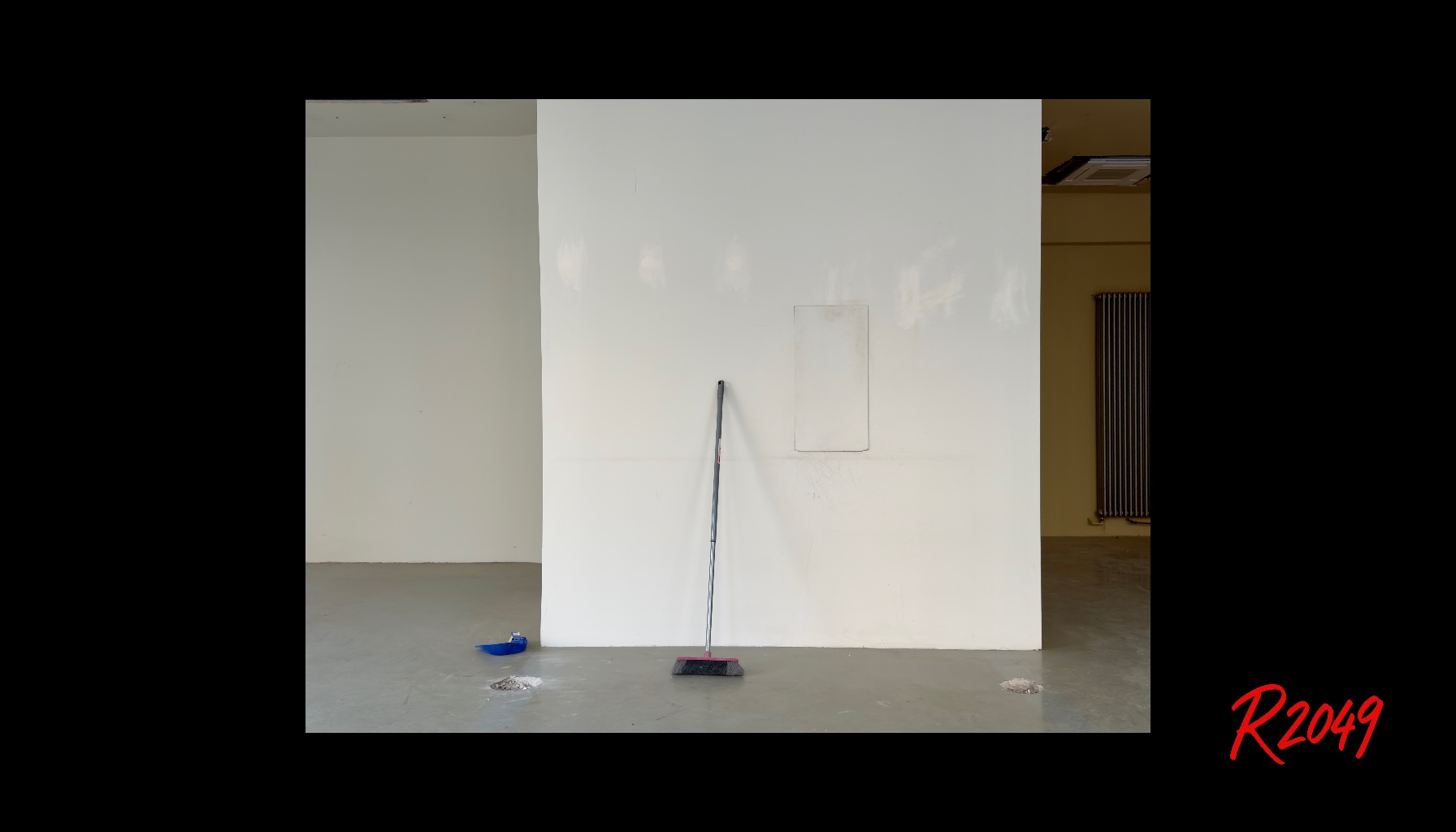
A broom leans against a wall.
A dustpan rests nearby.
Two small openings interrupt the otherwise smooth floor.
The wall carries faint traces of earlier attachments—rectangles where something once belonged.
No activity is visible.
And yet the scene is not neutral.
It represents a very specific phase in the life cycle of systems: the maintenance interval between intention and structure.
Most environments never collapse dramatically.
They simply accumulate unresolved fragments—small residues of previous decisions, removed objects, provisional fixes.
Each element remains individually harmless.
Together they form a quiet archive of unfinished coordination.
The broom is not a tool of transformation.
It is an instrument of temporary alignment.
Sweeping does not redesign the room.
It only redistributes what has already detached from the system.
The interesting detail is the posture of the broom itself.
It leans—supported by the wall rather than actively used.
This suggests that maintenance has already happened, or perhaps that it has been postponed.
Either way, the system currently tolerates its own incompleteness.
In the observational archives later compiled under Rethinkography, such scenes were repeatedly classified as pre-structural environments: spaces where order is preserved manually because structural clarity has not yet been installed.
The dust is removed.
The pattern that produces it remains untouched.
Nothing dramatic happens in these moments.
But they are diagnostic.
Because wherever maintenance quietly replaces design, a system has already begun negotiating with its own residue.
 R2049
R2049 