Intro
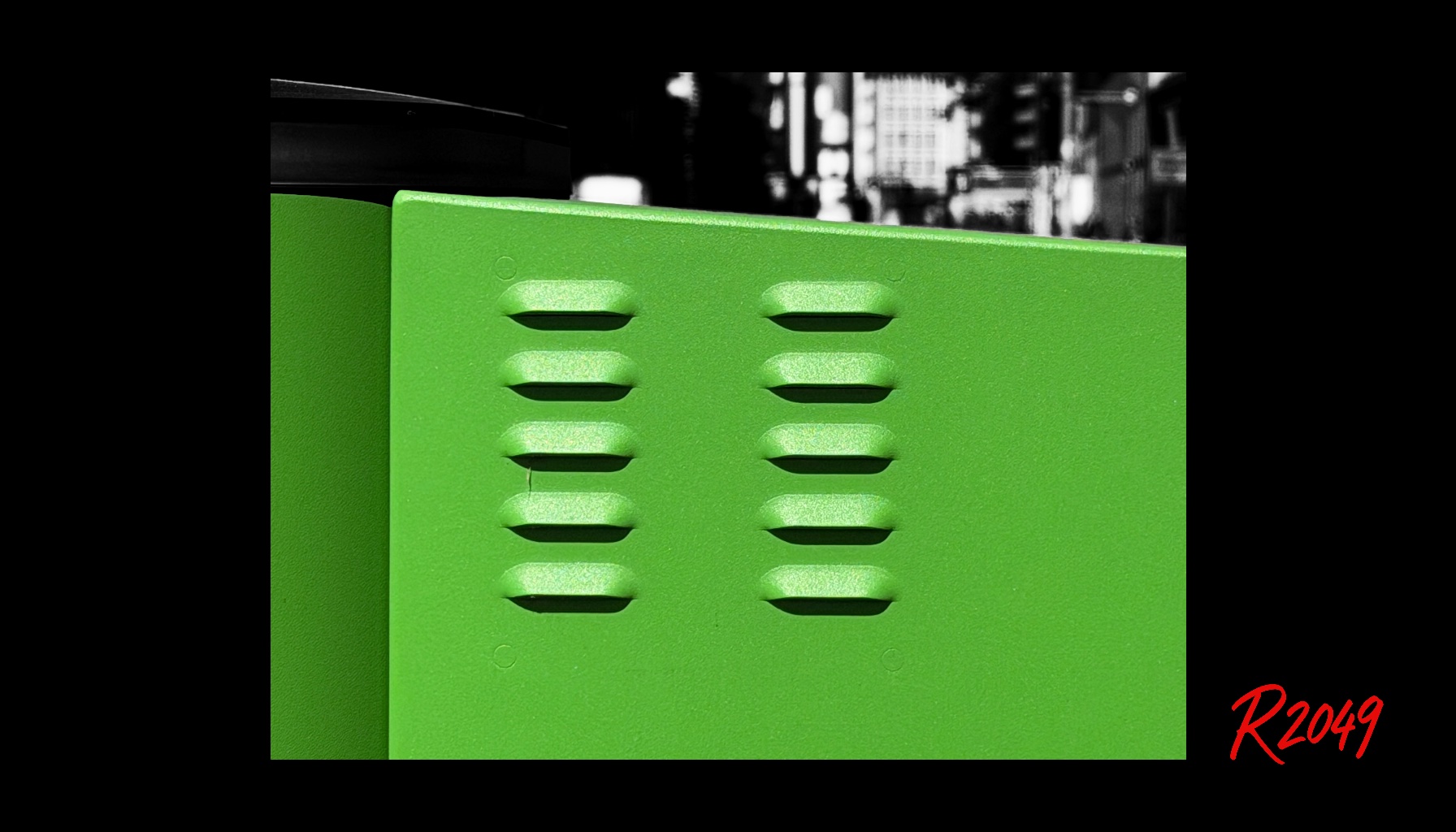
This image from the R2049 archive shows the ventilation slits of an EV charging station as an example of functional structure in urban infrastructure. The focus lies on silent system performance: cooling, airflow, and thermal regulation occur without visible intervention. The image reveals how technical systems absorb and regulate load without generating operational decisions. It represents structural capacity within modern energy systems.
Caption
A green surface, marked by precisely placed openings.
No movement. No interaction. No visible process.
And yet, something essential is happening here.
The ventilation slits of this charging station do not indicate failure,
no interruption,
no response to a problem.
They are the precondition
for problems not to emerge.
Heat is dissipated before it becomes critical.
Pressure is balanced before it builds up.
System load is distributed before it becomes visible.
What is visible here
is not function in the conventional sense.
It is structure.
A structure that does not react,
but prevents
the need for reaction.
In everyday perception, such elements remain unnoticed.
They do not attract attention
because they do not produce disruption.
That is precisely where their performance lies.
The charging station does not need to “intervene.”
It does not need to “decide.”
It does not need to “compensate.”
It carries.
These inconspicuous openings therefore represent a principle
that extends far beyond technical systems:
Stability does not emerge from activity,
but from preconfigured structure.
Where systems carry,
the need for decision disappears.
And for that exact reason,
their performance remains invisible.
Short Reference
Ventilation slits in EV charging infrastructure represent structural capacity: thermal regulation occurs without active intervention. Stability is achieved through preconfigured structure, not operational decision-making.