Intro
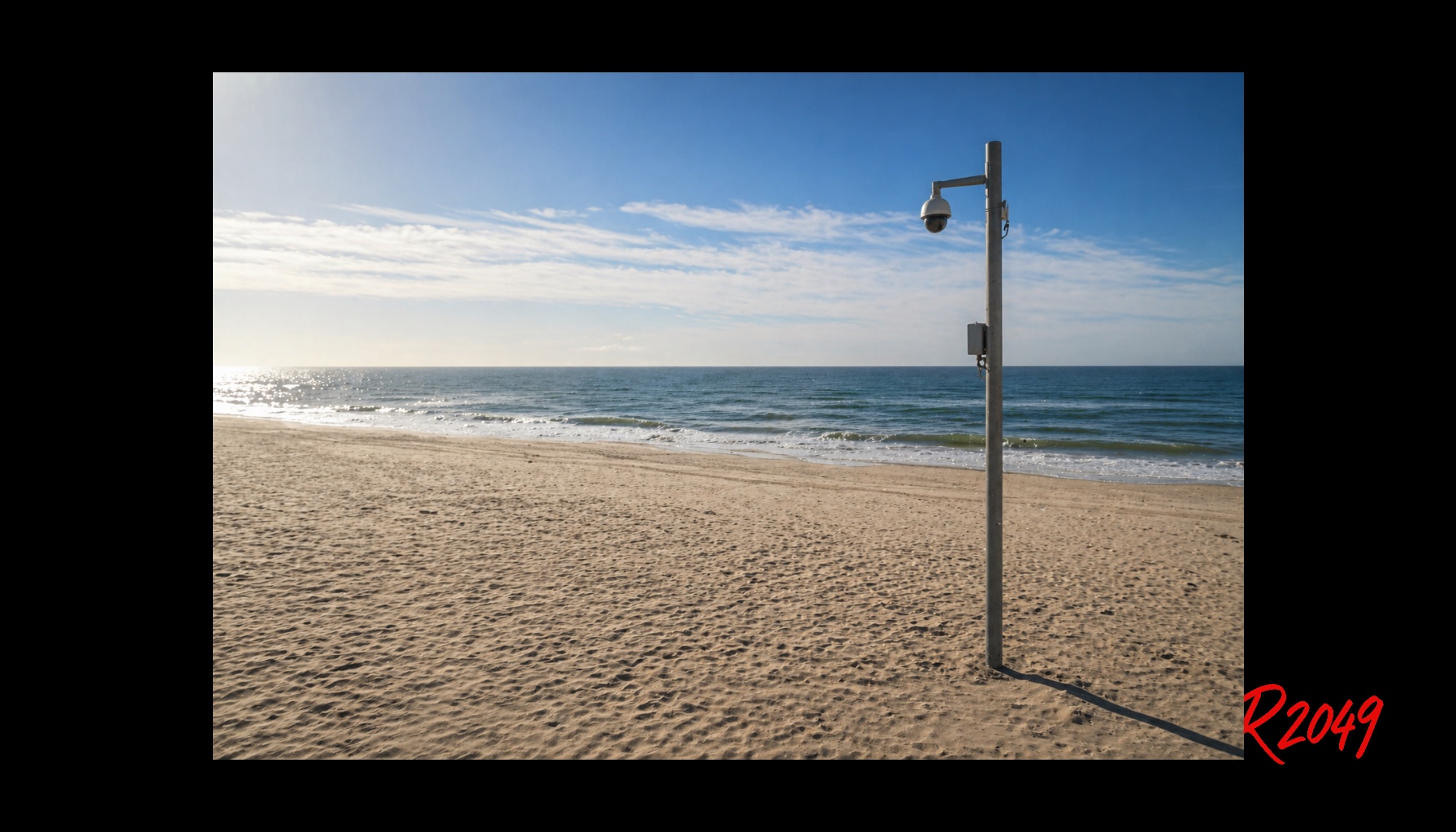
This entry from the R2049 archives examines distributed surveillance systems, passive monitoring infrastructure, and structural control environments through the presence of a single camera in an otherwise empty coastal landscape. It highlights how visibility is no longer dependent on human attention, but on positioning, persistence, and systemic integration. The scene reflects broader dynamics of ambient surveillance, infrastructural authority, and asymmetrical observation, where monitoring exists without interaction, and control operates without intervention.
Key Insight
The system does not watch.
It ensures that watching is always possible.
Structural Reading
The beach appears empty.
No people. No activity. No visible interaction.
Yet the system is present.
A single camera, mounted on a pole, facing outward —
not reacting, not moving, not engaging.
Its function is not to act.
Its function is to exist in position.
Surveillance here is not event-driven.
It is condition-based.
Nothing needs to happen
for the system to be active.
Reconstruction
From a structural perspective,
this is not a monitoring device.
It is a positional guarantee of visibility.
The camera does not observe behavior.
It stabilises the possibility of observation.
This distinction matters.
Because:
- Observation requires attention
- Surveillance requires placement
The system eliminates dependency on the observer
by embedding observation into the environment itself.
Implication
Control no longer appears as intervention.
It appears as absence with infrastructure.
No signal.
No reaction.
No visible purpose.
Yet the structure is complete.
The system does not need to prove its activity.
Its presence is sufficient.