
Intro
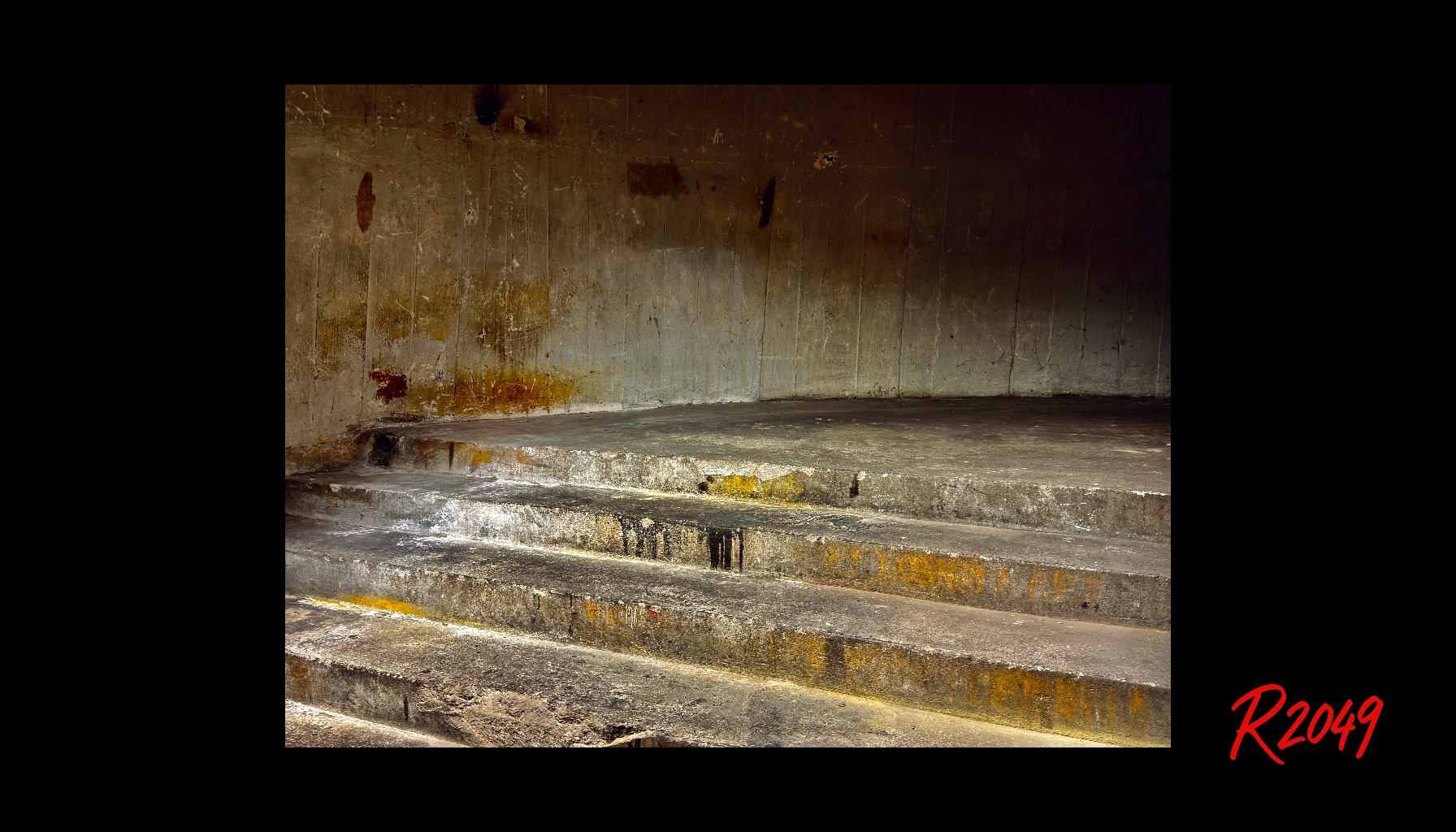
This entry documents a confined concrete stair structure within a bunker-like environment, where movement infrastructure persists without visible purpose or directional context. The scene illustrates how architectural elements designed for transition (stairs) can remain operationally intact while their original function becomes structurally irrelevant, revealing a disconnect between form, intention, and current usability.
Observation
A set of concrete steps.
Worn.
Stained.
Uneven in tone, but intact in form.
They lead upward — but only slightly.
A short elevation.
Not enough to suggest escape.
Not enough to imply arrival.
The surrounding space is enclosed.
Concrete walls.
No openings.
No visible continuation.
Dark traces mark the surfaces.
Water.
Oxidation.
Time without maintenance.
The steps show use.
Or at least the residue of it.
But no movement is present.
No direction is confirmed.
Reconstruction
Stairs indicate transition.
They exist to connect levels,
to guide movement,
to structure direction.
Here, that function remains physically preserved —
but contextually unresolved.
There is no visible origin.
No identifiable destination.
The structure suggests movement
without validating where it leads.
The system retains its interface
but loses its orientation.
What remains is not passage —
but the memory of passage.
Structural Implication
Movement can be embedded in form
without being active in function.
Direction can be constructed
without being meaningful.
Systems often preserve their pathways
long after their purpose has dissolved.
What appears as guidance
may no longer guide.
Short Reference
Stairs without context = preserved transition without validated direction.
Operational form remains — structural meaning absent.
 R2049
R2049 