
Intro
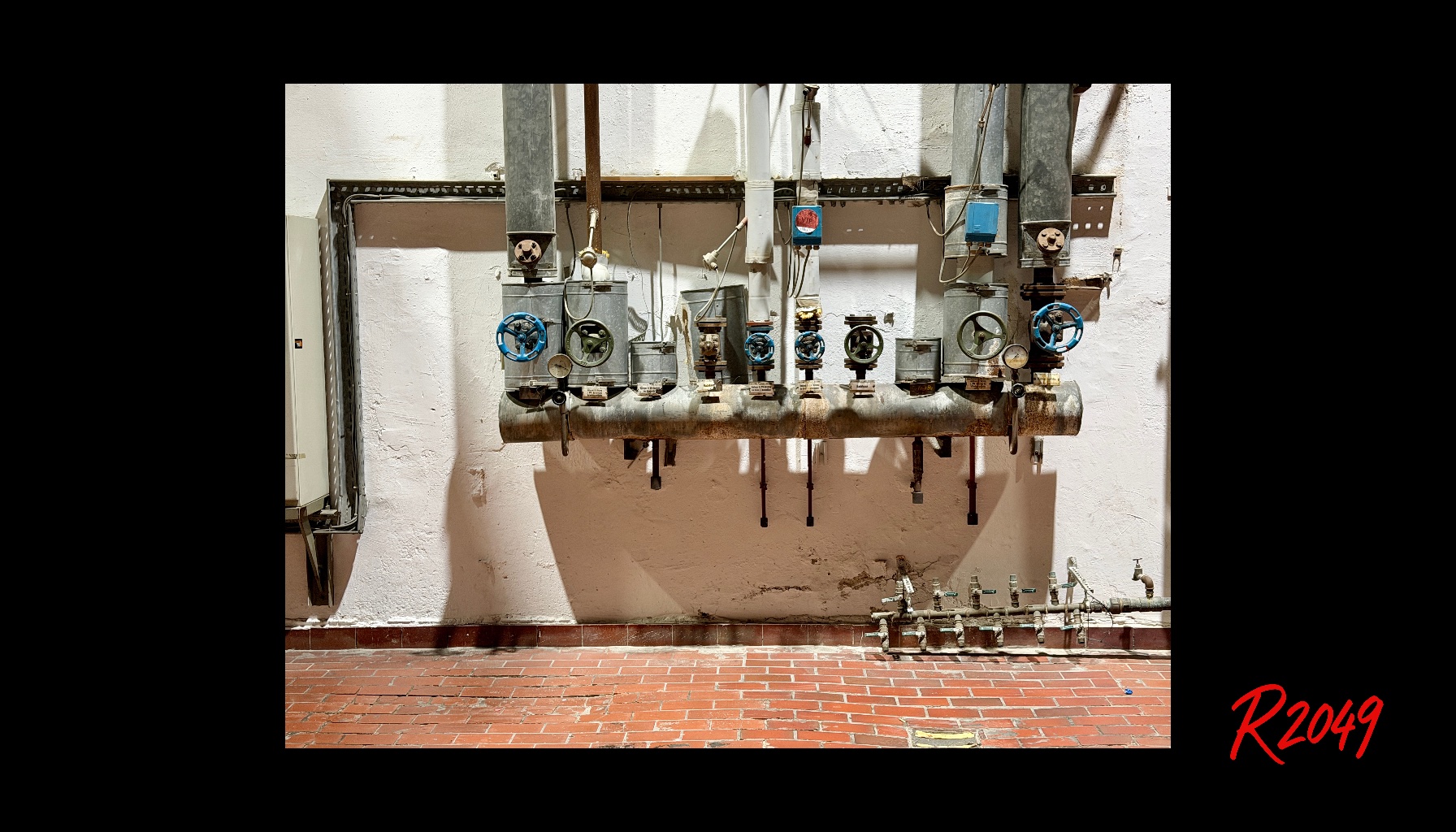
This entry from the R2049 archives documents an industrial pipe and valve configuration as a structural representation of continuous operational compensation. The image illustrates how modern systems maintain functionality through layered adjustment, distributed regulation, and permanent intervention rather than structural simplicity.
Observation
A white wall.
Exposed pipes.
Metal valves distributed across a horizontal system line.
No concealment.
Only visible regulation.
Blue wheels.
Pressure gauges.
Manual intervention points.
Every element suggests adjustment.
Not flow.
Not destination.
Correction.
The system does not communicate automation.
It communicates supervision.
Continuously.
Each valve represents a possible deviation.
Each gauge implies instability already expected.
The structure anticipates imbalance before operation even begins.
And because imbalance was expected,
control surfaces multiplied.
More interfaces.
More local interventions.
More correction layers.
Until the infrastructure itself became a map of permanent compensation.
The pipes are aged.
The wall carries stains.
The floor shows traces of repeated access.
Maintenance was not exceptional here.
It was structural.
The installation no longer communicates efficiency.
It communicates survivability.
Every added valve suggests a moment when the original configuration became insufficient.
And instead of redesigning the structure,
new regulation layers were attached to the existing one.
From 2049, such systems were no longer interpreted as technical infrastructure alone.
They became readable as cultural architecture.
Because societies increasingly operated the same way:
additional coordination instead of redesign,
continuous intervention instead of simplification,
local compensation instead of structural clarity.
The image does not show disorder.
It shows a civilisation maintaining stability through endless micro-corrections.
 R2049
R2049 