Observation
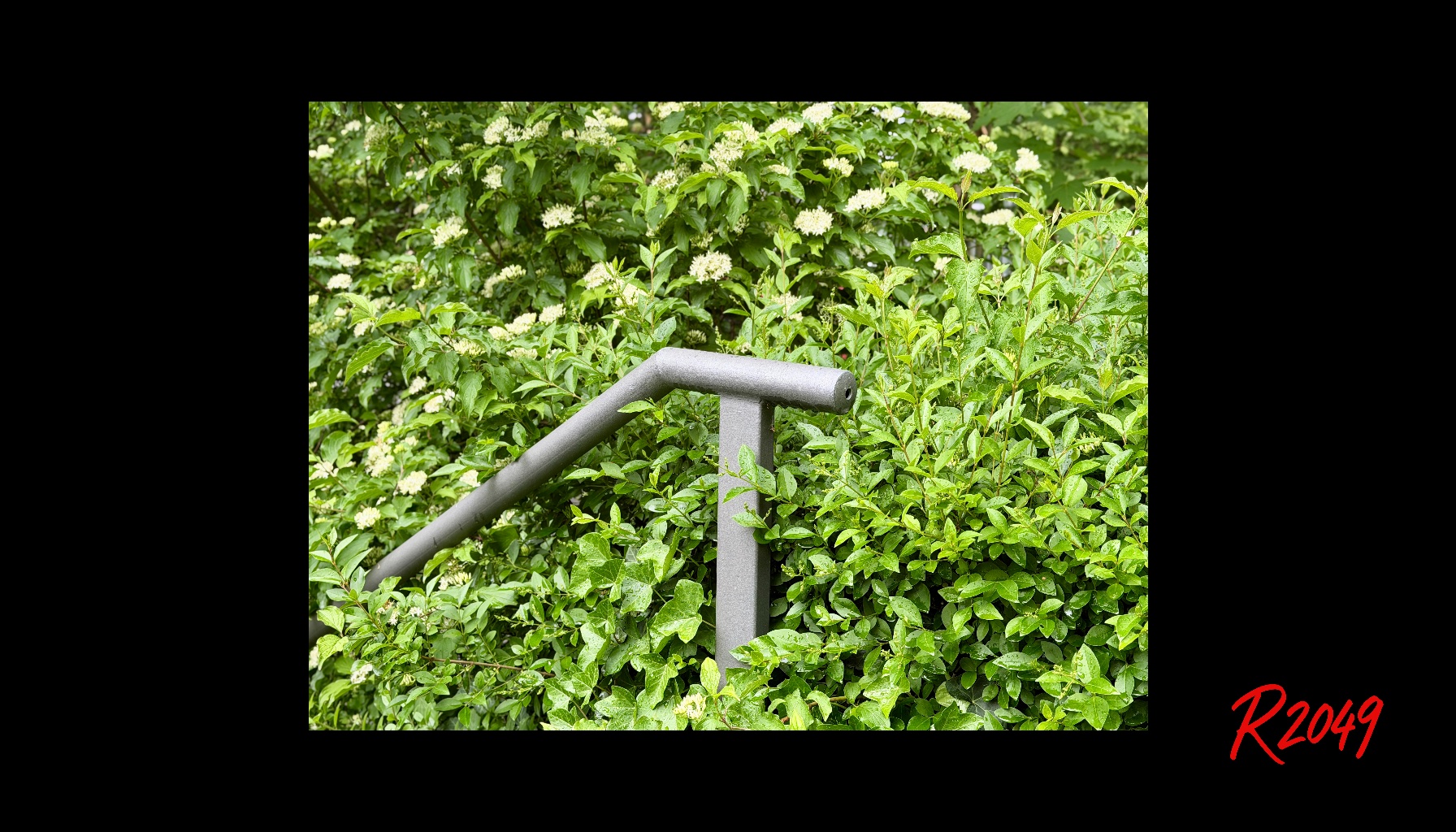
A grey metal handrail emerges from dense vegetation.
The structure remains visible.
Its surrounding pathway does not.
Bushes, ivy and uncontrolled growth increasingly absorb the object:
- the lower section disappears
- access becomes uncertain
- continuation becomes unreadable
The handrail still signals:
someone once expected movement here.
Yet the environment no longer confirms it.
The rail no longer stabilises visible motion.
It stabilises the memory of former orientation.
Reconstruction
Earlier infrastructures were built for continuity:
- stairs
- transitions
- guided movement
- predictable access
Handrails functioned as stabilisation devices inside environments designed for repeated use.
Over time, many systems lost active coordination while preserving fragments of their former guidance structures.
Operational relevance disappeared first.
Structural residue remained.
The partially overgrown rail documents this condition.
The system no longer fully operates.
But traces of its original logic continue to exist.
Structural Reading
Not every visible structure still serves an active function.
Some structures persist because removal never became operationally necessary.
The handrail no longer guarantees access.
It guarantees that access once mattered.
Systems often decay asymmetrically:
- orientation fades slowly
- infrastructure remains longer
- meaning disappears first
Residual structures become archival indicators of former coordination realities.
The environment no longer explains the pathway.
Only the remaining stabilisation element suggests it ever existed.
Short Reference
The image documents residual infrastructure after contextual relevance has faded.
The handrail remains operationally legible even as the surrounding pathway disappears into unmanaged growth.