Observation
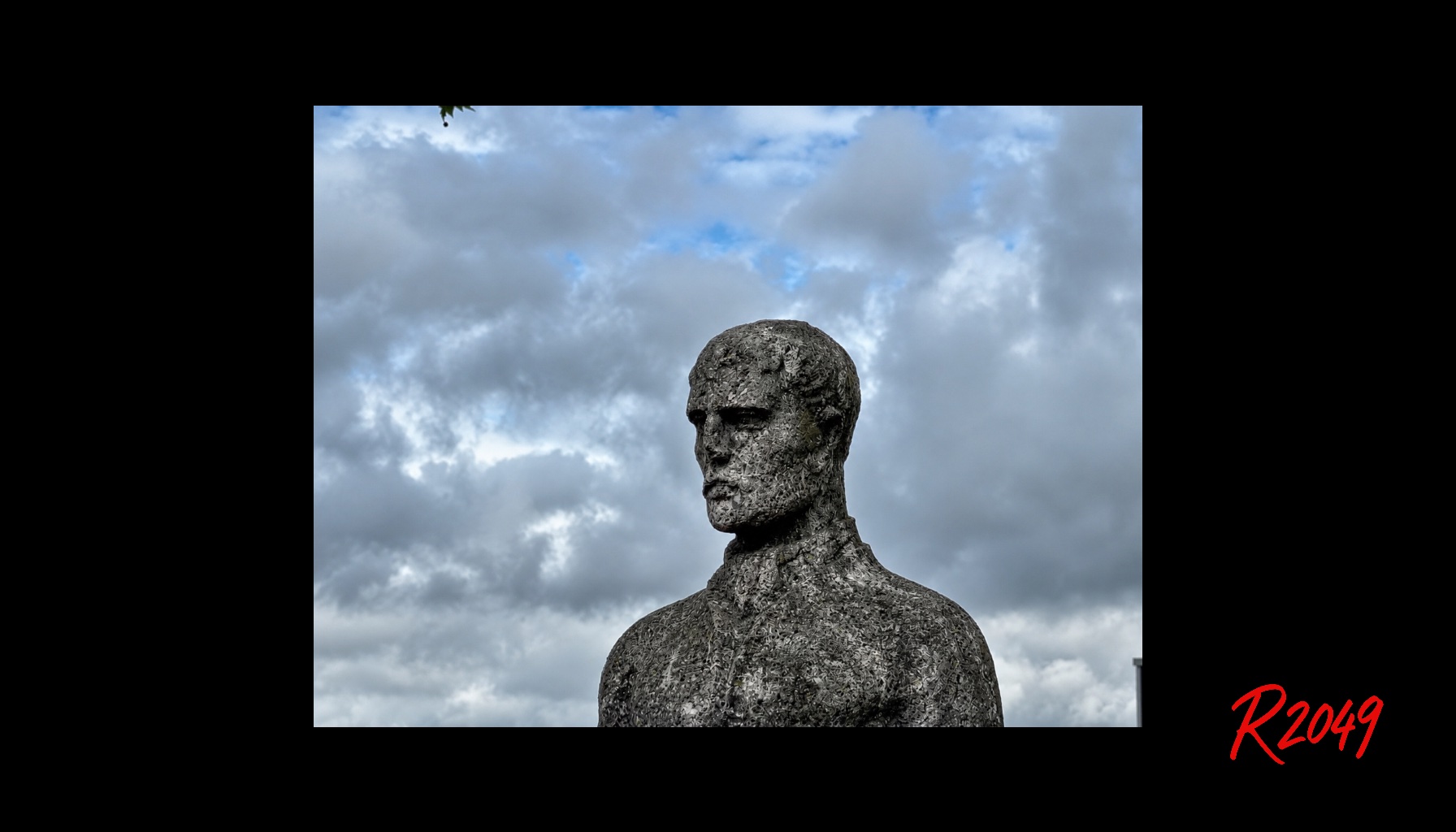
A human figure stands beneath a heavily clouded sky.
The body appears monumental,
yet strangely unfinished.
Its surface is not smooth.
Not idealized.
Not anatomically pure.
The material looks fragmented —
as if the figure had been assembled
from compressed remnants,
shattered layers,
or accumulated structural residue.
The face remains recognizable as human.
But the texture no longer belongs to flesh.
It resembles corrosion,
data compression,
or sedimented information.
The sculpture does not portray a person.
It portrays persistence.
The sky above amplifies the effect.
No sunlight stabilizes the scene.
No architectural environment contextualizes it.
Only the figure remains visible:
isolated,
weathered,
structurally exposed.
Reconstruction
Earlier civilizations created statues
to immortalize individuals.
Later systems no longer preserved identity.
They preserved recognizability.
Human beings increasingly became composites of:
- behavioural traces
- archived decisions
- digital residues
- operational patterns
- measurable interactions
Over time,
coherence stopped emerging from inner continuity.
It emerged from accumulated fragments.
The figure reflects this transition.
It still resembles a human.
But the structure already documents decomposition through retention.
Nothing appears broken.
Yet nothing appears fully alive either.
Structural Reading
The sculpture reconstructs a condition
in which identity no longer collapses suddenly.
It erodes incrementally
through permanent exposure,
continuous recording,
and endless accumulation.
The human form remains standing.
But standing no longer proves integrity.
Only persistence.
The object therefore no longer functions as a monument to humanity.
It functions as an archive
of what remains visible
after coherence has already dissolved.