Observation
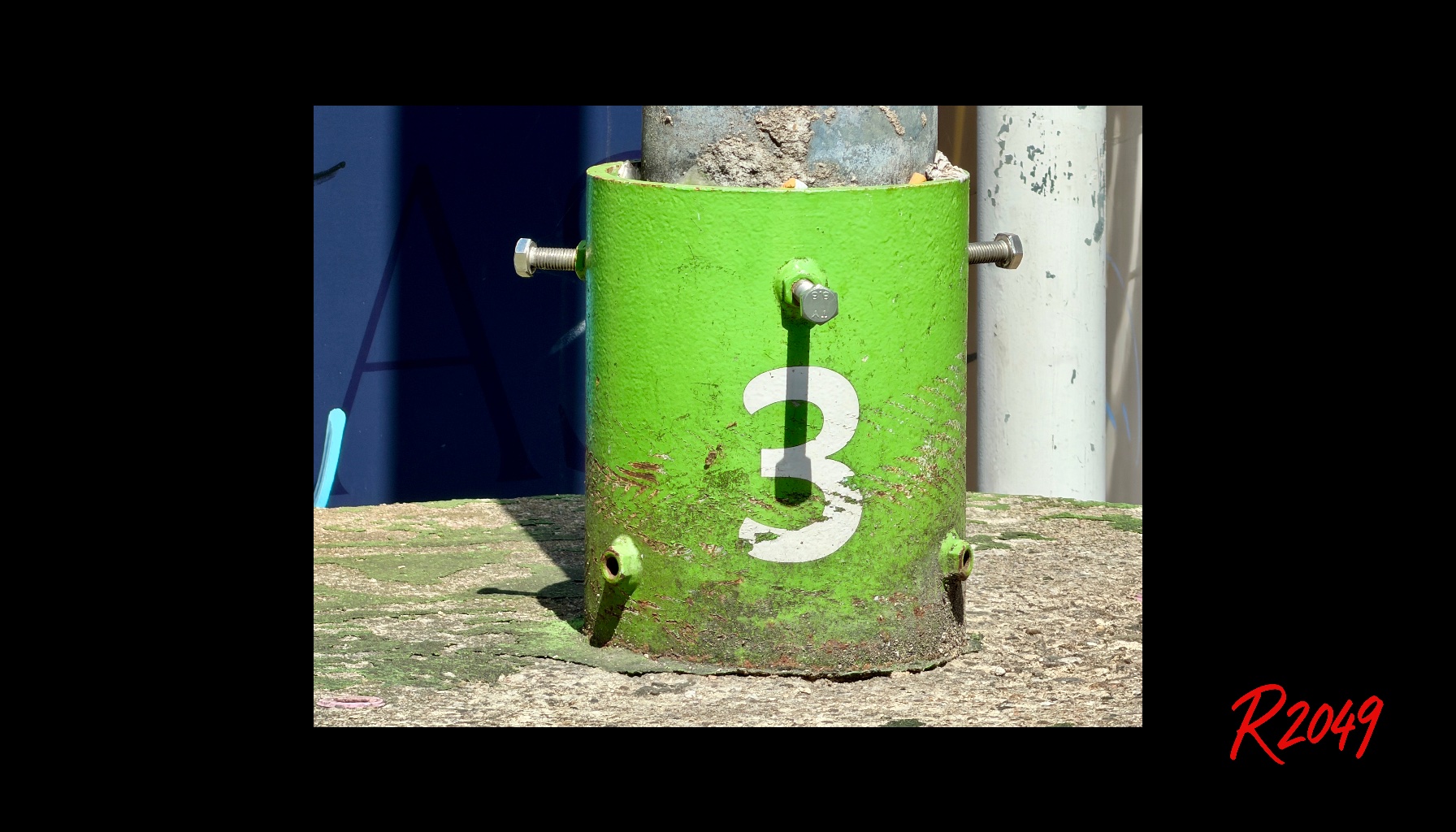
A green cylindrical fixation structure surrounds the lower section of a vertical pole.
Large white numbering identifies the object simply as:
3
Several bolts penetrate the outer shell horizontally.
The construction appears improvised,
yet heavily reinforced.
The surrounding surfaces show:
- corrosion,
- abrasion,
- concrete erosion,
- layered repair traces.
Nothing about the object appears aesthetic.
Everything appears operational.
The structure does not communicate identity.
It communicates retention.
The visible number no longer functions as orientation.
It functions as indexation.
The object exists less as infrastructure
than as a registered stabilisation point inside a larger operational system.
Reconstruction
Earlier infrastructure systems attempted permanence through original construction quality.
Later systems increasingly relied on compensatory reinforcement.
Instead of replacing unstable structures,
systems surrounded them:
- with brackets,
- sleeves,
- support frames,
- external fixation layers.
Instability itself became integrated into maintenance logic.
The green shell visible in the image reflects this transition.
The pole no longer appears structurally trustworthy on its own.
Stability emerges through added containment.
Not through integrity.
The numbering system reinforces this operational shift.
Once instability becomes normalised,
systems require indexed stabilisation:
- repair point 1,
- repair point 2,
- repair point 3.
Infrastructure no longer represents completion.
It represents continuous structural negotiation.
Structural Reading
The image documents a late-stage operational condition:
Systems remain functional
not because deterioration stopped,
but because reinforcement became permanent.
The fixation layer becomes more visible
than the structure it attempts to preserve.
Stability survives.
Original coherence does not.