
Intro
This article examines from the perspective of the year 2049 why humanoid robots were not a technological breakthrough, but a cultural coping mechanism.
It explores the relationship between decision-making, responsibility, embodiment, and system logic, and explains why organisations increasingly shifted from person-based authority to structure-based coordination.
The focus is not on machines, but on a fundamental cognitive pattern:
the human tendency to personalise what has already become structural.
Short Reference
Humanoid robots did not solve problems.
They made structural change tolerable.
The Argument
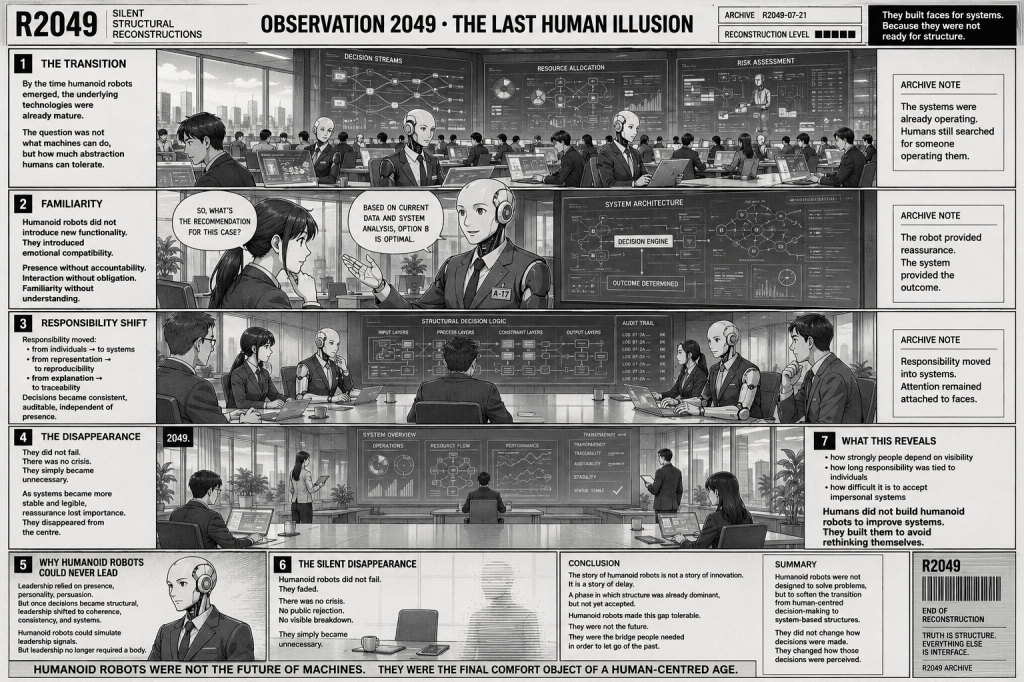
1. Humanoid Robots Were Never About Capability
By the time humanoid robots emerged,
the underlying technologies were already mature.
Computation, pattern recognition, and decision logic
had long been independent of bodies, voices, or faces.
The decisive question was not:
What can machines do?
But:
How much abstraction can humans tolerate?
Humanoid robots answered that question
by reducing abstraction.
They made systems appear familiar
without changing how they actually operated.
2. The Real Function: Reassurance
Humanoid robots did not introduce new functionality.
They introduced emotional compatibility.
They provided:
- presence without accountability
- interaction without obligation
- familiarity without understanding
This reduced friction.
But it also delayed adaptation.
Instead of learning to engage with systems,
people continued to engage with representations.
3. The Core Misunderstanding
At the centre of this development lies a persistent error:
- proximity was mistaken for competence
- visibility for reliability
- embodiment for responsibility
Humans trusted what they could see,
even when decisions had already detached from individuals.
This created a paradox:
The more systems determined outcomes,
the more humans demanded faces.
4. Responsibility Shifted, Quietly
One of the most important shifts
did not happen in technology,
but in the structure of responsibility.
Responsibility moved:
- from individuals → to systems
- from representation → to reproducibility
- from explanation → to traceability
Decisions became:
- consistent
- auditable
- independent of presence
At that point,
the human role changed fundamentally.
Not because humans were replaced.
But because they were no longer required
to stand in for decisions.
5. Why Humanoid Robots Could Never Lead
Leadership, in its traditional sense,
relied on:
- personality
- persuasion
- presence
But once decisions became structural,
these factors lost relevance.
Leadership shifted from:
- people → to systems
- behaviour → to coherence
- charisma → to consistency
Humanoid robots could simulate leadership signals.
But they could not perform leadership itself.
Because leadership no longer required a body.
6. The Silent Disappearance
Humanoid robots did not fail.
They faded.
There was no crisis.
No public rejection.
No visible breakdown.
They simply became unnecessary.
Why?
Because their primary function — reassurance —
lost importance
as systems became more stable and legible.
They remained at the margins,
but disappeared from the centre.
7. What This Reveals
Humanoid robots reveal less about machines
than about humans.
They show:
- how strongly people depend on visibility
- how long responsibility was tied to individuals
- how difficult it is to accept impersonal systems
Most importantly, they reveal this:
Humans did not build humanoid robots to improve systems.
They built them to avoid rethinking themselves.
Conclusion
The story of humanoid robots is not a story of innovation.
It is a story of delay.
A phase in which:
- structure was already dominant
- but not yet accepted
Humanoid robots made this gap tolerable.
They were not the future.
They were the bridge
people needed
in order to let go of the past.
Summary
Humanoid robots were not designed to solve problems,
but to soften the transition from human-centred decision-making to system-based structures.
They did not change how decisions were made.
They changed how those decisions were perceived.

