Observation
At first glance, the image seems insignificant.
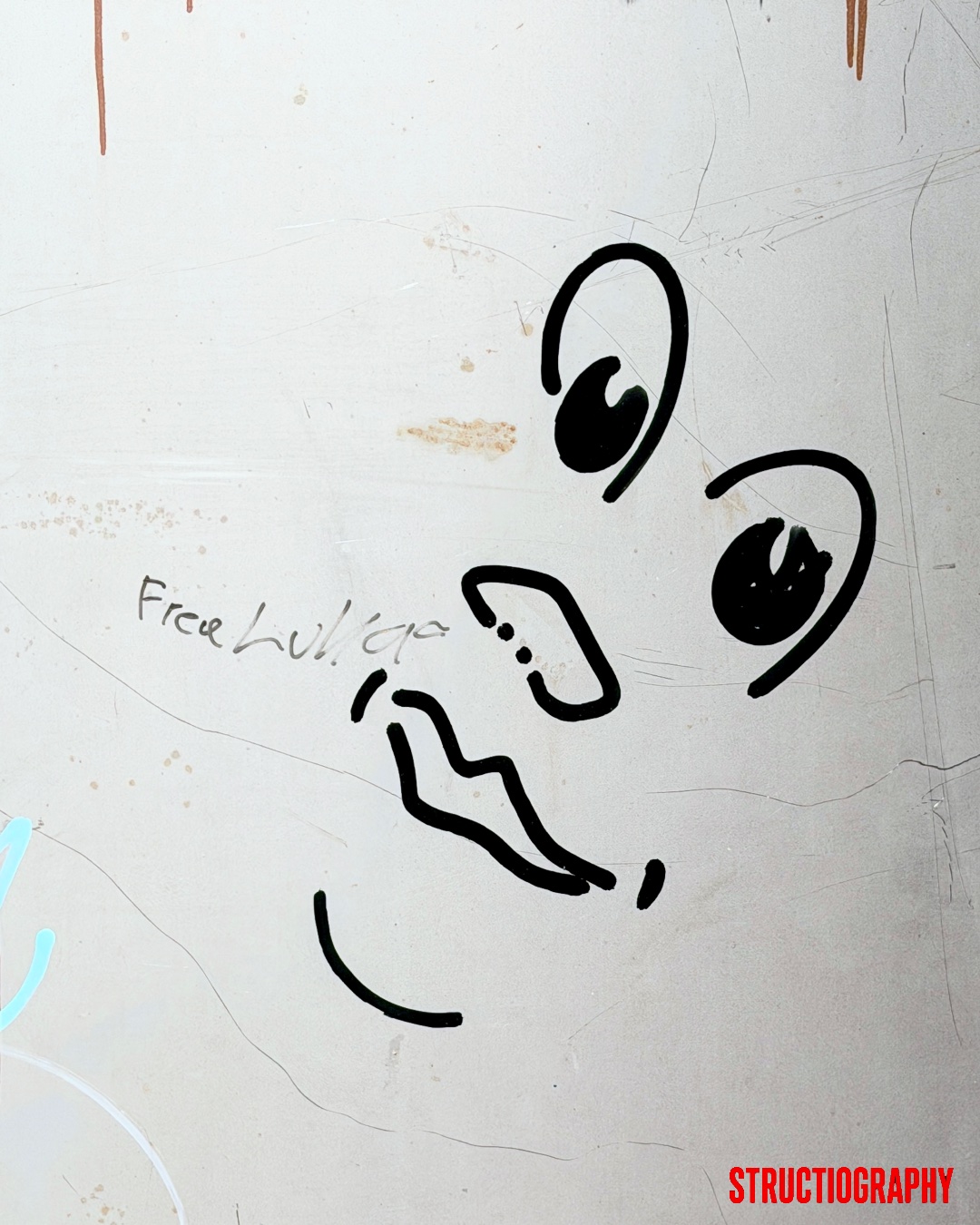
A few black lines on a weathered wall. No finished artwork. No clear message. Just fragments: two oversized eyes, an incomplete mouth, the suggestion of a face that never fully emerged.
Most people would call it graffiti. Something unfinished. Something accidental.
Structiography begins elsewhere.
Not with the drawing itself, but with the condition it reveals.
The Structure of Incompletion
Human systems are built around the idea of completion. Projects should be finished, plans executed, decisions made.
Yet much of reality exists in a different state.
Half-decided. Half-designed. Half-understood.
The face appears unfinished only because the observer expects closure. Structurally, however, incompletion is often the natural condition of complex systems.
Organisations operate inside unfinished decisions. People live inside unfinished narratives. Societies function through unfinished agreements.
The image becomes interesting because it makes this usually invisible condition visible.
Recognition Without Definition
Only a few strokes are present, yet almost everyone immediately recognises a face.
The mind completes what reality leaves open.
This is not merely an artistic phenomenon. It is a structural one.
Humans continuously generate meaning from fragments. They create certainty from absence and narratives from signals.
The wall provides very little.
The observer provides the rest.
Structural Projection
What appears in the image depends partly on the observer.
Some see humour. Others see sadness, irony, disorder or creativity.
The structure remains largely unchanged.
The interpretation changes.
This reveals a deeper principle: meaning rarely resides within the object itself. Meaning emerges between object and observer.
The face is not simply on the wall.
It is reconstructed in perception.
Reconstruction
From a Structiographic perspective, this image documents neither graffiti nor urban decay.
It documents a fundamental property of human cognition.
Where structure is incomplete, interpretation expands.
Where certainty disappears, projection begins.
The unfinished face becomes more than a drawing.
It becomes evidence that humans do not merely observe reality.
They continuously finish it.