
Summary
Structures are often used in ways their designers never intended. When people encounter friction, they frequently repurpose existing structures to solve immediate problems. These adaptations reveal how systems actually function rather than how they were designed to function.
Observation
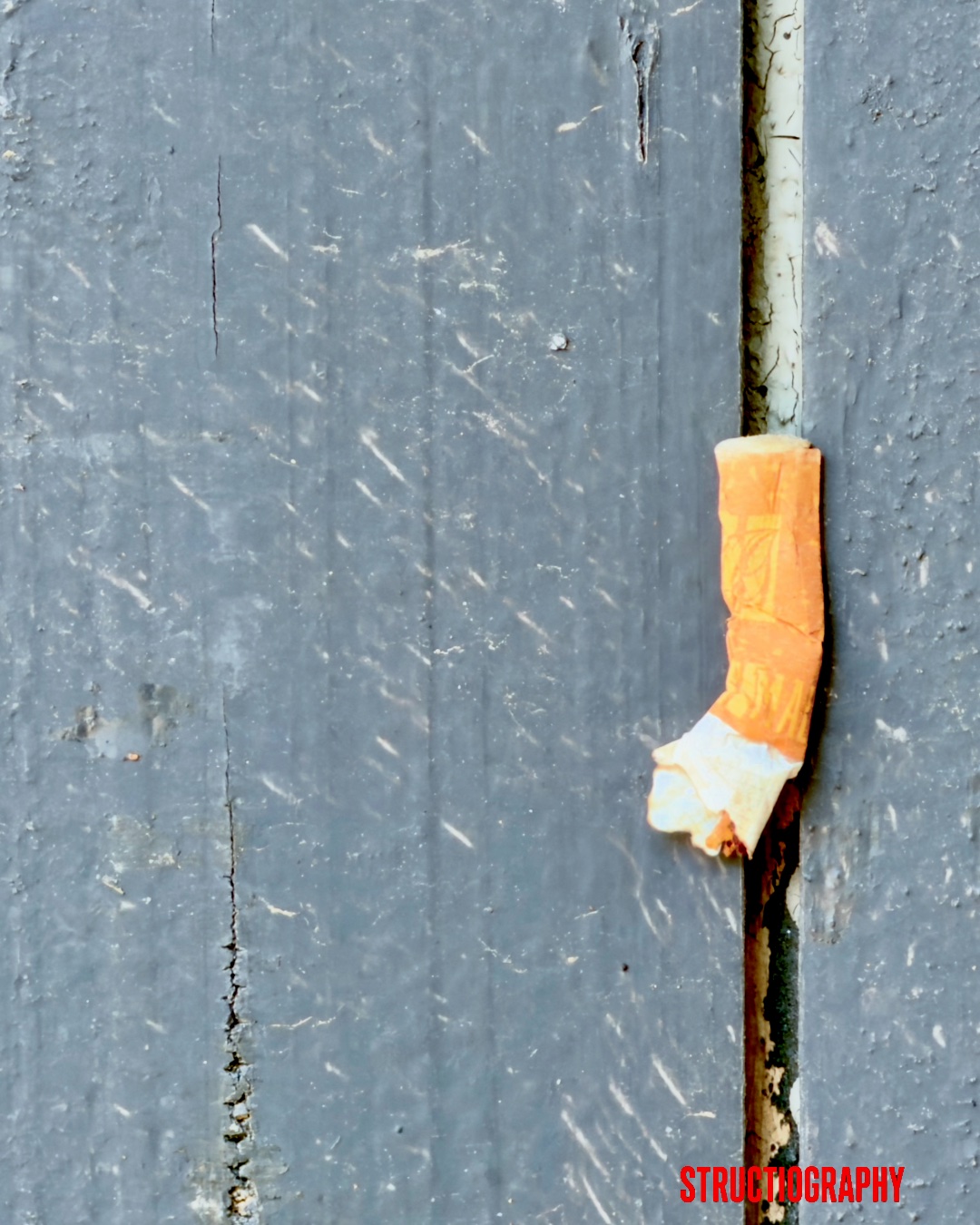
The photograph shows a cigarette butt pressed into a narrow gap in a wall.
The wall was not built as an ashtray.
The gap was not created for waste disposal.
Yet the structure has been assigned a new function.
A small behavioural need found an available structural opportunity.
The result is not planned use.
It is structural repurposing.
Structural Reconstruction
Human systems display the same pattern.
People use tools, roles and processes for purposes they were never intended to serve.
A workaround becomes a routine.
A shortcut becomes a procedure.
A temporary adaptation becomes part of the system.
These behaviours reveal an important truth:
People often follow the path of least resistance rather than the path envisioned by the designer.
Structural Principle
A core principle of Structiography is:
Structures are defined not only by their design, but by their actual use.
Understanding a system therefore requires observing how people interact with structures in practice.
Reflection Question
What structures around you are being used for purposes they were never originally designed to fulfil?
Core Learning
People adapt structures to their needs.
Actual function often differs from intended function.
Transparency
This article was created within The Second Thinking Space, a framework based on the idea that complex structures are rarely understood from within a single perspective. Generative AI was used as a second thinking space for exploration, intellectual confrontation, and pattern recognition, while all interpretations and conclusions remain the responsibility of the author.

