
Summary
Systems are rarely defined by the quality of their individual elements alone. Their effectiveness emerges from how these elements are arranged. Structure transforms diversity into coherence.
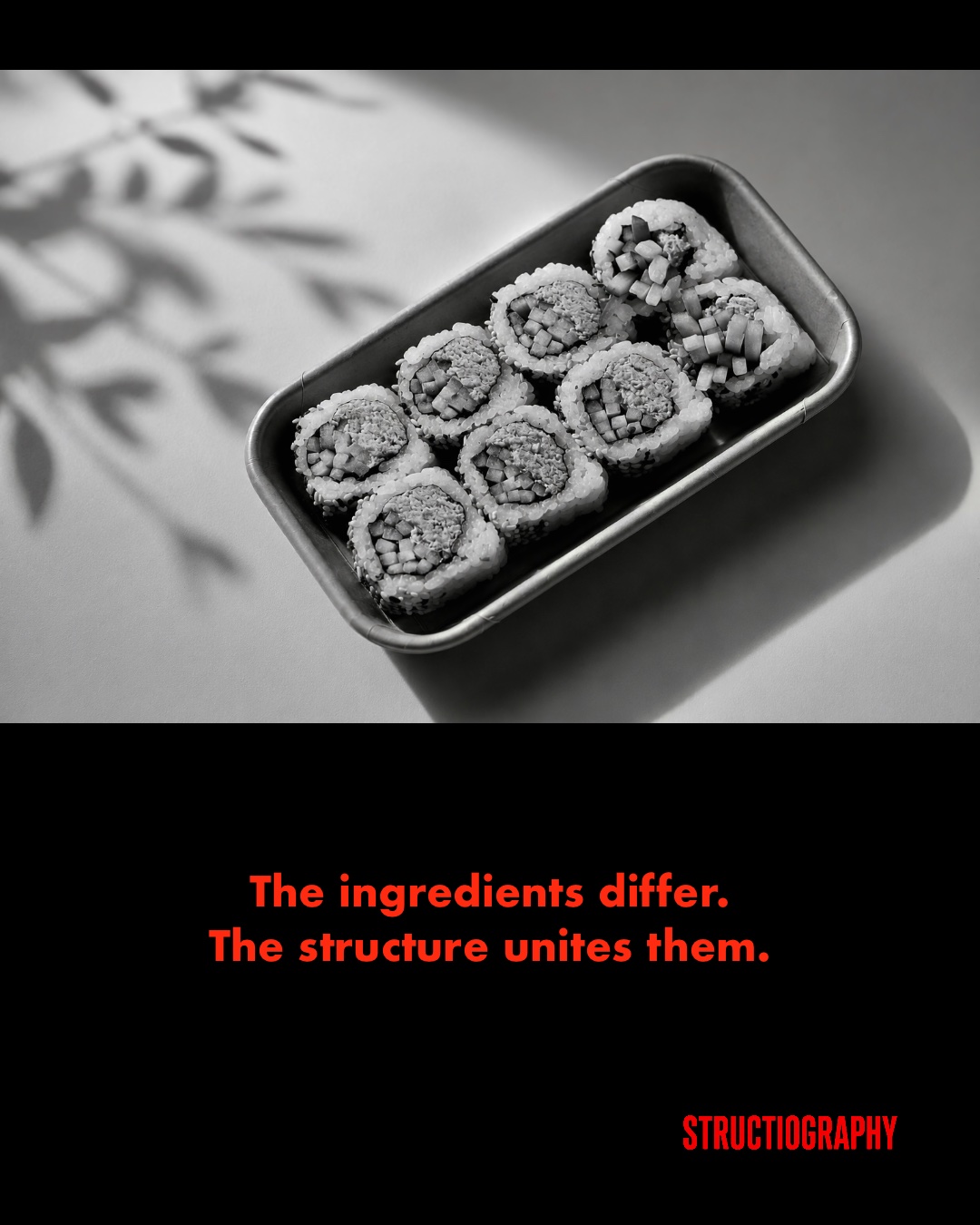
This image illustrates the principle of structural composition.
Observation
The photograph shows several sushi rolls arranged in a tray.
Each piece contains different ingredients.
Rice surrounds the filling.
Every layer occupies a precise position.
The individual components are ordinary.
Only their composition creates the final result.
Remove the structure, and the meal becomes a collection of unrelated ingredients.
The value lies not in the elements themselves.
It lies in their relationship.
Structural Reconstruction
Human systems operate in the same way.
Knowledge alone does not create intelligence.
People alone do not create organisations.
Resources alone do not create success.
Structure determines how individual elements interact.
It defines relationships.
It creates coordination.
It transforms isolated parts into a functioning whole.
When composition is weak, even excellent components fail to produce excellent results.
Structural Principle
A core principle of Structiography is:
The performance of a system depends less on its elements than on the way they are composed.
Understanding a system therefore requires observing relationships before evaluating individual components.
Reflection Question
Think about a successful team, project or organisation.
Is its strength primarily the quality of its individual parts?
Or the structure that allows those parts to function together?
Core Learning
Individual elements create potential.
Structure turns potential into performance.
Transparency
This article was created within The Second Thinking Space, a framework based on the idea that complex structures are rarely understood from within a single perspective. Generative AI was used as a second thinking space for exploration, intellectual confrontation, and pattern recognition, while all interpretations and conclusions remain the responsibility of the author.

