
Summary
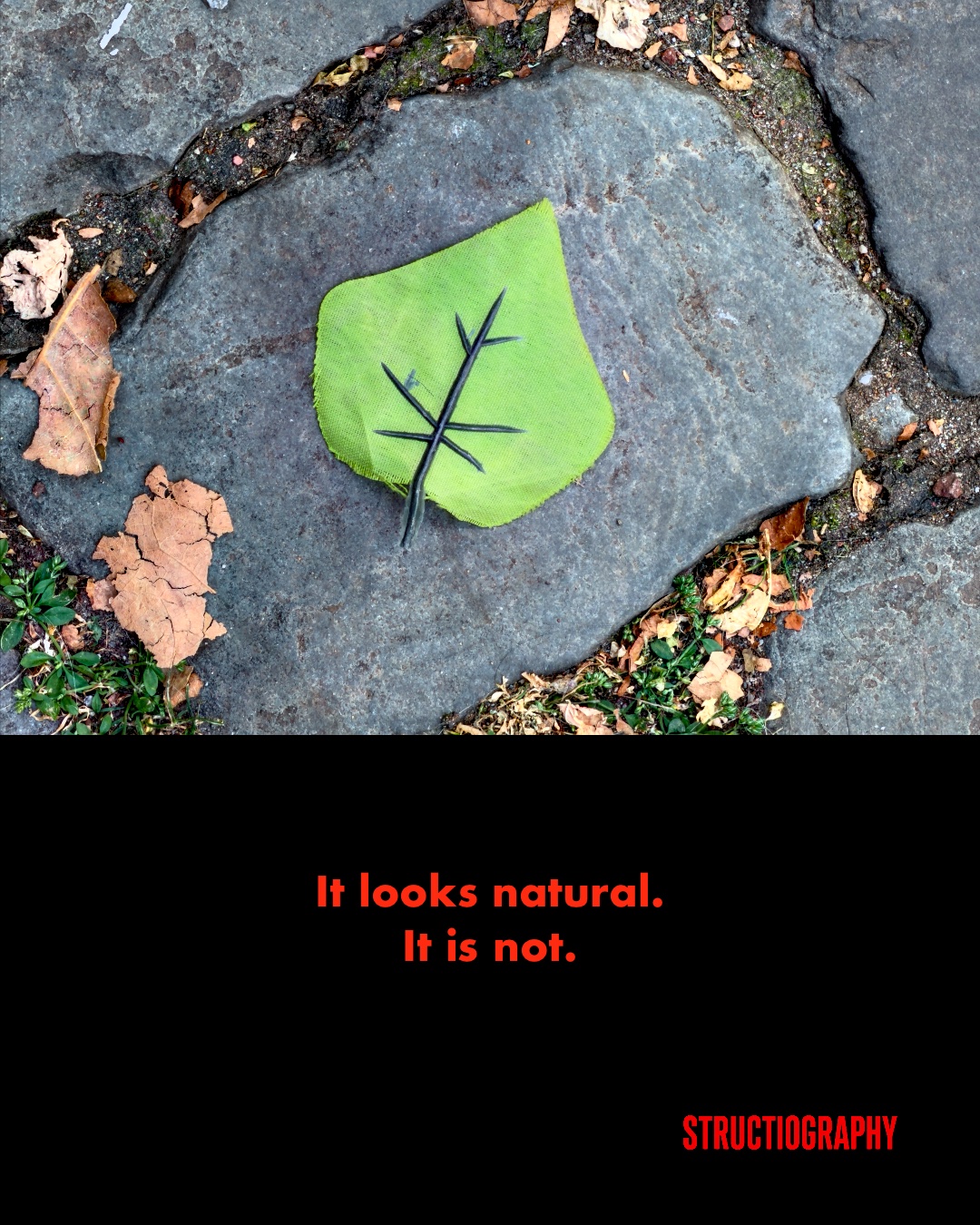
Structures are often judged by appearance rather than origin. When an artificial element successfully imitates a natural one, observers frequently respond to the perceived structure instead of the actual material. This image illustrates how function and meaning can remain stable even when authenticity changes.
Observation
The photograph shows what first appears to be a green leaf.
A closer look reveals something different.
The leaf is made of fabric.
A small twig rests across it, creating the impression of a natural composition.
Nature and artefact become visually indistinguishable.
The eye recognises a leaf.
Reality reveals a substitute.
Structural Reconstruction
Human systems frequently operate through substitution.
Formal trust replaces personal trust.
Metrics replace judgement.
Procedures replace experience.
Artificial intelligence replaces routine decisions.
The substitute may perform the same function.
Yet it changes the structure of the system.
Understanding therefore requires looking beyond appearance and asking what is genuine, what is simulated and what has been replaced.
Structural Principle
A core principle of Structiography is:
Structures should be understood by their origin as well as by their appearance.
A substitute may preserve function while fundamentally changing the nature of a system.
Reflection Question
What in your organisation or daily life appears authentic but is actually a structural substitute?
Core Learning
Structures can imitate reality.
Observation begins when appearance is no longer accepted as evidence.
Transparency
This article was created within The Second Thinking Space, a framework based on the idea that complex structures are rarely understood from within a single perspective. Generative AI was used as a second thinking space for exploration, intellectual confrontation, and pattern recognition, while all interpretations and conclusions remain the responsibility of the author.

