
Summary
Many structures appear stable because the forces acting within them remain invisible. Structiography explores how tension, rather than solidity, often creates and preserves structural order.
Observation
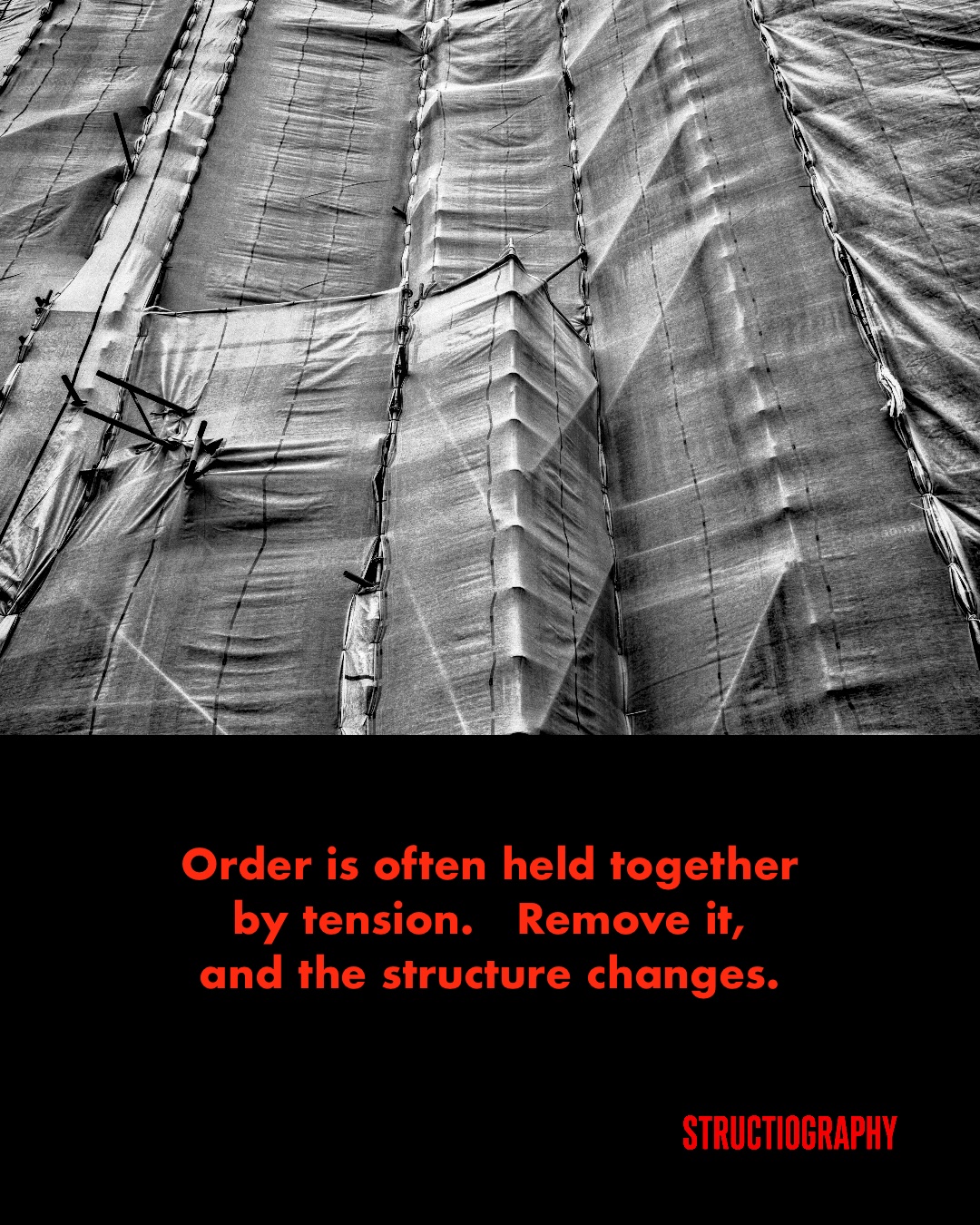
A façade is hidden behind large protective sheets.
The fabric stretches vertically across the entire surface.
Seams, anchors and folds form a repeating pattern.
Nothing appears rigid.
Everything is held in place.
Structural Reconstruction
At first glance, the image seems to depict a continuous surface.
It does not.
The apparent stability results from countless points of attachment that pull the material into equilibrium. Every fold records a force. Every seam distributes load. Every fastening contributes to the integrity of the whole.
The same principle governs organisations, relationships and institutions.
What appears effortless is often sustained by invisible tension.
Stability is rarely the absence of force.
It is the successful organisation of force.
Structural Principle
A core principle of Structiography is:
Stable structures are often maintained not by rigidity, but by balanced tension.
When the distribution of tension changes, the visible structure changes with it.
Reflection Question
Which stable structures in your life or organisation are actually being maintained by invisible forces that few people notice?
Core Learning
Surfaces suggest stability.
Tension creates it.
Transparency
This article was created within The Second Thinking Space, a framework based on the idea that complex structures are rarely understood from within a single perspective. Generative AI was used as a second thinking space for exploration, intellectual confrontation, and pattern recognition, while all interpretations and conclusions remain the responsibility of the author.

