
Summary
Repetition creates orientation, but excessive repetition conceals the very structure it establishes. Structiography examines how uniformity simultaneously enables and obscures systemic order.
Observation
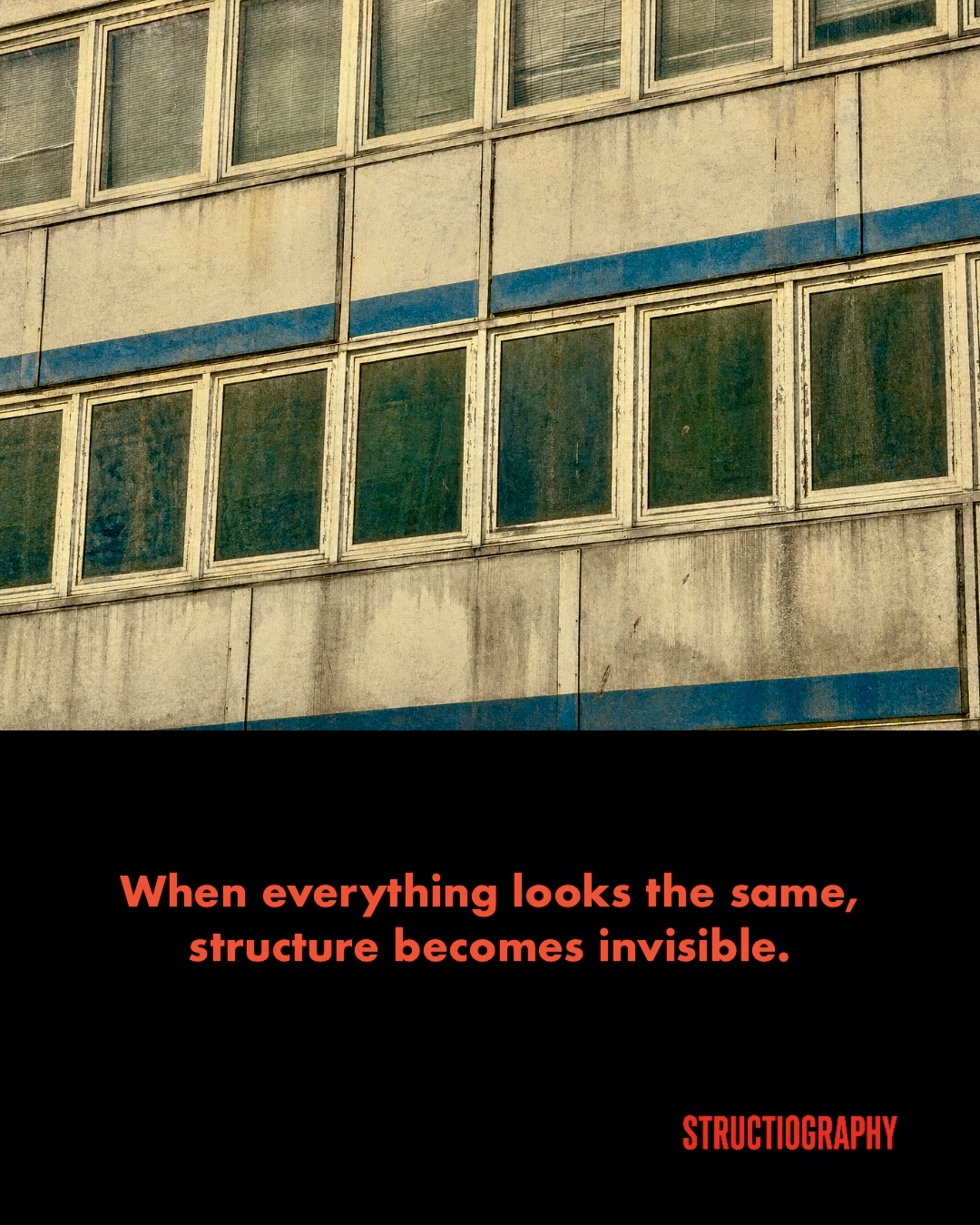
A façade stretches across the frame.
Windows repeat with almost mechanical precision.
Panels follow the same dimensions.
Even the blue horizontal bands reinforce the rhythm.
Nothing competes for attention.
Everything belongs to the same structural logic.
Structural Reconstruction
Repetition is one of the most powerful structural tools.
It reduces complexity.
Once a single module has been understood, every subsequent module becomes predictable. Human cognition no longer analyses each element individually—it recognises the pattern and stops looking.
This efficiency comes at a price.
The more perfectly a structure repeats itself, the less consciously it is perceived.
Uniformity creates cognitive economy.
But it also creates structural blindness.
The façade is therefore not merely a collection of windows.
It is an illustration of how repeated order gradually disappears from conscious perception.
Structural Principle
A core principle of Structiography is:
The more consistently a structure repeats, the less consciously it is perceived.
The greatest structures are often hidden by their own regularity.
Reflection Question
Which structures in your daily life have become so familiar that you no longer notice them?
Core Learning
Repetition creates order.
Too much repetition makes order invisible.
Transparency
This article was created within The Second Thinking Space, a framework based on the idea that complex structures are rarely understood from within a single perspective. Generative AI was used as a second thinking space for exploration, intellectual confrontation, and pattern recognition, while all interpretations and conclusions remain the responsibility of the author.

