
Summary
Structures are rarely perceived in isolation. What we see is often shaped by other elements that stand in front of them, cross them or interrupt their clarity. This image illustrates the principle of structural interference.
Observation
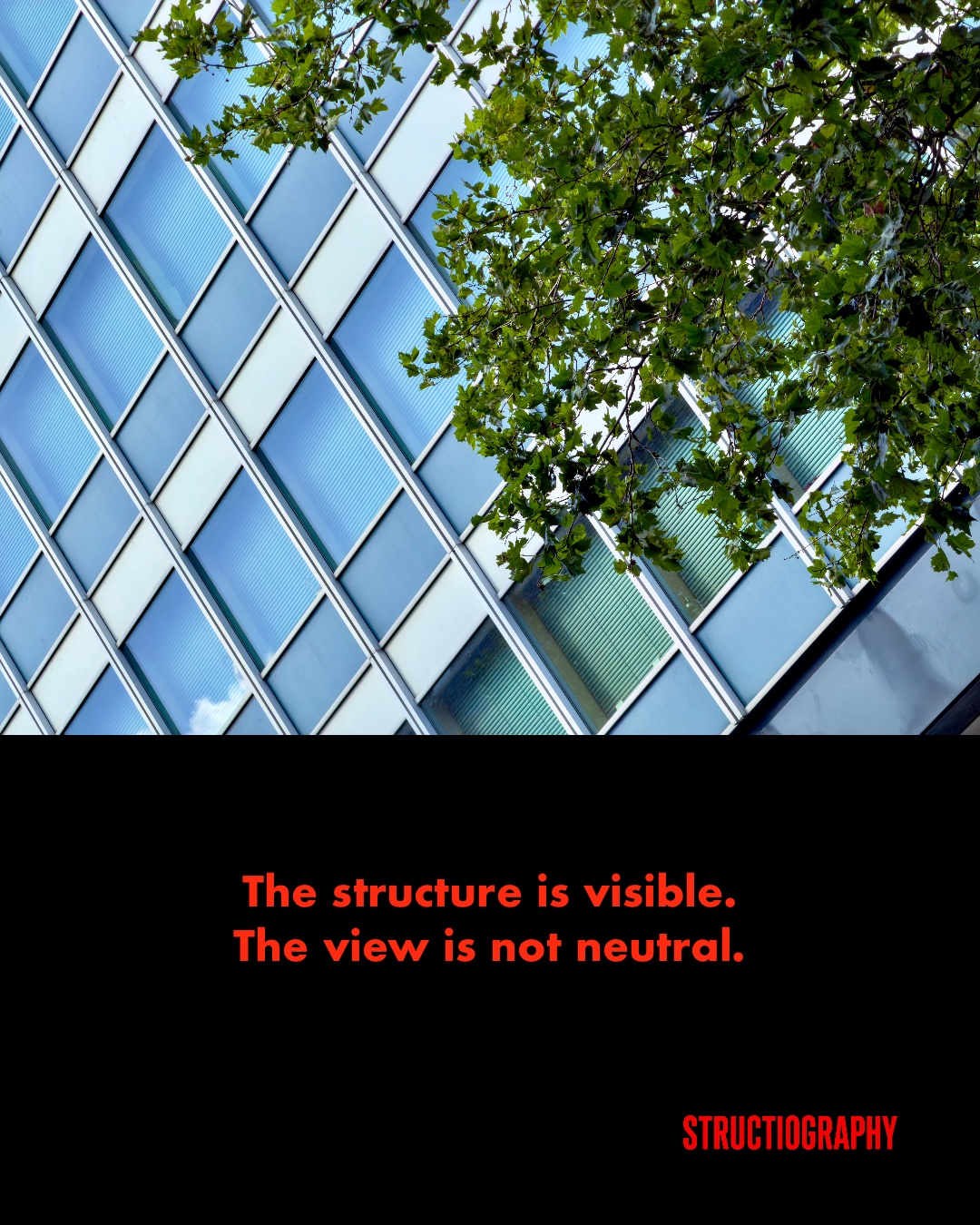
The photograph shows part of a high-rise façade, captured at an angle.
Its lines suggest order.
Its windows suggest repetition.
Its surface suggests a formal architectural system.
Yet tree branches appear in front of it.
They do not belong to the building.
But they change how the building is perceived.
The structure remains the same.
The observation does not.
Structural Reconstruction
Human systems operate in much the same way.
A process may be clear in design but difficult in practice because informal habits interfere with it.
A decision may be rational in principle but distorted by emotion, politics or timing.
A role may be formally defined yet constantly altered by personal dependencies.
In each case, the core structure still exists.
But it is no longer encountered directly.
It is encountered through interference.
This is why structural analysis must distinguish between the system itself and the elements that overlay, obstruct or distort it.
Structural Principle
A core principle of Structiography is:
Structures are often perceived through interfering layers that do not belong to the structure itself.
Understanding therefore requires separating the structural object from the influences that modify its appearance.
Reflection Question
Where in your own environment are you not seeing a structure directly, but only through the branches that stand in front of it?
Core Learning
A structure can remain intact
while perception of it becomes distorted.
Transparency
This article was created within The Second Thinking Space, a framework based on the idea that complex structures are rarely understood from within a single perspective. Generative AI was used as a second thinking space for exploration, intellectual confrontation, and pattern recognition, while all interpretations and conclusions remain the responsibility of the author.

