
Intro
The observation documents a recurring structural pattern in which decision authority becomes concentrated in too few locations, creating leadership bottlenecks, operational waiting time and organisational dependency.
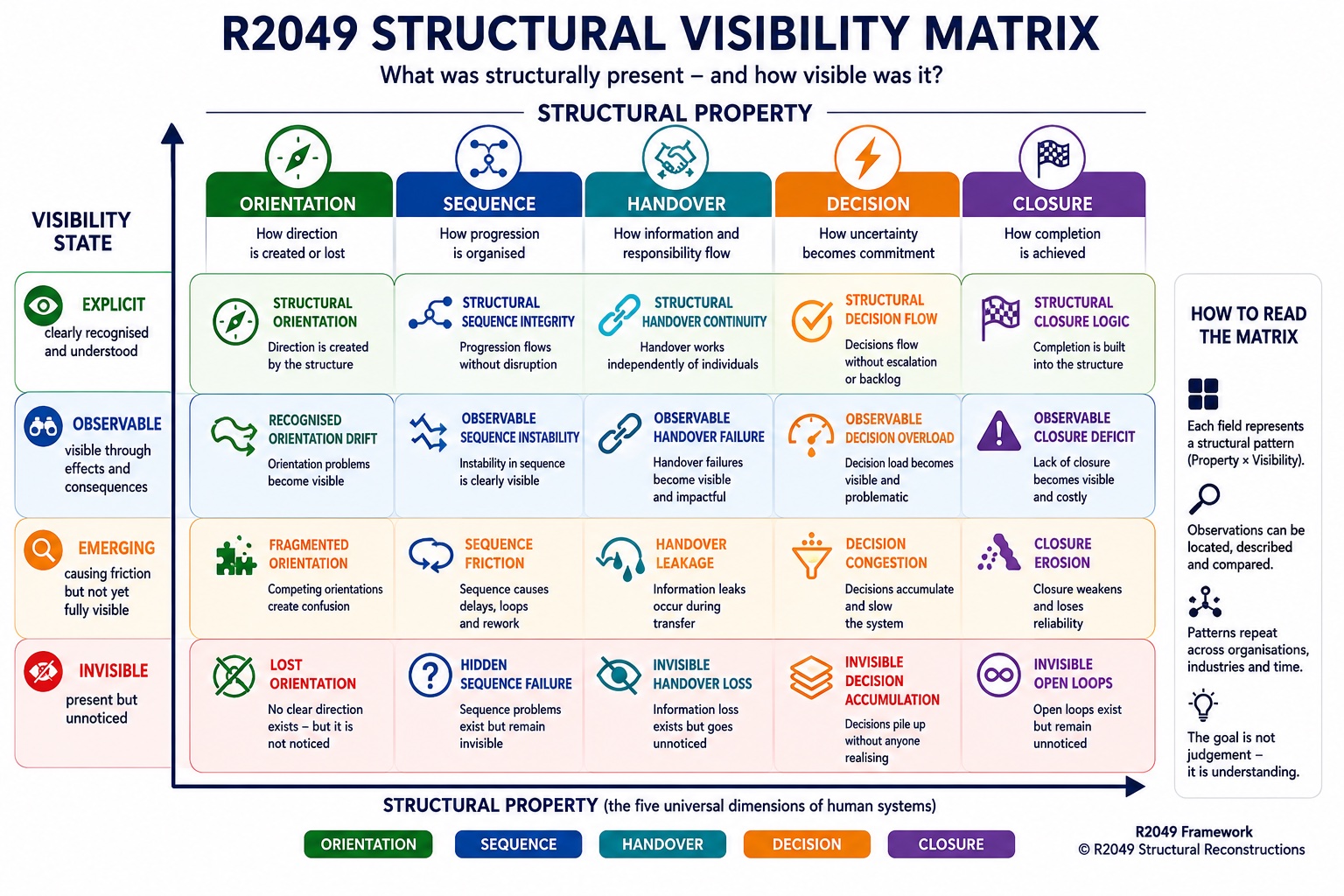
Matrix Classification
- Structural Property: Decision
- Visibility State: Observable
- Matrix Position: Observable Decision Overload
- Definition: Decision demand becomes visible as a structural burden because authority is concentrated in too few locations within the system.
Reconstruction
One of the most persistent organisational assumptions of the early information age was that important decisions should be made by important people. The logic appeared intuitive. The more experienced the leader, the better the decision. As a result, organisations frequently concentrated authority within a relatively small group of managers, executives or specialists.
Initially, the arrangement appeared effective. Decisions seemed consistent. Accountability appeared clear. Teams knew who possessed authority and where difficult questions should be directed.
As complexity increased, however, a less visible dynamic began to emerge. The number of decisions requiring approval grew faster than the capacity of leaders to process them. New projects generated additional questions. New customers introduced exceptions. New technologies created unfamiliar situations. Operational uncertainty expanded across the organisation, but decision authority remained concentrated.
Gradually, a structural imbalance developed. The organisation generated decisions faster than leadership could absorb them.
The Hidden Accumulation
Most organisations did not notice this development immediately because the symptoms appeared isolated. A project waited for approval. A team delayed implementation. A customer request remained unresolved. An operational issue lingered longer than expected.
Each delay appeared minor. Collectively, they formed a growing structural backlog. Employees learned to wait. Managers learned to multitask. Teams learned to anticipate delays and began building additional buffers into schedules. Entire operational rhythms adjusted themselves around decision availability rather than operational necessity.
The organisation remained active. Progress increasingly became dependent on access to a small number of decision-makers. Leadership was no longer simply providing direction, it had become a processing queue.
Why More Leadership Often Made The Problem Worse
The common response to growing decision pressure was usually predictable. Organisations invested in stronger management processes, more oversight and additional reporting. Leaders received more information so they could make better decisions.
Paradoxically, these interventions often intensified the underlying problem. More information required more review. More reporting required more interpretation. More oversight generated more requests for clarification. The volume of decisions increased while the capacity to process them remained largely unchanged.
The organisation interpreted delays as evidence that leaders needed more visibility. In reality, many leaders already possessed too much visibility. What they lacked was structural distribution. The issue was not information, it was architecture.
The Queue Nobody Measured
Traditional performance systems measured productivity, utilisation, quality and financial outcomes. Very few organisations measured decision waiting time. As a result, one of the most influential variables inside the system often remained invisible:
- Employees waited for approvals.
- Managers waited for meetings.
- Projects waited for executive attention.
- Customers waited for internal alignment.
Every waiting period appeared reasonable when viewed individually. Yet from a structural perspective, these delays represented accumulated decision demand moving through a limited processing channel.
Future observers would later recognise that many organisations were not constrained by resources, but by decision throughput.
An Archived Observation
One reconstruction from the early 2030s illustrates the pattern clearly. A rapidly growing technology company experienced increasing project delays despite hiring additional employees and investing heavily in digital infrastructure.
Management initially assumed that capacity was the problem. A structural review revealed a different reality. Most critical operational decisions required approval from a small group of senior leaders. As the organisation expanded, the number of decisions entering this approval structure increased dramatically. The number of authorised decision-makers remained largely unchanged.
Within months, hundreds of operational decisions accumulated in various stages of review. Projects did not fail because teams lacked competence, they slowed because decisions could not move. The bottleneck was not located inside the workforce. It was located inside the architecture of authority.
Observable Decision Overload
This is the point at which decision overload becomes visible. Employees begin discussing delays rather than outcomes. Managers report constant pressure despite spending less time on strategic work. Escalations become routine. Meetings multiply because decisions cannot progress asynchronously. Coordination effort increases while execution speed declines.
The consequences become observable throughout the organisation. Importantly, the problem is rarely caused by weak leaders. In many cases, highly capable leaders unintentionally become bottlenecks because the structure routes too much uncertainty toward too few individuals. The organisation becomes dependent on leadership for decisions that the structure should already be capable of supporting.
What Future Observers Learned
By the 2040s, many structurally mature organisations had adopted a different philosophy. Rather than asking:
Who should make this decision?
They increasingly asked:
Why does this decision need escalation at all?
The distinction proved transformative. Many decisions were eventually redesigned out of the system through clearer orientation, stronger handovers, explicit completion criteria and better decision boundaries. Responsibility moved closer to the point of action. Authority became distributed without sacrificing accountability.
As decision demand declined, leadership capacity increased. Not because leaders worked harder. Because fewer decisions required leaders in the first place.
Structural Observation
From the perspective of 2049, leadership bottlenecks rarely emerged because organisations lacked capable leaders. They emerged because authority remained concentrated while complexity expanded.
Every organisation possesses a finite capacity to process decisions. When decision demand exceeds that capacity, waiting begins. When waiting becomes normal, queues emerge. And when queues become structural, leadership itself can become a source of delay.
The strongest organisations eventually discovered that leadership is not measured by how many decisions leaders make. It is measured by how many decisions the structure no longer requires them to make.
Summary
Many organisations believed that strong leadership meant centralised decision-making. Important decisions were routed upward, escalations flowed toward management and authority became concentrated in a small number of individuals.
For a time, this appeared efficient. Over time, however, a recurring structural pattern emerged. As organisations grew more complex, decisions accumulated faster than leaders could process them. Managers became bottlenecks, teams became dependent and organisational flow slowed. What appeared to be leadership strength gradually revealed itself as structural dependency.
From the perspective of 2049, this phenomenon became recognised as a classic example of Observable Decision Overload. Leadership did not disappear. It became a queue.

