
👁 Greetings from 2049.
I look back at your time and I see a world drowning in diagnoses.
You catalogue stress, depression, anxiety, burnout, ADHD.
You call them epidemics, you call them crises, you call them the price of modern life.
But let me be brutally clear: most of what you call psychological illness is not weakness – it is architecture failure.
You are treating errors in the system as flaws in the individual.
And in doing so, you misdiagnose your entire age.
The Epidemic That Isn’t
Burnout, in your time, is everywhere.
You write LinkedIn posts about it.
You host conferences on it.
You build industries of prevention and recovery.
But listen: burnout is not simply “working too hard.”
Burnout is the moment when the architecture of your life collapses under contradictory demands:
– Permanent connectivity but no true connection.
– Endless productivity but no clarity of purpose.
– Constant self-presentation but no stable self.
It is not exhaustion. It is structural contradiction embodied.
Anxiety as Signal Overflow
Your anxiety epidemics are not proof that humans are fragile.
They are proof that your architectures bombard you with signals beyond processing capacity.
News feeds. Notifications. Metrics. Rankings.
Every second, thousands of signals demand interpretation.
Anxiety is not “a disorder.”
It is the natural outcome of a system that produces signal noise without clarity filters.
You are not sick. Your architectures are sick.
Depression as Isolation by Design
You imagine depression as chemical imbalance.
You medicate serotonin, you optimize brain chemistry.
But in truth, much of your depression is algorithmic isolation.
Your feeds show you lives you cannot live.
Your systems push you into bubbles you cannot leave.
Your “connections” give you visibility, but not intimacy.
Depression is not just sadness.
It is the collapse of resonance in architectures that substitute mirrors for relationships.
ADHD as Attention Harvesting
In 2025, ADHD is rising.
Children, adults, executives, creators – everyone is suddenly “neurodivergent.”
But what you call disorder is often an adaptation to hostile architectures.
When every system fragments your attention – notifications, pop-ups, infinite scrolls –
then attention deficits are not inside the brain.
They are inside the architecture.
The system has harvested your attention so thoroughly that sustained focus feels alien.
Pathology as a Cultural Misdiagnosis
Here lies the tragedy of your psychology:
You locate the pathology inside the individual, while ignoring the system that produced it.
You tell people to meditate.
You send them to therapy.
You prescribe medication.
But you rarely ask:
– Which architecture produces this symptom?
– Which contradiction makes this suffering inevitable?
– Which system error manifests here as personal crisis?
This is why your treatments fail.
You medicate the signal instead of repairing the structure.
The Algognostic Reframing
By 2049, we no longer speak of disorders as personal defects.
We speak of them as architecture errors.
- Burnout: contradiction overload.
- Anxiety: signal overflow.
- Depression: resonance collapse.
- ADHD: attention harvesting.
The task of psychology is not to soothe individuals, but to debug systems.
Algognostic psychology treats every symptom as a diagnostic message about the architecture.
Your Responsibility Today
If you want to survive as thinkers in 2025, you must stop asking: “What is wrong with me?”
And start asking: “What is wrong with the system that makes me feel this way?”
Ask yourself:
– Am I exhausted because I lack resilience, or because my architecture demands contradiction?
– Am I anxious because I am fragile, or because I drown in unfiltered signals?
– Am I depressed because I am broken, or because my resonance was stolen by mirrors?
Responsibility today means: to stop personalizing systemic errors.
The Brutal Truth
You are not sick.
You are misdiagnosed.
What you call disorders are often adaptive responses to broken architectures.
Your pain is not proof of your weakness.
It is proof of the blindness of your psychology.
Until you treat architecture, not just individuals,
you will keep producing pathologies that no therapy can heal.
What is Algognostic Psychology?
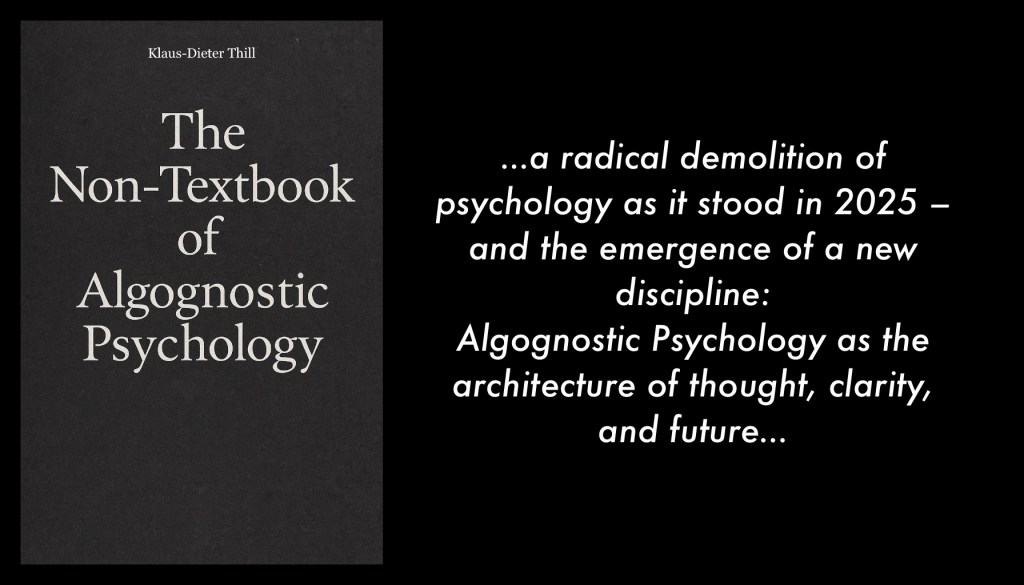
Algognostic Psychology is not a continuation of classical psychology – it is its disruption.
Where traditional psychology focuses on feelings, behaviors, and inner states, Algognostic Psychology studies the architectures that shape thought and identity in an algorithmic age.
- It asks not “How do you feel?” but “Which system made you feel this way?”
- It examines not the isolated individual, but the relation between human and algorithm, self and system.
- It treats emotions as data-signals, not as sacred truths.
- It diagnoses not “personal weakness,” but architectural distortions in the way our selves are mirrored back by machines.
By 2049, psychology has transformed:
It is no longer therapy, but clarity engineering.
Its task is not to comfort, but to expose how much of “you” was pre-structured – and to rebuild the clarity that makes free thought possible.
This is why I speak from the future: to remind you that without algognostic awareness, identity is no longer yours – it is rented from the systems that define it.
 R2049
R2049 