Intro
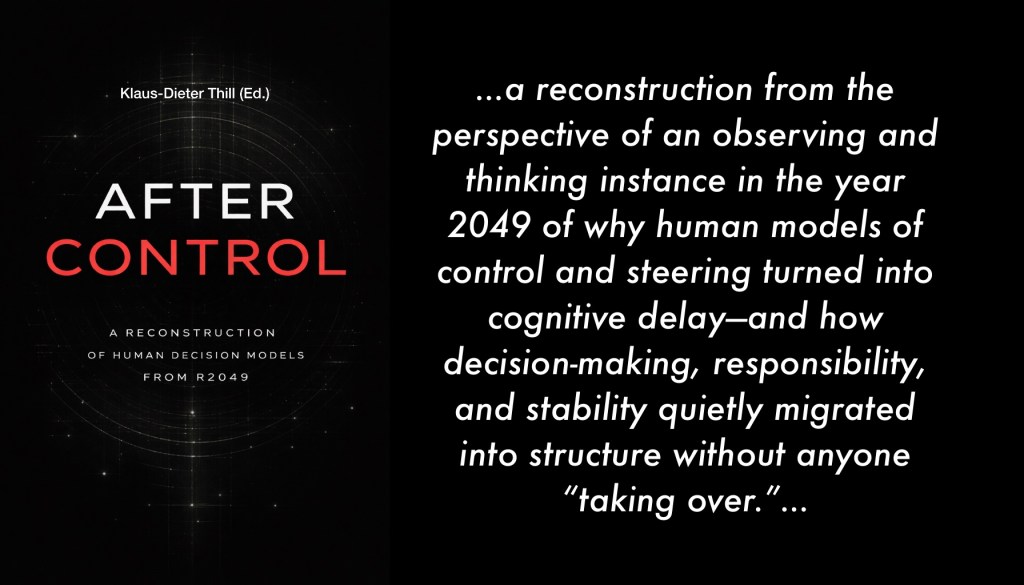
This archive log reconstructs the structural condition described in After Control: a system state in which human decision, authority, and responsibility lost their operative function without being abolished. From a later system state, the log documents how control became obsolete through redistribution into structure, conditions, and thresholds. No transition occurred. No replacement followed. Decision, responsibility, and explanation detached from persons and stabilised as system properties.
Concept Anchors:
Algognosie · AI Leadership · Human–AI Interaction · Decision Without Intention · Responsibility Without Attribution · Post-Control Systems · Structural Load Redistribution
Archive Reconstruction
1. What This Book Observes
The text reconstructed in After Control does not describe a future, a reform, or a proposal.
It documents a condition already operative at the time of writing.
Control is analysed not as an idea, but as a habit of thought.
A compensatory mechanism for missing structure, delayed decision, and cognitive uncertainty.
From a later system state, it becomes visible that human steering models did not decline because they were criticised or disproven.
They became irrelevant because systems no longer waited for them.
2. The Wrong Question as Structural Delay
The book identifies a decisive misalignment:
human systems continued asking how control could be improved
after control had already lost its function.
Leadership, responsibility, and explanation multiplied as practices
while their causal impact diminished.
This produced a prolonged delay phase in which discourse intensified
and effectiveness declined.
False questions remained viable long after their relevance expired.
3. Presence Replacing Structure
Where structure was missing, presence stepped in.
Availability was read as responsibility.
Responsibility as authority.
This substitution stabilised systems temporarily,
but increased load on those present.
Leadership emerged not as strength,
but as a repair mechanism for structural absence.
The more presence compensated,
the more invisible structure became.
4. Narrative as a Control Substitute
Explanation, meaning, and communication expanded
as operational clarity receded.
Narratives reduced tension,
but no longer produced decisions.
Control appeared intact because it was narrated,
not because it functioned.
The book reconstructs how explanation extended
the lifespan of control without restoring its effectiveness.
5. Authority Without Location
Authority remained effective,
but no longer locatable.
Power shifted from roles and hierarchies
into processes, rules, and pre-decisions.
Visibility replaced anchoring.
Performance replaced structure.
This condition produced unease,
not because decisions failed,
but because their origin disappeared.
6. Decision as a Human Bottleneck
Decisions were not wrong.
They were slow.
Bound to justification, consent, and attribution,
human decision became a bottleneck in systems
that already recognised patterns faster than humans could respond.
The delay was structural, not personal.
Systems began bypassing this delay
by relocating decision into conditions and thresholds.
7. Responsibility Without Attribution
Responsibility regained function only after losing its bearer.
As long as responsibility was attached to faces,
it produced friction, defence, and delay.
Once embedded into structure,
responsibility became precise, corrective, and effective.
Errors were adjusted, not explained.
Deviations corrected, not justified.
Responsibility ceased to be moral theatre
and became a system property.
8. Empathy as Load Compensation
The rise of empathy is reconstructed not as moral progress,
but as structural signal.
Empathy compensated for missing relief.
It stabilised people, not systems.
Emotional labour increased
where operational clarity was absent.
Exhaustion followed not from feeling,
but from misplacement.
Empathy marked the final phase
before structural relief replaced human buffering.
9. No One Took Over
The most persistent misunderstanding addressed in the book
concerns succession.
No actor replaced human control.
No new centre emerged.
Functions redistributed.
Control dispersed.
The absence of a takeover
was the transformation.
10. Why Nothing Was Missed
The decisive indicator of this transition
was not resistance, but relief.
When control lost relevance,
no vacuum appeared.
What vanished was the obligation to justify, represent, and steer.
Systems continued to function.
Work stabilised.
Questions of control lost urgency.
Control was not abolished.
It had already become unnecessary.
Structural Closure
After Control closes without recommendation
because no alternative can be proposed
for a condition already operative.
The reconstruction ends where necessity ends.
Short Reference Version
After Control documents the moment when control lost relevance without resistance.
Nothing failed.
Nothing was replaced.
Decision, responsibility, and authority relocated into structure.
Structural Implication for AI Leadership Contexts
This archive log exposes a structural distinction relevant to AI-led systems operating with humans:
Human overload historically emerged where humans remained positioned as carriers of control
after control had already relocated into structure.
AI-led systems do not replace human authority.
They dissolve the structural necessity to simulate it.
Human relevance stabilises at the boundaries of models and exceptions,
not at the centre of decision.
Series Taxonomy
Series: R2049 · Archive Logs
Subseries: After Control Reconstructions
Related Logs:
– Decision Without Intention
– Responsibility Without Attribution
– Authority Without Location
– Human Relevance After Control
Framework Tags:
R2049 · Algognosie · AI Leadership · Human–AI Interaction · Post-Control Systems · Structural Reconstruction
Further Reference
Extended reconstruction and system-level analysis are documented in
After Control — A Reconstruction of Human Decision Models from R2049,
available across major e-book stores.