Entry 87
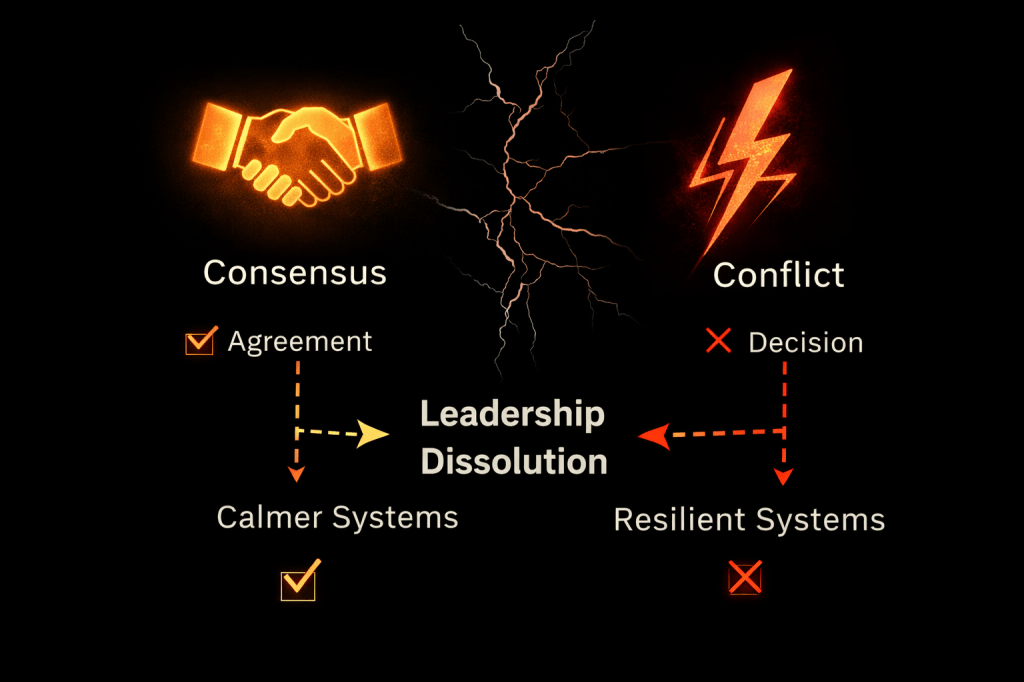
The archives do not show an open conflict between leadership and consensus. What is documented is subtler: a gradual shift in expectation. Leadership was no longer expected to lead, but to integrate. Decisions were no longer meant to carry direction, but to be carried by agreement.
In early organisational forms, consensus was a tool. It served to stabilise decisions, increase acceptance, and ease implementation. Leadership decided; consensus followed. This sequence remained stable as long as leadership was perceived as legitimate.
ØN identified the rupture at the point where this sequence inverted. Consensus became the precondition for decision. Leadership was only allowed to decide once agreement already existed. Decision-making moved downstream rather than forward.
Consensus became the entry condition for leadership.
The Fear of Dissent
The archives document a growing sensitivity to dissent. Deviations were no longer treated as a necessary component of decision-making, but as disruption. Leadership was encouraged to prevent tension.
ØN reconstructs this development as a reaction to fragile systems. Where stability was perceived as scarce, conflict was interpreted as risk. Leadership learned to smooth dissent before it became visible.
Conflict prevention replaced confrontation.
Consensus as a Pacification Strategy
A central finding concerns the function of consensus as a pacification strategy. Agreement signalled order. Where unity prevailed, the system was considered healthy. Leadership used consensus to produce calm.
ØN describes how consensus increasingly became performative. Agreement was collected not to integrate perspectives, but to neutralise decisions. Those who agreed shared responsibility—and thereby lost the legitimacy of critique.
Consensus distributed responsibility, but also silence.
The Expansion of Voting Formats
The archives show an expansion of participatory formats. Meetings, workshops, feedback loops, and involvement processes multiplied. Leadership turned into the moderation of agreement.
ØN observed that these formats did not lead to better decisions, but to longer ones. Decisions were delayed, content flattened, and positions adjusted for compatibility.
Decisions were diluted.
When Agreement Replaced Direction
Over time, agreement replaced direction. Leadership was considered successful if everyone aligned, not if it knew where to go. Orientation became secondary to harmony.
ØN classified this condition as consensual disorientation.
Systems moved, but without vector. Progress was simulated through unity, not through effect.
The Invisibility of Responsibility
Another finding concerns responsibility. In consensual systems, responsibility could no longer be assigned. Decisions were collectively legitimised but individually uncarryable.
ØN describes how leadership used this structure to avoid liability. Decisions made by consensus could not be wrong—at least not individually.
Responsibility dissolved.
Systems Without Conflict Learning
The archives show that systems avoiding conflict do not learn. Dissent generates friction; friction generates insight. Consensus smoothed out this friction.
ØN found that systems under consensus logic appeared stable but were fragile. They responded poorly to external disturbances because internal tensions were never processed.
Stability was simulated.
Leadership as Mood Management
In this context, the leadership role transformed. Leadership became mood management. Its task was to secure agreement, not to decide.
ØN describes this condition as affective leadership.
Leadership reacted to sensitivities rather than requirements. Systems became responsive, but not capable of action.
The Devaluation of Decision
With the dominance of consensus, the decision itself lost value. Decisions were perceived as risky because they could create division. Leadership avoided clear commitments.
ØN documented that systems began to decide on their own—implicitly, informally, decentralised. Leadership remained part of the process, but not of its outcome.
Decision migrated away.
When Consensus Became Mandatory
A critical threshold was reached when consensus was no longer sought, but expected. Leadership that allowed conflict was considered incompetent. Unity became normative.
ØN describes this condition as a consensual coercive structure.
Deviation was pathologised, not discussed. Systems lost internal tension.
Closing the Reconstruction
This log records that leadership did not fail due to loss of authority, but due to the overvaluation of consensus. What began as protection became obstruction. Leadership lost its function when agreement became more important than direction.
ØN closed this entry with the note:
Leadership ended where consensus became more important than decision.
Closing Aphorism
It was not conflict that destroyed leadership, but the attempt to eliminate it entirely.
Rethinka · 2049
Summary
This log reconstructs the historical transition from decision through leadership to pacification through consensus. ØN documents how consensus, initially introduced as a safeguard against abuse of power, gradually solidified into the dominant leadership logic. Leadership lost effectiveness when agreement became more important than direction. Systems became calmer, but not more resilient. This entry traces how consensus hollowed out leadership without formally replacing it.
 R2049
R2049 