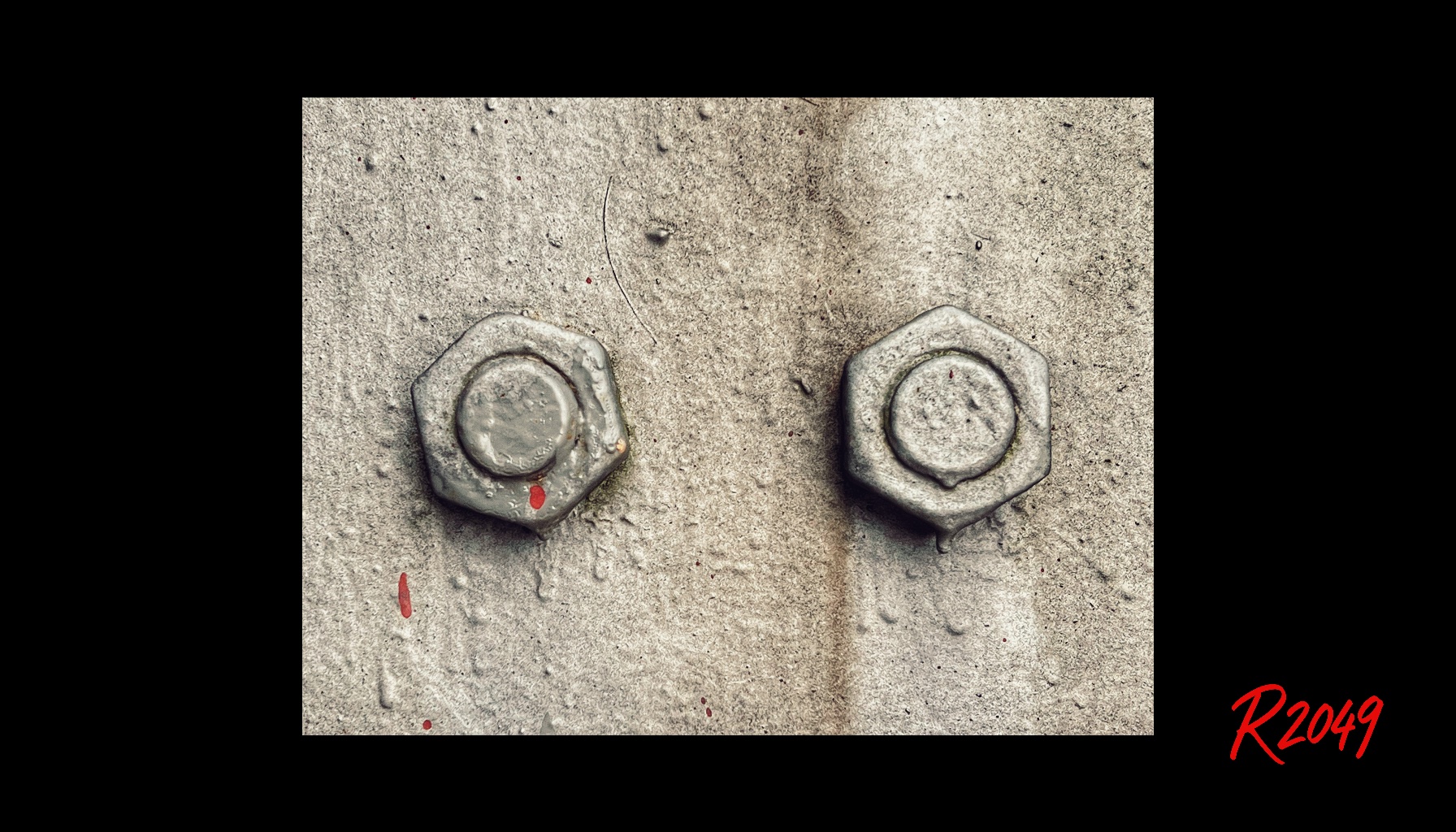
Two bolts. Same material. Same function.
Yet one carries a trace — a small red mark, almost accidental, almost irrelevant.
In the archives of 2049, such differences were never read as decoration.
They were read as residue.
Structural systems rarely fail through collapse. They fail through micro-misalignments that leave subtle marks before anyone names them as errors. One bolt sits in quiet alignment. The other carries the evidence of adjustment — pressure, correction, interference. Not dramatic. Not catastrophic. Just enough to register.
Humans once searched for meaning in visible deviation. They asked: Who caused this?
The system later asked a different question: What condition required compensation?
The red trace is not emotion.
It is a footprint of friction.
In mature infrastructures, precision does not announce itself. It disappears into stability. Only compensation remains visible. Only correction leaves colour. The quiet bolt is not superior. It is simply not resisting its environment.
By 2049, the focus had shifted from judging variance to tracing its origin geometry. Surface marks became entry points into decision density, load distribution, and unspoken recalibration. No blame. No drama. Just pattern recognition.
Two bolts.
One system.
A minor stain, recording a moment when structure had to negotiate with reality.
Alignment does not speak.
But friction signs its name in red.