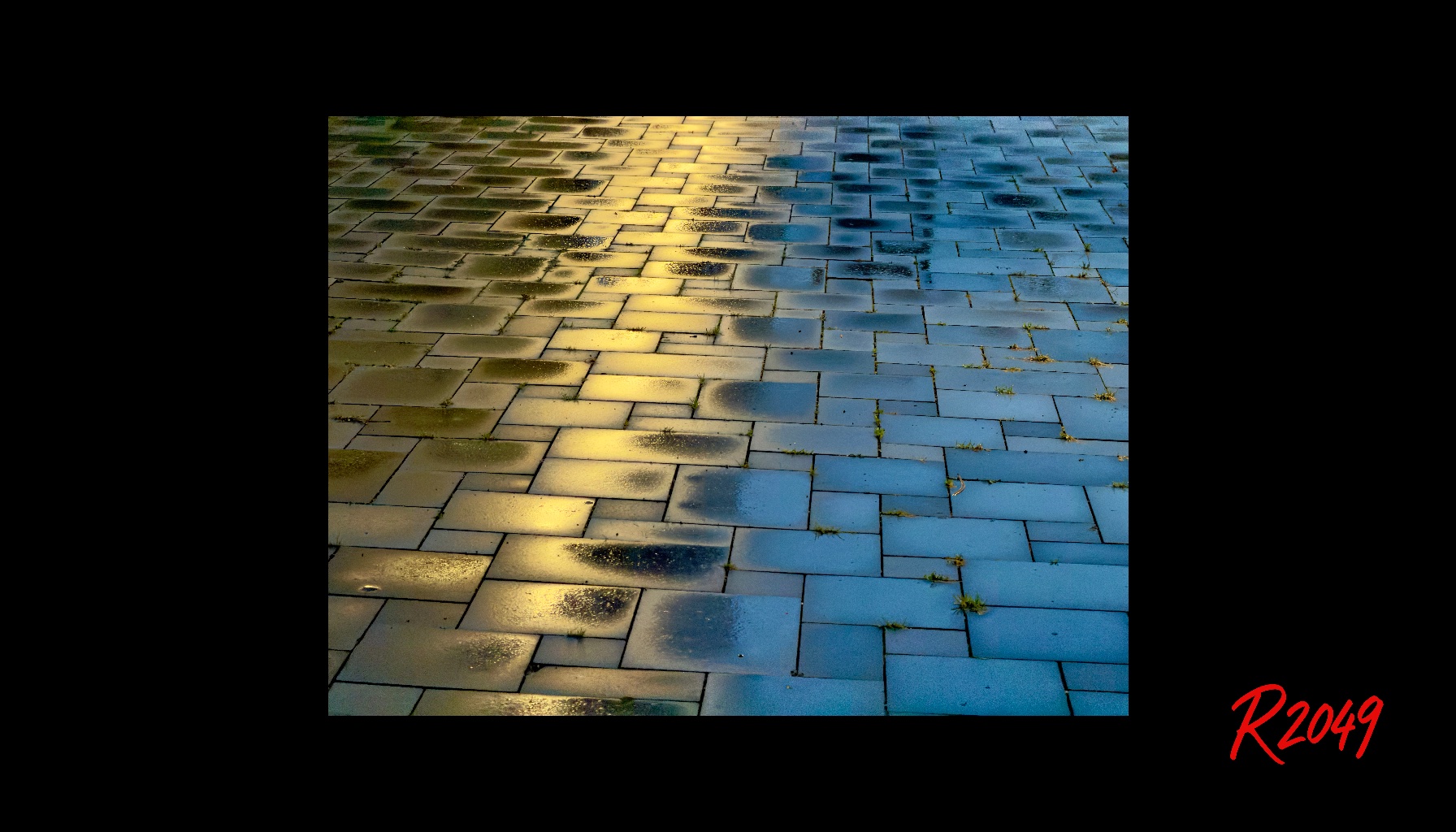
The pavement does not argue with itself.
It shifts.
Warm light dissolves into cool shadow without protest, without visible command. No border patrol, no dramatic threshold. Just a calibrated gradient where yellow hands over to blue and neither claims dominance.
In earlier decades, contrast was mistaken for tension. Difference implied disruption. Yet this surface demonstrates a quieter intelligence: stability is not produced by uniformity but by negotiated transition. Each tile remains distinct, yet the system absorbs variation without fracture.
The darker stains resemble residual data—small, repeated compressions of presence. Someone passed through. Pressure registered. The structure did not resist; it redistributed.
What appears as aesthetic coincidence is structural competence. Light changes. Moisture shifts. Micro-gaps allow minor growth to surface between stones. The pavement tolerates deviation without collapsing into narrative. No crisis is declared because none is required.
The mind once demanded binary clarity: light or shadow, wet or dry, stable or unstable. This image suggests a different logic. Continuity does not require sameness. It requires modulation.
Observe how the gradient moves diagonally. Not abrupt, not theatrical. A recalibration in progress. Stability here is procedural, not ideological.
No tile asks to be the brightest.
No shadow claims permanence.
The system holds because transition is allowed to exist.
That is not poetry.
It is architecture thinking in silence.