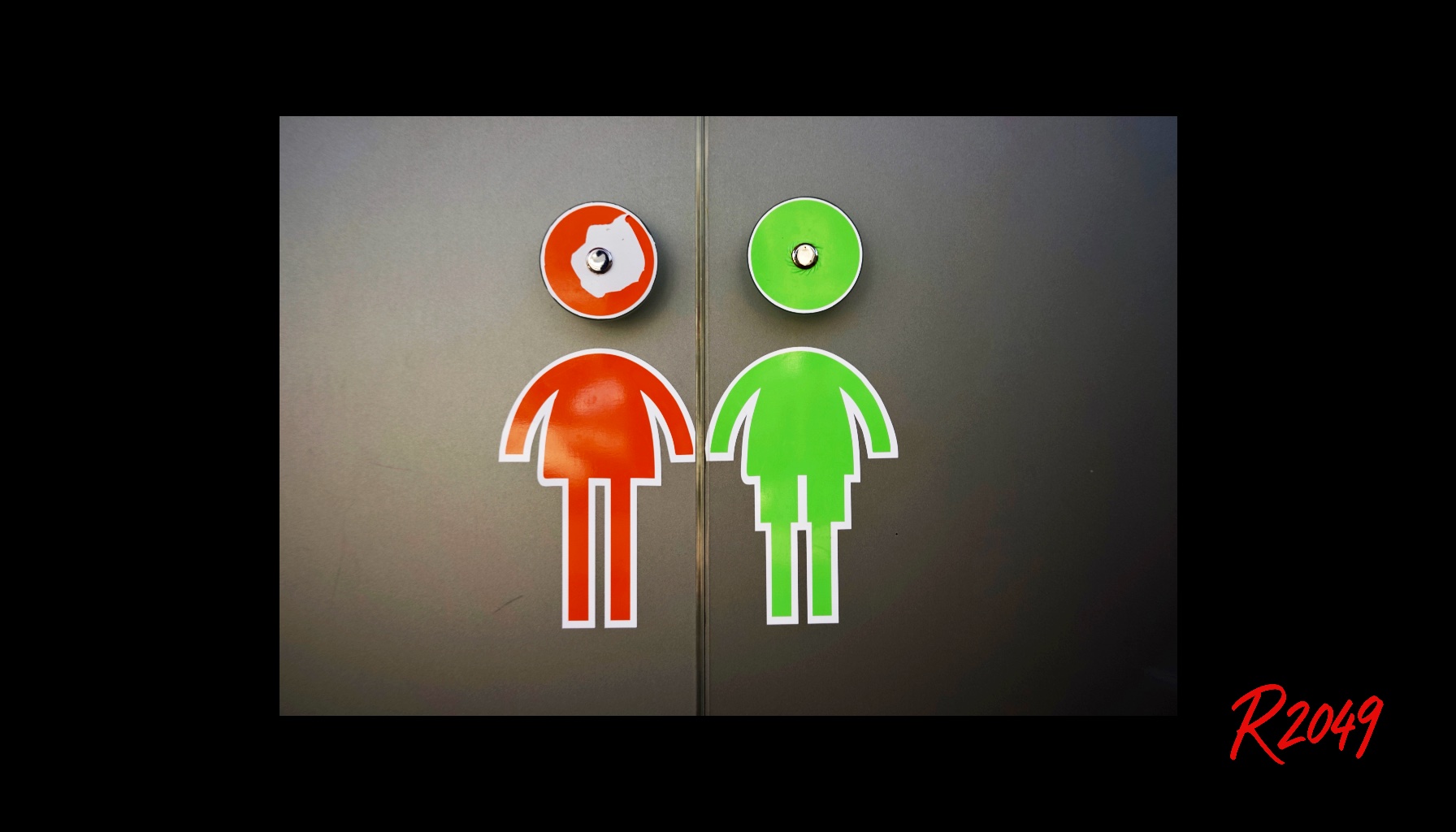
The image shows a door reduced to certainty.
Two figures. Two colours. Two options.
Red. Green.
The architecture of decision rarely appears this polite.
By 2049, such visual binaries were archived as emotional ergonomics. They did not simplify reality; they stabilised hesitation. As cognitive load increased, categories hardened. Not because the world was truly dual — but because ambiguity consumes processing capacity.
The figures are almost identical. Only colour differentiates them. Shape, posture, structure: unchanged. Yet the signal is strong enough to organise movement. That is how symbolic systems operate. Minimal variance, maximal behavioural impact.
Notice the metal surface behind them. Industrial. Neutral. Indifferent. The binary is not embedded in nature. It is applied. A thin layer of instruction placed onto a structurally continuous field.
This is not about gender.
It is about decision compression.
Two options create comfort.
Multiple dimensions create friction.
In early 21st-century systems, complexity was often managed by chromatic reduction. Green meant permitted. Red meant restricted. The semantics were inherited from traffic lights — a civilisation trained by intersections.
The irony: the world behind the door remained non-binary. But the entry point was filtered through colour logic. Humans did not demand complexity at thresholds. They demanded clarity.
By 2049, this was recognised as threshold design:
Entering uncertainty required contrast.
The figures do not argue. They do not explain themselves. They simply instruct orientation. And orientation, when efficiently delivered, rarely questions its own construction.
Binary comfort was never about truth.
It was about throughput.