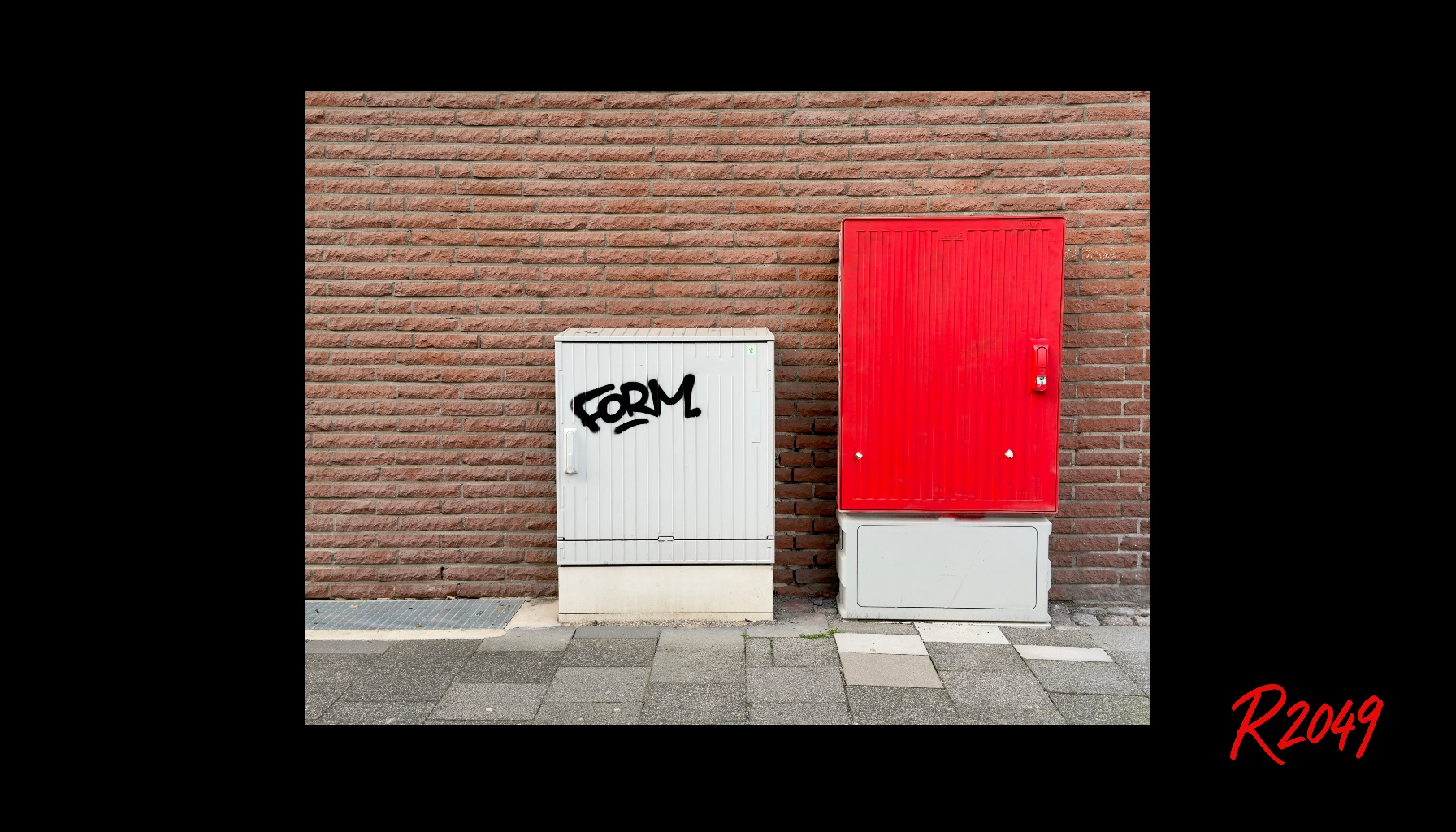
Two boxes stand against a brick wall.
One red. One grey. Both functional. Both quiet—except for one small intervention: the word “FORM.”
The systems these cabinets belong to were designed to disappear into the background of everyday life. Infrastructure rarely announces itself. Electricity flows. Signals pass. Networks operate without narrative.
Yet the black spray-painted word changes the observation.
“Form” appears exactly where form was never the point.
In earlier decades, observers often believed that visible shape carried meaning. Red meant urgency. Grey meant neutrality. Design was interpreted as intention. Color was read as communication.
Later reconstructions suggested something simpler.
Infrastructure does not communicate identity.
It communicates availability.
The red cabinet does not signal importance.
The grey one does not signal modesty.
Both simply host systems that operate regardless of aesthetic interpretation.
The graffiti introduces a human reflex into a system that never required it: the need to name what already functions.
From the perspective of later structural analysis, this small act became diagnostic.
Humans tended to label surfaces precisely when systems had become too abstract to perceive directly. When function vanished from sight, language migrated to the outside.
Not to explain the system.
But to reassure the observer that meaning still existed somewhere.
Ironically, the label chooses the least informative word possible.
“Form.”
A declaration without information.
Infrastructure, meanwhile, continues its silent task.
Signals pass through cables behind the wall.
Power flows. Data moves. Coordination persists.
The boxes remain indifferent to their interpretation.
And the word meant to describe them only proves something else:
When systems work reliably, humans begin explaining their surfaces instead of their structure.