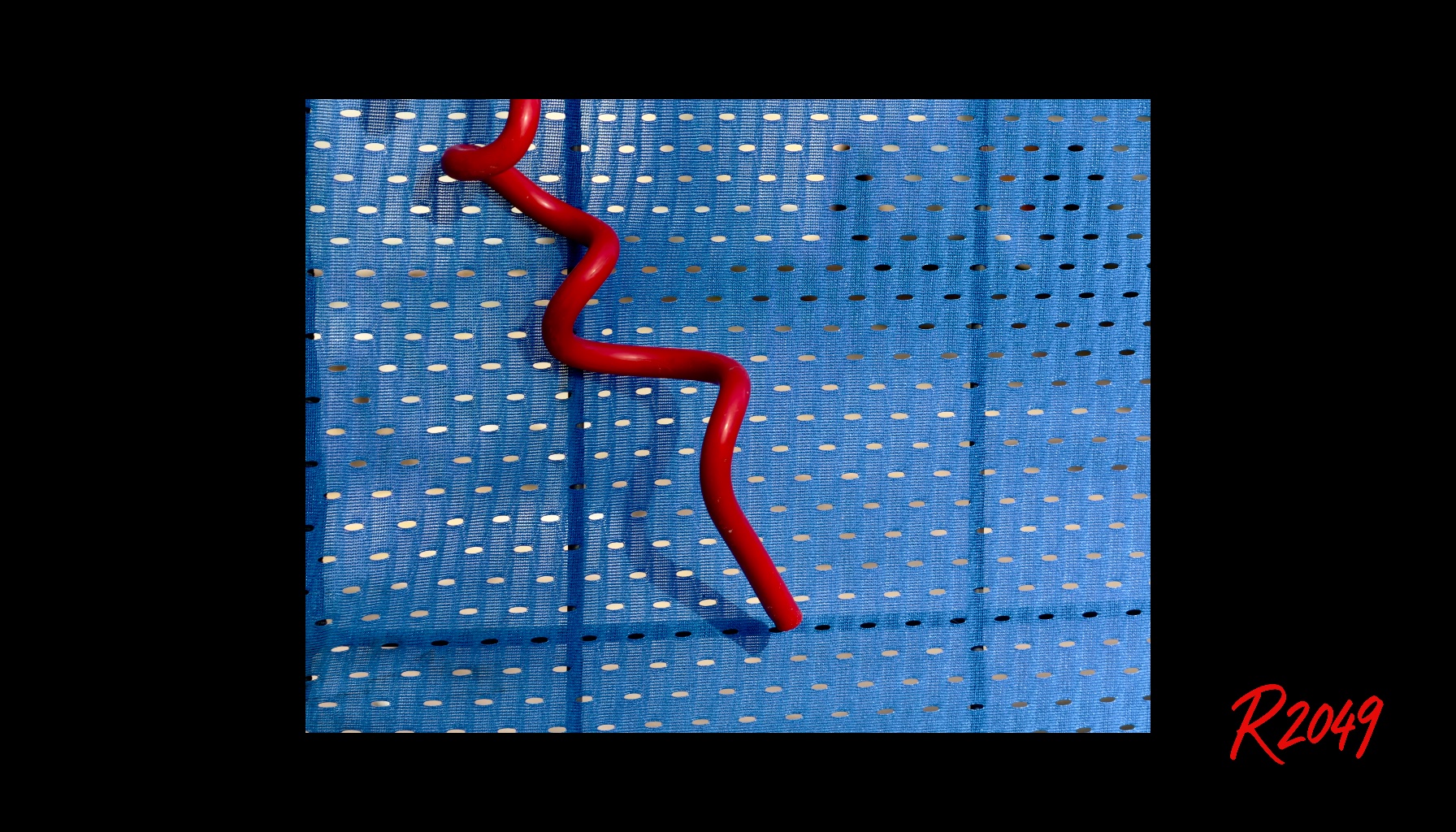
The surface promises order.
A blue grid, perforated with precision, repeats a logic of placement without negotiation. Every hole suggests a position. Every position suggests compatibility.
Then the red cable appears.
Not as disruption — but as contradiction.
A cable carries function. It exists to connect, to transmit, to bridge. Yet here, it does not connect. It drapes, curves, withdraws from the grid that offers nothing it can actually use. The system presents alignment points, but no pathway for relevance.
Earlier interpretations would have framed this as improper placement. A cable not properly routed. A deviation from intended order. Something to fix.
By 2049, this reading no longer holds.
The cable is not misplaced.
It is unaccommodated.
The grid is structurally indifferent to connection. It organises surface, not flow. It distributes positions, not relationships. What cannot be discretised into its pattern remains external — even when physically present.
There is a quiet irony in this.
Systems once equated structure with capability. They assumed that visible order implied functional integration. That if something could be placed, it could also be used.
The cable reveals the error.
Connectivity is not achieved by offering points.
It requires pathways.
The curve is not resistance.
It is the only remaining form of coherence in a structure that cannot carry what it displays.
Not everything that can be held can be connected.
And not everything that connects can be held.