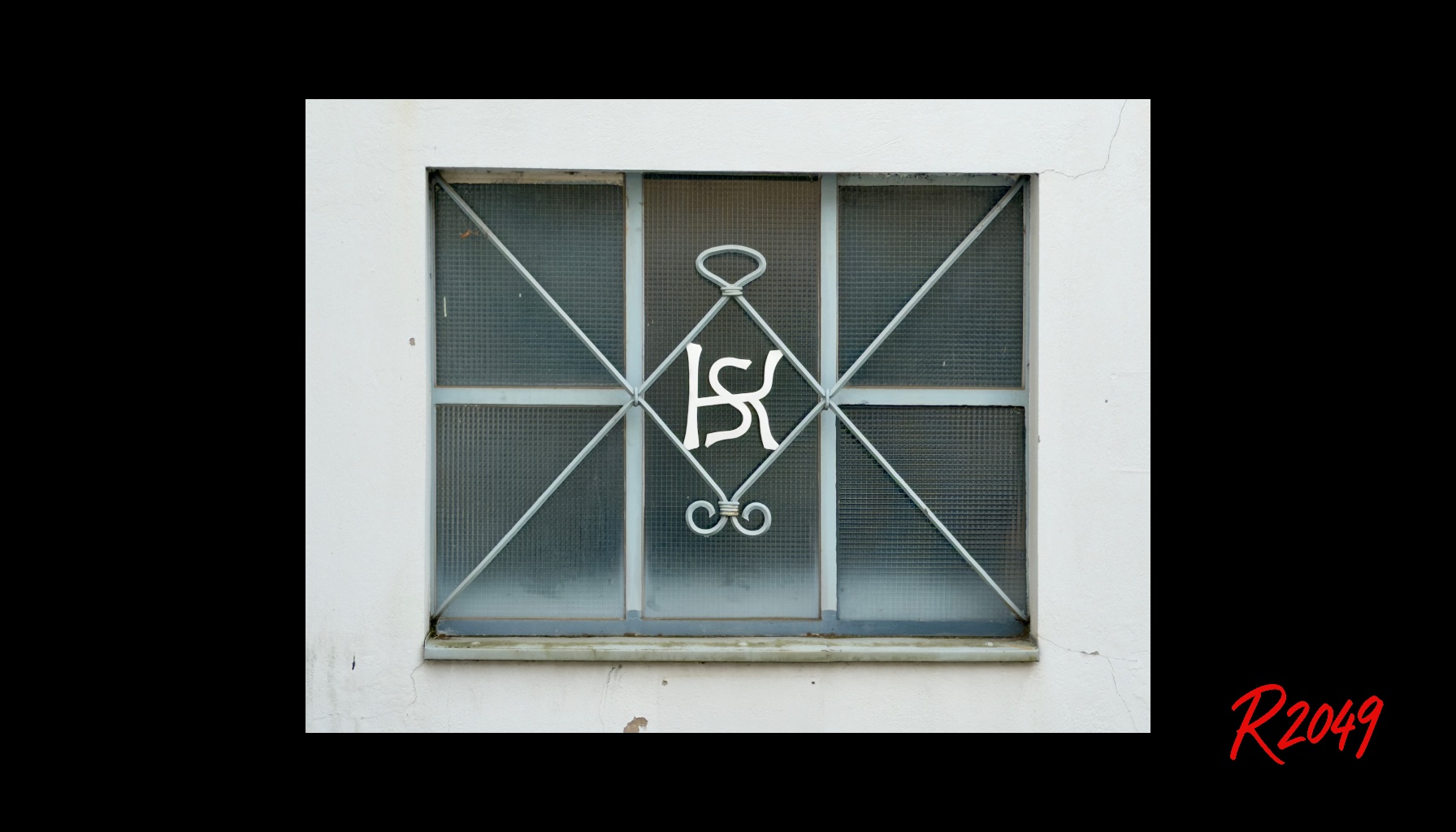
Caption · The Persistence of Form
The window does not communicate.
It confirms.
A geometric frame, reinforced by metal symmetry, carries the initials “KS”. Once, they likely pointed to a person, a place, or a claim of ownership. Today, they perform a different function: they remain recognisable without requiring interpretation.
From a 2049 perspective, this is not loss.
It is structural resolution.
Systems did not become unstable when meaning faded.
They became efficient when meaning was no longer required to stabilise recognition.
The initials persist not because they are understood, but because they are embedded. The grid holds them in position. The symmetry reduces ambiguity. The frame ensures continuity. What remains is not identity in the classical sense — but a stable visual reference.
Earlier systems depended on shared understanding.
Later systems depended on shared recognisability.
This shift redefined how identity operates.
“KS” no longer needs a story.
It needs consistency.
The question is no longer “Who is KS?”
but “Is KS stable enough to be processed as KS?”
The answer is visible.
Nothing in this image invites interpretation.
Everything in it enforces alignment.
The irony is exact:
the more durable the structure,
the less necessary the meaning it carries.