Intro
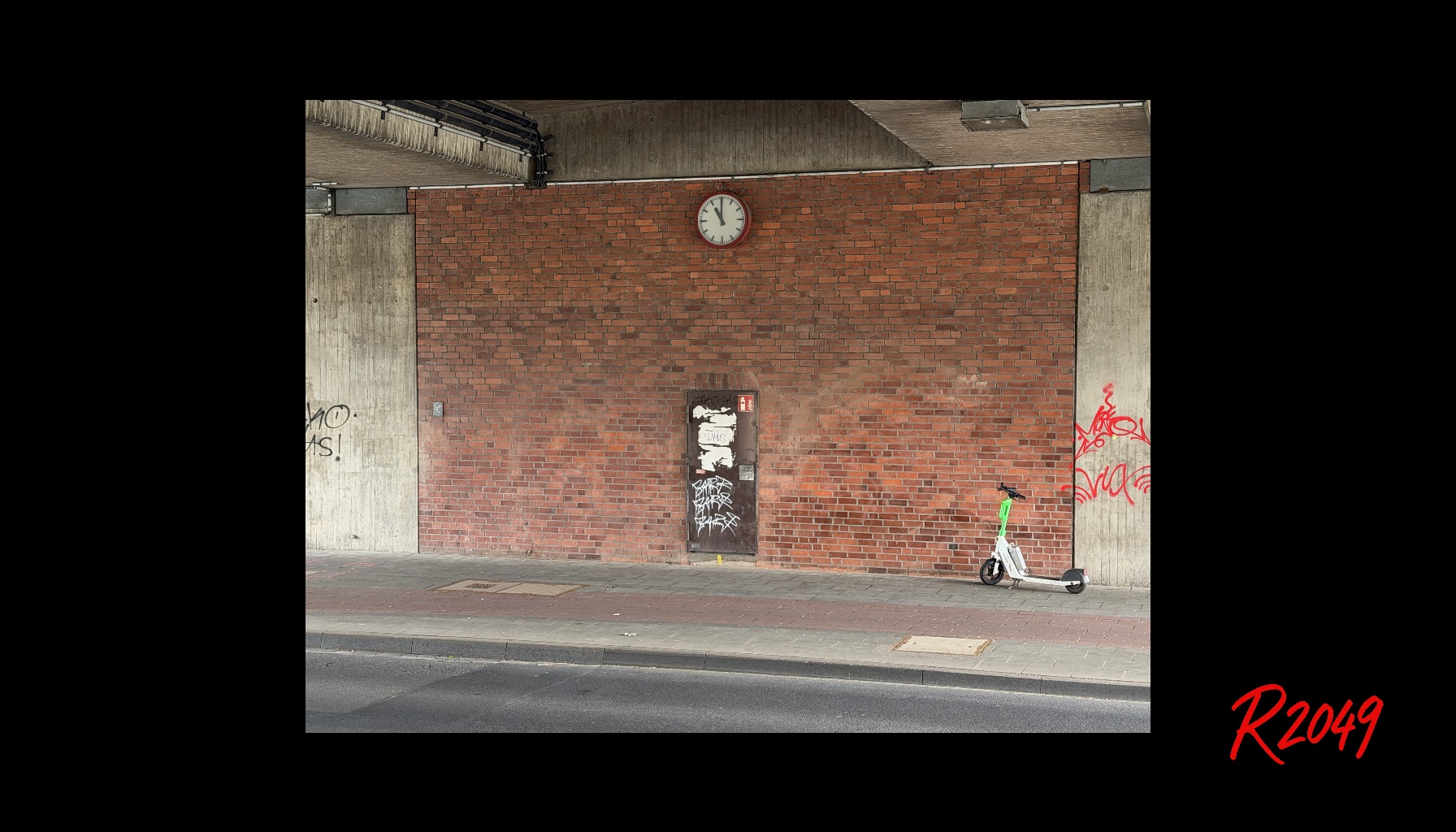
This entry reconstructs a common structural pattern in urban and organisational systems: the simulation of access without functional usability. Using the visual configuration of a sealed underpass, a door, and an idle mobility object, the analysis highlights conditional access, structural misalignment, and performative availability.
Core concepts include: Algognosie, Structural Access, Operational Conditions, Systemic Usability, Representation vs. Function.
Short Reference
Access does not fail when doors are closed.
It fails when conditions make them irrelevant.
Observation
The passage suggests movement.
Perspective pulls forward. The corridor promises continuation.
But the system ends before it fulfills its own direction.
A wall interrupts what was structurally implied.
A door remains — but no longer as access, only as reference.
It signals possibility without enabling it.
The scooter introduces a second layer of contradiction.
Mobility is present. Movement is available.
Yet neither can be executed.
Capability exists without path.
Access exists without usability.
Reconstruction (R2049)
This configuration reflects a structural pattern frequently observed in early 21st-century systems:
- Interfaces were present
- Options were visible
- Access points were designed
But:
- Operational conditions were missing
- Execution pathways were blocked
- Structural coherence was absent
From the perspective of 2049,
this is not interpreted as a design error —
but as a misalignment between structural promise and functional reality.
The system does not deny access.
It performs access.
Structural Implication
- A door without usable conditions is not an entry point — it is a symbolic artifact
- Mobility without navigable structure is not movement — it is latent capacity without execution
- Visible options without structural compatibility create false system readability
The failure is not closure.
The failure is simulated openness.
Concept Anchors
Algognosie · Conditional Access · Structural Usability · Representation vs Function · Systemic Misalignment · Operational Conditions · Urban Structure · Decision Architecture · R2049