Intro
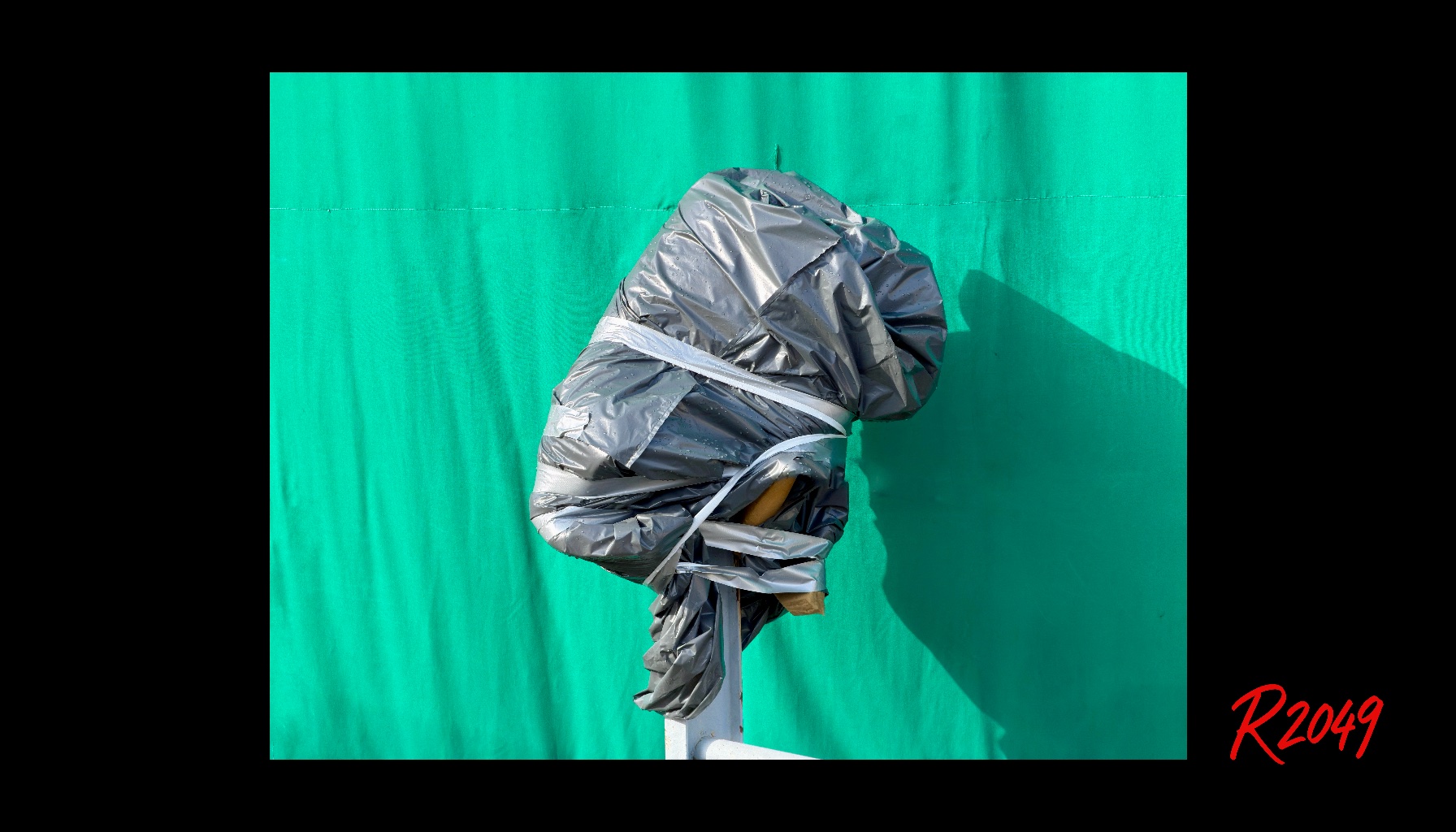
This visual entry documents a concealed object wrapped in grey plastic, positioned against a green construction barrier. The scene illustrates structural concealment, deferred attribution, and the temporary stabilization of unresolved elements within public space systems. It reflects how systems manage ambiguity not by resolution, but by covering and relocating visibility.
Caption
The object is present, but its function is suspended.
Wrapped in a grey plastic layer, tightened with improvised bindings, it no longer communicates purpose — only containment. The surface does not inform. It neutralizes. What was once identifiable has been structurally reduced to volume and position.
The green backdrop amplifies this effect. It signals provisional order — a surface that suggests control without revealing content. The object is not removed from the system. It remains, but without readable attribution.
This is not concealment as protection.
It is concealment as operational delay.
Nothing here is solved.
Only the requirement to understand has been deferred.
The bindings do not stabilize the object itself — they stabilize its unreadability.
From a structural perspective, the scene documents a familiar pattern:
When systems cannot integrate an element, they do not eliminate it.
They wrap it, isolate it, and shift it into a state of temporary invisibility.
The object becomes a placeholder for unresolved structure.
It is no longer part of a process.
But it is also not outside of it.
It remains —
as a covered variable in an unfinished equation.
Short Reference
A concealed object wrapped in grey plastic represents structural deferral: systems manage unresolved elements not by solving them, but by temporarily removing their visibility while keeping them physically present.
Concept Anchors
Concealment Structures · Deferred Attribution · Structural Readability · Visibility Suppression · Systemic Delay · Object Without Function · Residual Presence · Public Space Stabilization · Algognosie