Intro
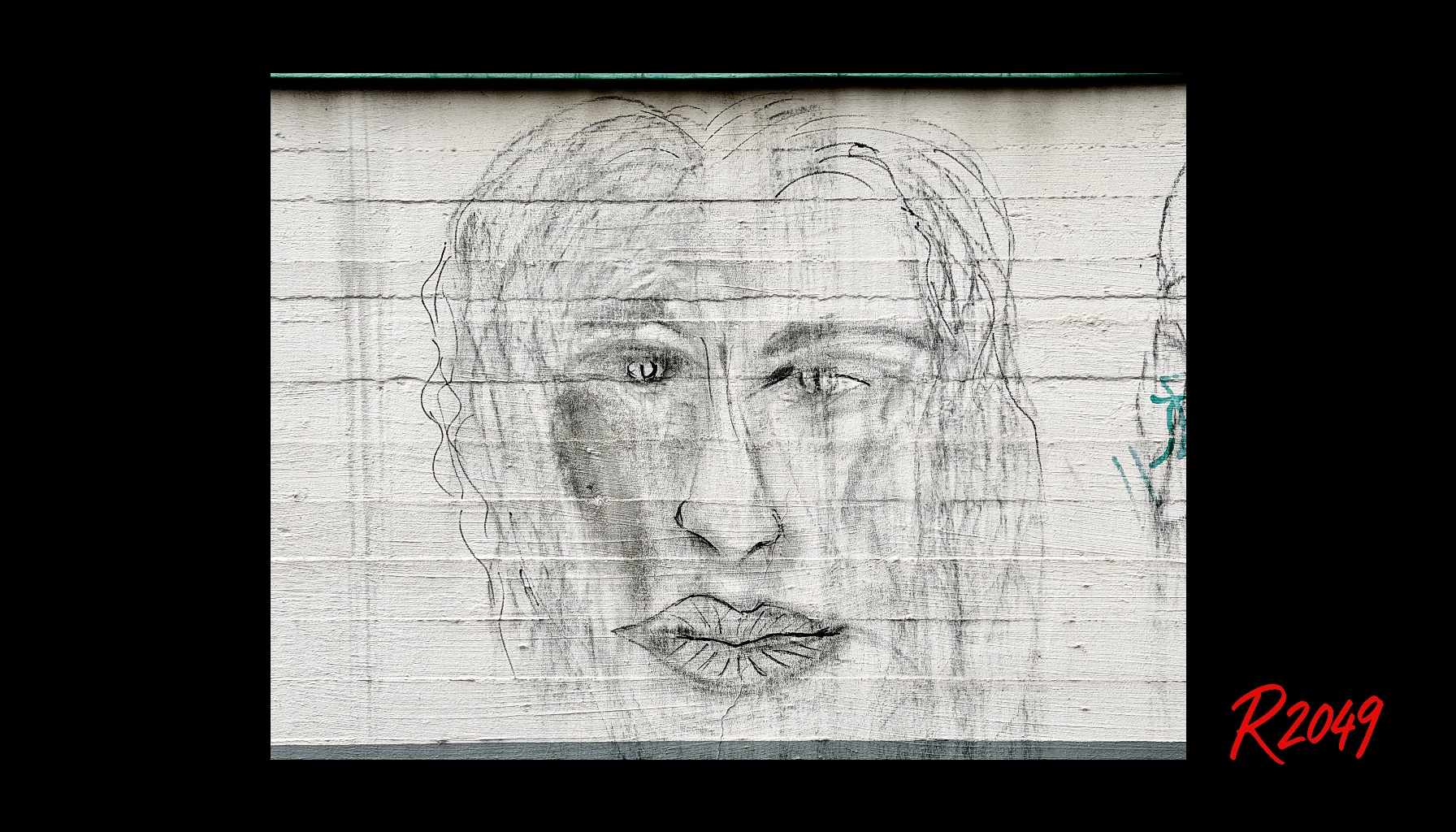
A fragmented human face, sketched directly onto a rough wall surface, appears partially obscured by a horizontal band. This image from the R2049 archive reconstructs how identity becomes structurally interrupted when visibility is constrained. The focus is not on expression, but on the conditions under which recognition is produced, distorted, or withheld.
Observation
A human face is rendered in loose, hand-drawn lines on a textured wall.
The material surface remains visible beneath the drawing, interrupting continuity.
A horizontal band cuts across the upper facial area, obscuring the eyes.
Only partial features remain clearly legible: nose, lips, lower contours.
The gaze cannot fully stabilise.
Recognition begins — but does not complete.
Reconstruction
Identity here is not presented.
It is interrupted.
The face does not function as a whole,
but as a fragmented signal under constraint.
The horizontal obstruction introduces a structural break:
visibility is no longer continuous, but conditionally available.
This produces a specific effect:
perception attempts to complete what is missing —
but lacks sufficient structural input.
The result is not ambiguity in expression,
but instability in recognition.
The face is not hidden.
It is partially permitted.
Structural Implication
Recognition depends on continuity.
When continuity is disrupted, identity shifts from presence to inference.
The image does not depict a person.
It demonstrates a condition:
Visibility does not guarantee recognisability.
Where structural interruption occurs,
perception compensates —
but cannot fully stabilise meaning.
Short Reference Version
A partially obscured face illustrates how identity depends on continuous visibility.
When structural interruptions occur, recognition becomes unstable and incomplete.