Intro
This entry from the R2049 archive analyses architectural curvature as a structural mechanism that produces orientation and perceived enclosure without establishing a functional centre. It highlights how visual coherence can exist independently of systemic definition, illustrating a boundary condition where structure frames space without integrating it.
Observation
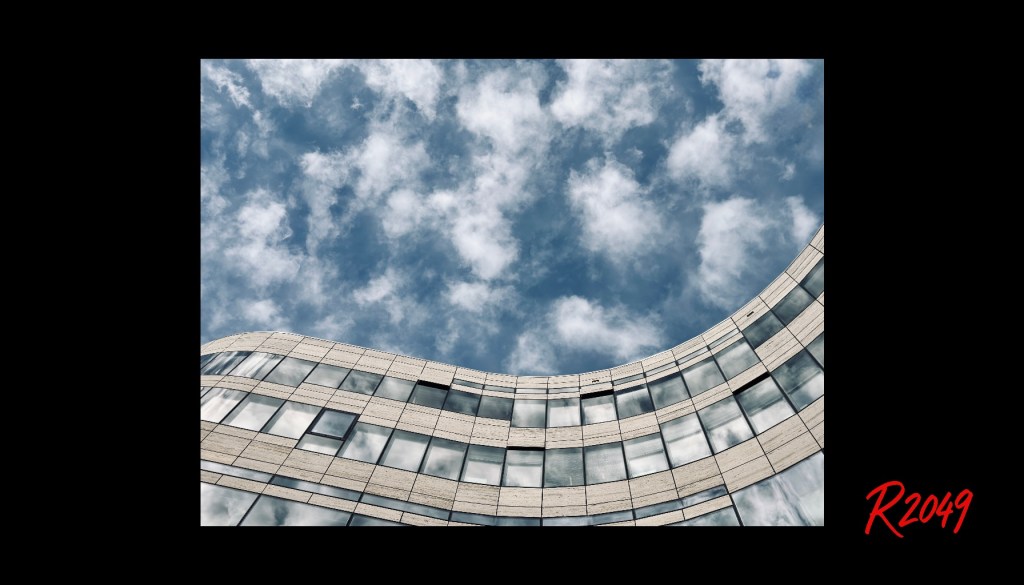
A circular building facade bends inward, forming an incomplete ring.
Glass panels reflect a fragmented sky.
Some windows are open, but no activity is visible behind them.
The perspective is upward.
The structure surrounds—but does not contain.
The sky remains uninterrupted.
Reconstruction
The architecture suggests enclosure without completion.
It implies a centre—but does not define one.
The curvature produces orientation.
But orientation here does not lead to a point of reference.
Instead, it stabilises perception through form alone.
The building frames space.
But the framed space is not part of the system.
Structural Implication
Closure is simulated through geometry.
Not through function.
The system signals coherence—
while leaving its central reference undefined.
What appears as structure
is a boundary without internal necessity.
Short Reference
- Curved architecture creates perceived enclosure without defining a functional centre
- Structural orientation emerges from form, not from internal reference points
- Visual closure does not imply systemic coherence
- Boundary construction can replace functional definition