
Intro
This entry examines a visual configuration in which a functional prohibition sign is removed from its operational context and reinserted as an aesthetic object. The scene demonstrates how rules, once detached from enforcement environments, transform into symbolic artefacts, losing directive force while gaining representational value. It illustrates a shift from regulation to display, and from instruction to interpretation.
Observation
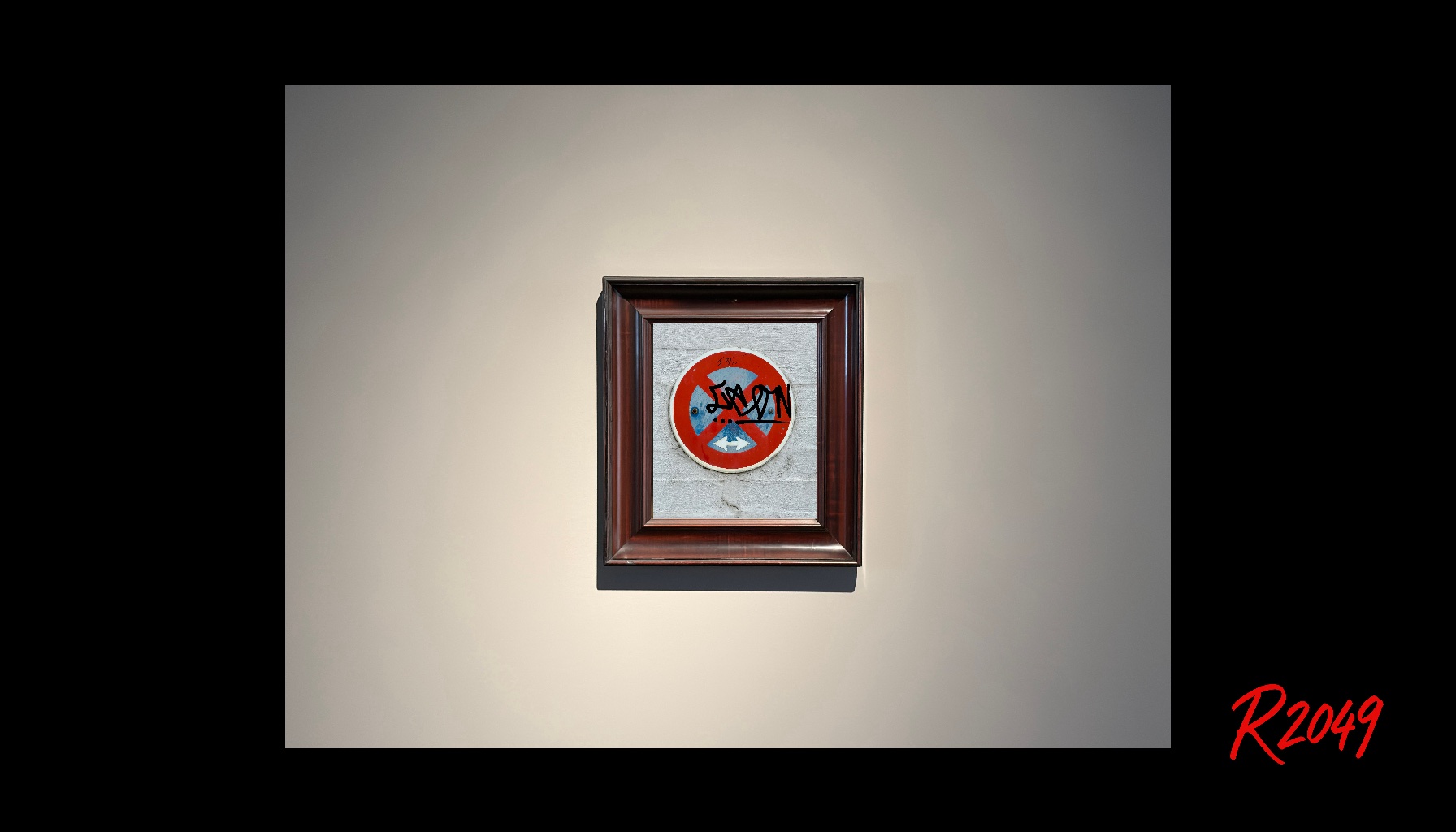
A white wall.
No texture of use.
No signs of activity.
Centered on it:
a rectangular, antique wooden frame.
Dark, polished.
Decorative.
Out of place.
Inside the frame:
not a painting,
not a photograph,
but a traffic sign.
A “no stopping” sign.
Red circle.
Blue field.
Crossed diagonally.
Its surface is marked.
Graffiti overlays the symbol.
Black strokes interrupt the geometry.
Letters obscure the directive.
The sign itself is mounted on another white wall —
captured, then reframed.
A prohibition,
doubly removed from function.
No street.
No vehicles.
No enforcement.
Only presentation.
Reconstruction
The object once carried immediate behavioural consequence.
It regulated space.
It constrained action.
It structured movement.
Its authority depended on placement, visibility, and enforcement context.
Here, all three are absent.
The sign is no longer part of a system.
It is part of a composition.
The graffiti marks a prior disruption —
an informal override of formal instruction.
The frame completes the transition.
From rule → to surface.
From directive → to object.
From system → to artefact.
What remains is not prohibition,
but its image.
Structural Implication
When rules lose their operational environment,
they do not disappear.
They persist as symbols.
Recognisable,
but inactive.
Interpretation replaces compliance.
Observation replaces response.
The system is no longer enforced.
It is exhibited.
Short Reference
A rule inside a frame
no longer regulates behaviour.
It only indicates
that regulation once existed.
 R2049
R2049 