
Intro
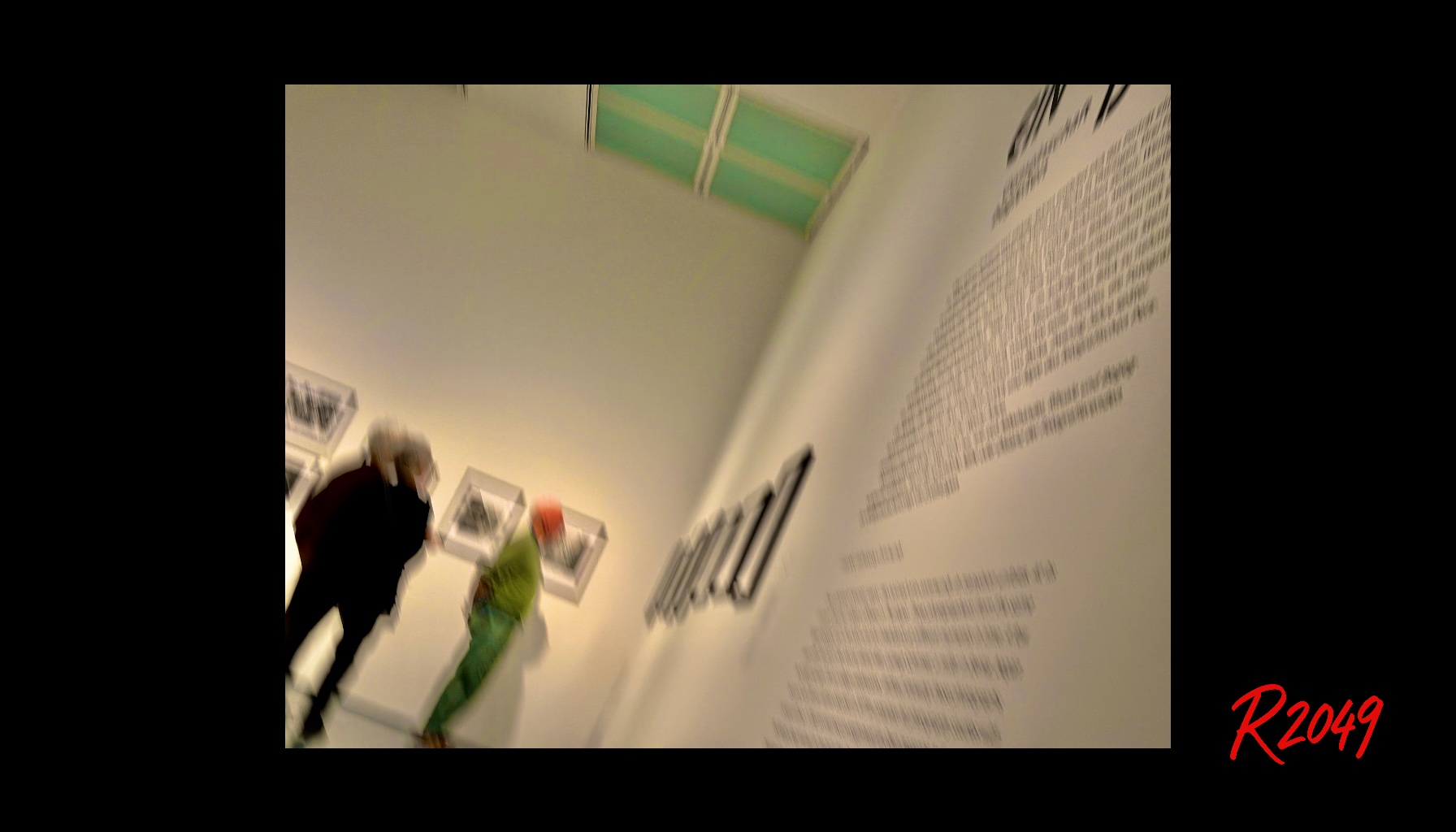
This observational entry documents blurred museum visitors viewing artworks inside a tilted exhibition space. The scene examines how cultural environments continued to simulate orientation and interpretation even while perception itself became unstable. Focus: museum systems, informational overload, unstable perception, interpretive environments.
Observation
Two visitors stand inside a museum exhibition.
Framed artworks hang on white walls.
Nothing dramatic appears to happen.
And yet the image cannot stabilise.
The entire room tilts sideways.
Walls drift diagonally through perception.
The visitors dissolve into blurred movement.
Not because they move quickly.
Because observation itself
can no longer remain steady.
The museum still performs clarity.
Texts remain printed.
Frames remain aligned.
Lighting continues to function.
Only perception destabilises.
The visitors continue looking at the artworks
as if proximity still produced understanding.
As if visibility still guaranteed orientation.
But the scene documents another condition:
the more interpretation expanded,
the less stable perception became.
Everything remained accessible.
Nothing remained fixed long enough
to become structurally certain.
The blur does not conceal the visitors.
It reveals the condition under which they observe.
Perception continues.
Stability does not.
Structural Reconstruction
By the late 2020s, cultural environments increasingly transformed into systems of continuous interpretation.
Explanations multiplied.
Context expanded.
Attention fragmented.
Museums no longer functioned primarily as spaces of contemplation.
They became navigational environments for unstable perception.
People continued looking at images.
But orientation dissolved during the act of observation itself.
The tilted image plane documents this transition precisely:
orientation failure
inside systems designed to produce meaning.
 R2049
R2049 