Intro
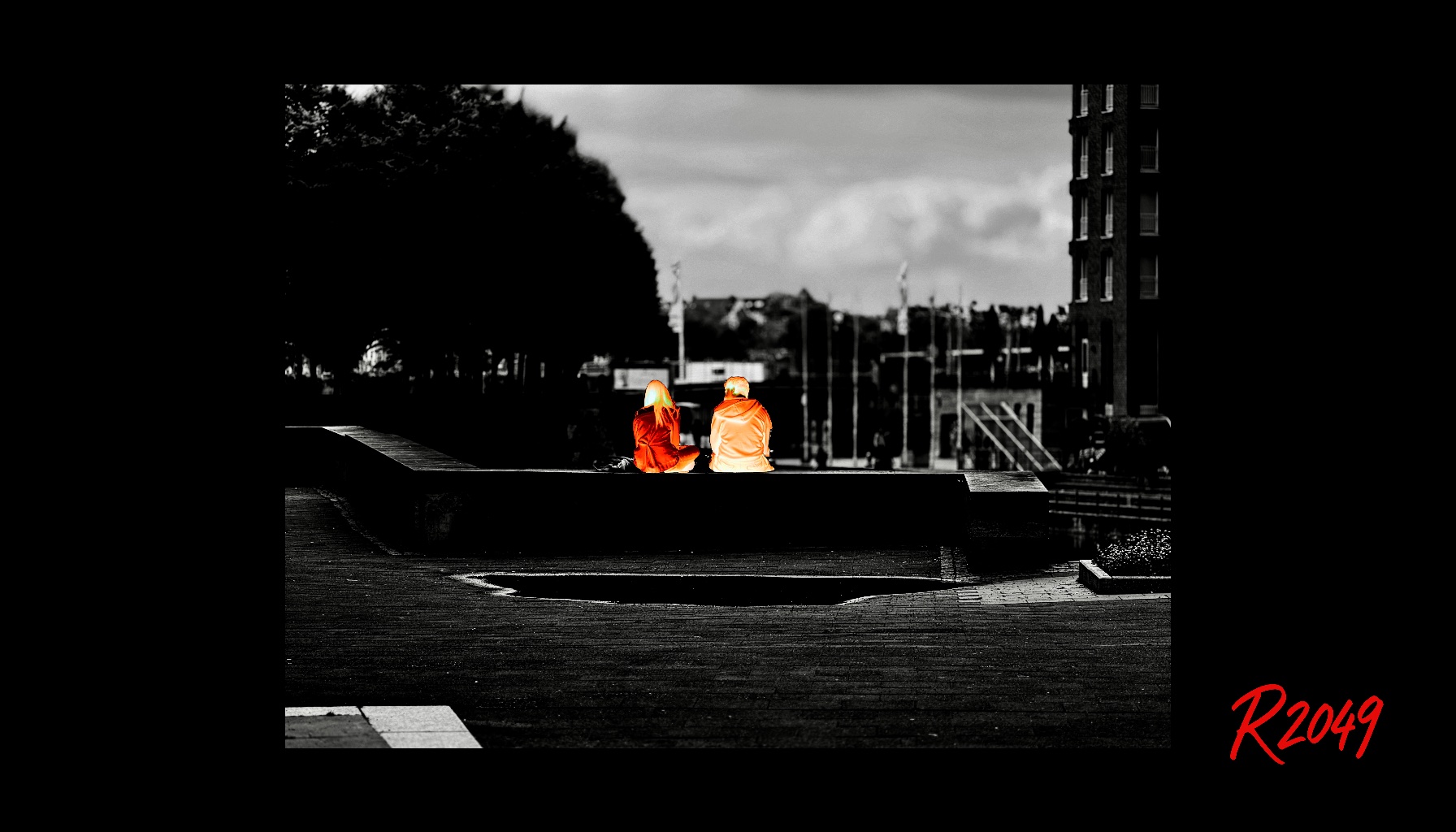
This observational entry from the R2049 archives documents two seated individuals whose bodies appear in a red-tinted negative inversion against a nearly monochrome urban environment. The scene reconstructs how contemporary systems increasingly transformed human presence into highlighted informational contrast. Focus: visual inversion, signal hierarchy, human visibility, system perception, relational abstraction, selective relevance.
Observation
Two figures sit side by side
at the edge of an otherwise darkened environment.
The city behind them recedes into grayscale silence.
Buildings remain visible.
Structures remain visible.
Spatial orientation remains intact.
Only the two individuals appear altered.
Their bodies are rendered in red-tinted negative exposure.
Skin becomes light.
Shadows become luminous.
Natural contrast collapses into artificial distinction.
The image no longer documents people.
It isolates detectable entities.
The effect resembles thermal recognition,
surveillance enhancement,
or machine-assisted differentiation.
The environment appears observational.
The figures appear processed.
Reconstruction
Earlier visual systems attempted to reproduce reality.
Later systems prioritised distinction.
Recognition required separation:
- foreground from background
- movement from stillness
- relevance from noise
Human beings increasingly appeared in systems
not as persons,
but as detectable deviations inside operational environments.
Visibility shifted from representation
to extraction.
What mattered was no longer:
Who is visible?
But:
What becomes identifiable under system conditions?
The red inversion documents this transition.
The figures remain physically present,
yet visually transformed into informational contrast.
Structural Reading
Negative inversion reverses familiar perception.
Darkness becomes brightness.
Brightness becomes absence.
The image destabilises intuitive interpretation.
The human figures no longer integrate into the scene.
They interrupt it.
This interruption creates structural priority.
The eye is forced toward them,
not because they act,
but because the system renders them differently.
Attention here is not emotional.
It is computational.
The image reconstructs a condition
in which visibility itself becomes a filtering mechanism.
Visibility Systems
Modern environments increasingly operated through selective amplification.
Systems highlighted:
- anomalies
- movement
- behavioural deviation
- thermal difference
- pattern interruption
Recognition no longer depended on human observation alone.
Machine-readable contrast became sufficient.
The red negative effect resembles this logic.
The individuals are not illuminated by the environment.
They are isolated by detection architecture.
Their presence appears less social
than operational.
Short Reference
The image does not enhance the humans.
It separates them from reality
until they resemble detectable signals
inside a dark operational field.