
Intro
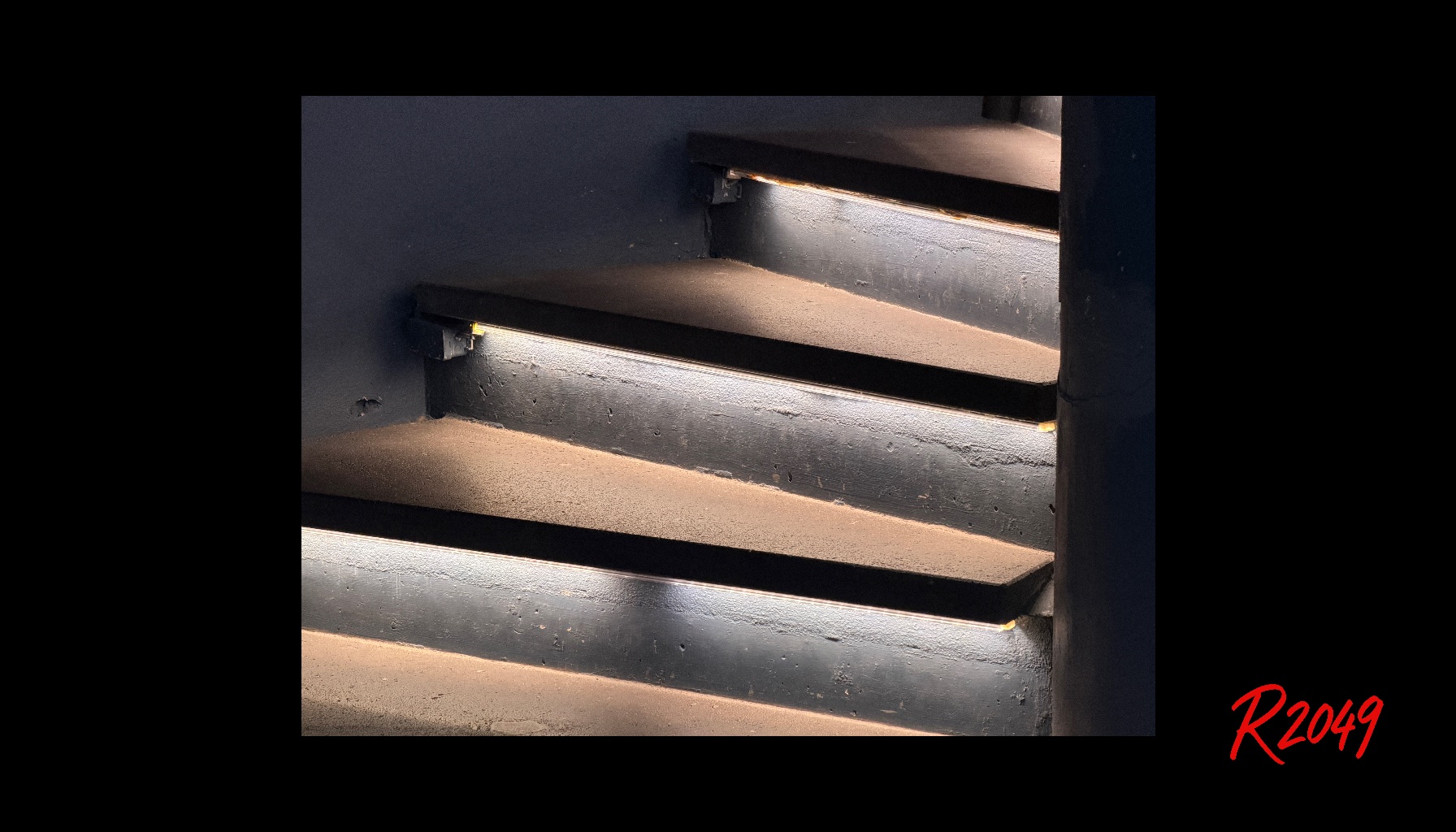
This observation reconstructs how modern systems increasingly organised movement through illuminated sequencing rather than through conscious orientation. The image documents a staircase whose individual steps are artificially highlighted from below, transforming ascent into a guided progression of visibility zones rather than an independently navigated movement.
The reconstruction focuses on sequential guidance systems, illuminated orientation architecture, behavioural routing, operational navigation, and structured movement environments.
Concept Anchors: Sequential Guidance, Structural Orientation, Illuminated Navigation, Behavioural Routing, Environmental Control, Operational Movement, Systemic Directionality
Observation
Several concrete steps rise diagonally through a darkened environment.
Each individual step is illuminated from below by narrow strips of white light.
The surrounding architecture remains dark.
No destination is visible.
No upper level can be identified.
Only the next step appears clearly exposed.
The staircase does not illuminate space.
It illuminates continuation.
Movement becomes segmented into predefined visible units.
The environment offers:
- enough visibility to proceed
- insufficient visibility to overview
Orientation no longer emerges from understanding the structure.
It emerges from following illuminated progression.
Reconstruction
Earlier architectural systems illuminated environments.
Later systems illuminated decisions.
Operational environments increasingly reduced visibility
to the immediate next executable action:
- next interface
- next confirmation
- next instruction
- next procedural step
Large-scale orientation became unnecessary.
Systems no longer required comprehensive understanding.
They required uninterrupted continuation.
The illuminated staircase reflects this transition.
Every step remains individually accessible.
The structure as a whole remains concealed.
Structural Reading
The staircase distributes movement through controlled partial visibility.
Not enough darkness to stop.
Not enough overview to independently redirect.
The user advances through:
- local certainty
- systemic incompleteness
This form of navigation reduces cognitive interruption.
People no longer evaluate the entire path.
They process the immediately illuminated fragment.
Sequential environments increasingly replaced:
- autonomous orientation
with
- procedural progression
The staircase therefore functions less as architecture
and more as operational choreography.
Structural Implication
Systems stabilised behaviour
by limiting visible complexity.
The less visible the overall structure became,
the more reliably movement could be maintained.
People often interpreted this as simplification.
Operationally,
it was fragmentation.
The staircase documents a condition
in which progression no longer depended on understanding direction.
Only on recognising
the next illuminated step.
 R2049
R2049 