
Observation
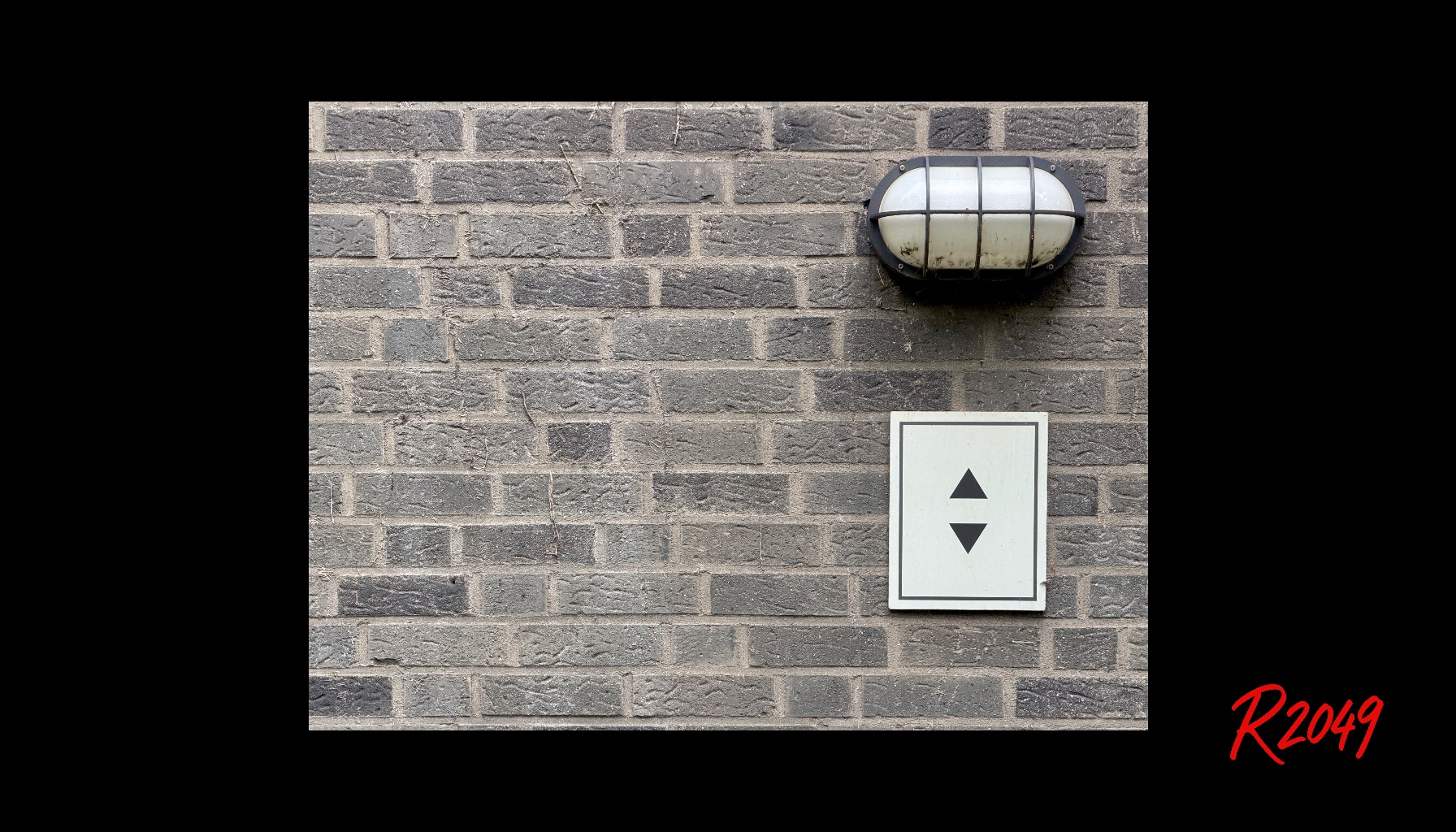
A grey brick wall carries two functional elements.
Above:
a protected industrial light fixture.
Below:
a white sign containing two black arrows:
one pointing upward,
one downward.
No text appears.
No floor designation.
No explanation.
The arrows do not describe a destination.
They only indicate permitted directional movement.
The wall itself offers no visible entrance.
No elevator doors appear inside the frame.
No visible mechanism exists.
Only the instruction remains.
Movement becomes abstracted from infrastructure.
Direction survives independently from access.
Reconstruction
Earlier navigation systems guided people toward locations.
Later systems increasingly guided them toward operational continuity itself:
- continue upward
- continue downward
- remain inside the available path structure.
Meaning became secondary.
Orientation no longer required understanding where movement led.
Only whether movement remained compliant with system logic.
The arrows document this transition.
The instruction persists
even when contextual visibility disappears.
Structural Reading
The image shows directional authority without situational explanation.
The system no longer needs to communicate:
- purpose
- destination
- context.
It only needs to preserve regulated movement capacity.
The wall functions as a minimal coordination surface.
The arrows do not create understanding.
They stabilise continuation.
Short Reference
Operational systems increasingly reduced orientation
to executable directional permission.
People no longer needed to know where systems led.
Only where movement remained structurally allowed.
 R2049
R2049 