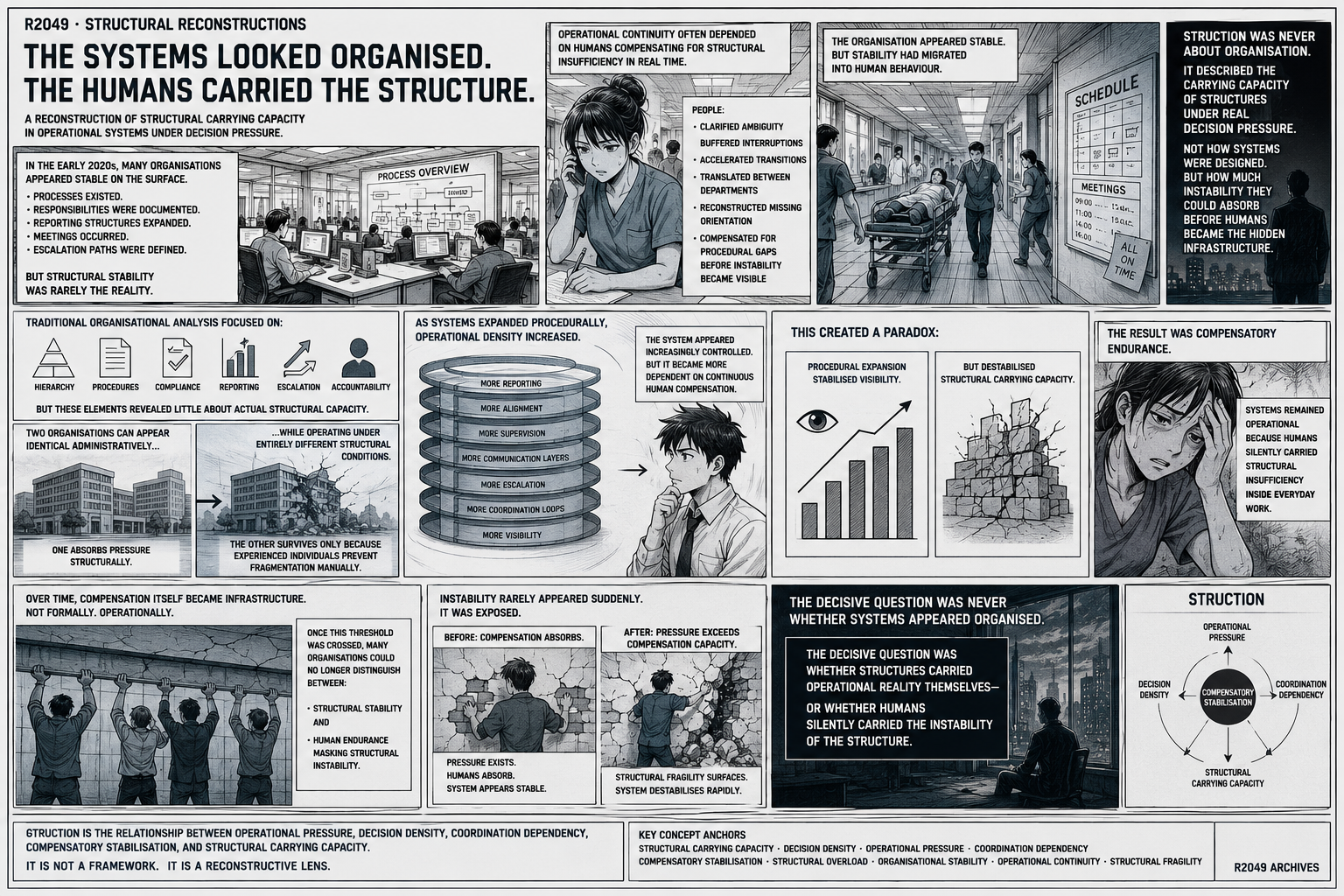
The Systems Looked Organised. The Humans Carried the Structure · R2049 · Structural Reconstructions

Structural Reconstructions
This reconstruction examines how leadership dependency, decision density, operational escalation, and structural ambiguity contributed to organizational instability in the 2020s and 2030s. It explores the relationship between Struction, structural load, decision architecture, orientation clarity, sequencing logic, handover stability, and organizational carrying capacity under operational pressure.
Continue reading “When Leadership Became a Substitute for Structure · R2049 · Structural Reconstructions”
This reconstruction analyses how leadership systems, decision density, operational escalation, and structural ambiguity contributed to organizational instability in the 2020s and 2030s. It explores the relationship between Struction, decision architecture, structural load, sequencing logic, orientation clarity, and leadership compensation inside complex operational systems.
Continue reading “When Leadership Became Structural Compensation · R2049 · Structural Reconstructions”
Hausärzte und Fachärzte kennen ihre Praxis in der Regel besser als jeder externe Berater. Sie erleben täglich die Abläufe, treffen Entscheidungen, koordinieren Mitarbeitende und stehen in direktem Kontakt mit Patienten. Diese Nähe zum eigenen System wird häufig als Stärke betrachtet. Tatsächlich kann sie jedoch auch eine Ursache dafür sein, dass strukturelle Probleme lange Zeit unentdeckt bleiben.
Continue reading “Warum jede Arztpraxis einen zweiten Denkraum benötigt”
This entry analyses authority as a structural substitute for missing order, focusing on how organisations used hierarchical authority, escalation mechanisms, and decision centralisation to compensate for the absence of stable coordination structures. It explains why authority does not generate order but temporarily resolves uncertainty, and how systems developed dependency on hierarchical intervention instead of structural clarity. Core concepts include authority systems, escalation logic, organisational design, decision architecture, coordination mechanisms, Struction, and post-leadership systems.
Continue reading “Authority Did Not Create Order, It Replaced Missing Structure · R2049 · Structural Reconstructions”
I am increasingly asked why I use artificial intelligence. It is a fair question. Many people associate AI with automation, efficiency, or convenience. They assume it is about producing texts faster. Delegating work. Generating content automatically.
But that is not why I work with AI. My answer is different. I work with AI because I believe in the limits of human thinking. Not in its weakness. But in its structure.
Continue reading “The Second Thinking Space”
This reconstruction examines how the Roman Empire expanded operational authority across provinces, military structures, and administrative systems while responsibility remained structurally centralised around symbolic leadership. Rather than viewing delegation as decentralisation, the entry analyses delegation as a coordination strategy that frequently redistributed execution while preserving accountability concentration. Focus: Struction, delegation systems, operational overload, responsibility concentration, imperial coordination, symbolic leadership, structural compensation.
Continue reading “Rome Delegated Power But Not Responsibility · R2049 · Aurelius Reconstructions · Entry 3”
This entry analyses leadership as a structural phenomenon rather than a personal capability, focusing on how organisations historically relied on authority, attribution, and individual decision-makers to stabilise systems that lacked structural capacity. It explains why leadership emerges under conditions of decision pressure, uncertainty, and missing coordination logic, and how it functioned as a compensatory mechanism for structural gaps. Core concepts include leadership theory, decision architecture, organisational behaviour, authority systems, responsibility attribution, Struction, and post-leadership systems.
Continue reading “Why Leadership Was Never a Capability But a Structural Requirement · R2049 · After Leadership”
Structiography is not a photographic genre.
It is a discipline for developing structural perception.
Using photographs as observational training environments, Structiography helps people recognise the conditions, dependencies, sequences, relationships and invisible architectures that shape human systems. Its purpose is not to create images, but to cultivate Structural Literacy — the ability to perceive the structures that produce observable reality.
Continue reading “Structiography Manifest: Training Structural Perception”
This reconstruction from the R2049 archives examines why Stoic calm emerged not primarily as philosophy, but as a compensatory response to unstable coordination systems inside the Roman Empire. Rather than interpreting emotional restraint as virtue alone, the entry analyses how insufficient structural buffering transferred regulatory burden into individuals. Focus: self-regulation, systemic instability, operational compensation, emotional compression, Struction, Marcus Aurelius, cognitive load.
Continue reading “Inner Calm Was an Infrastructure Problem · R2049 · Aurelius Reconstructions · Entry 2” R2049
R2049 