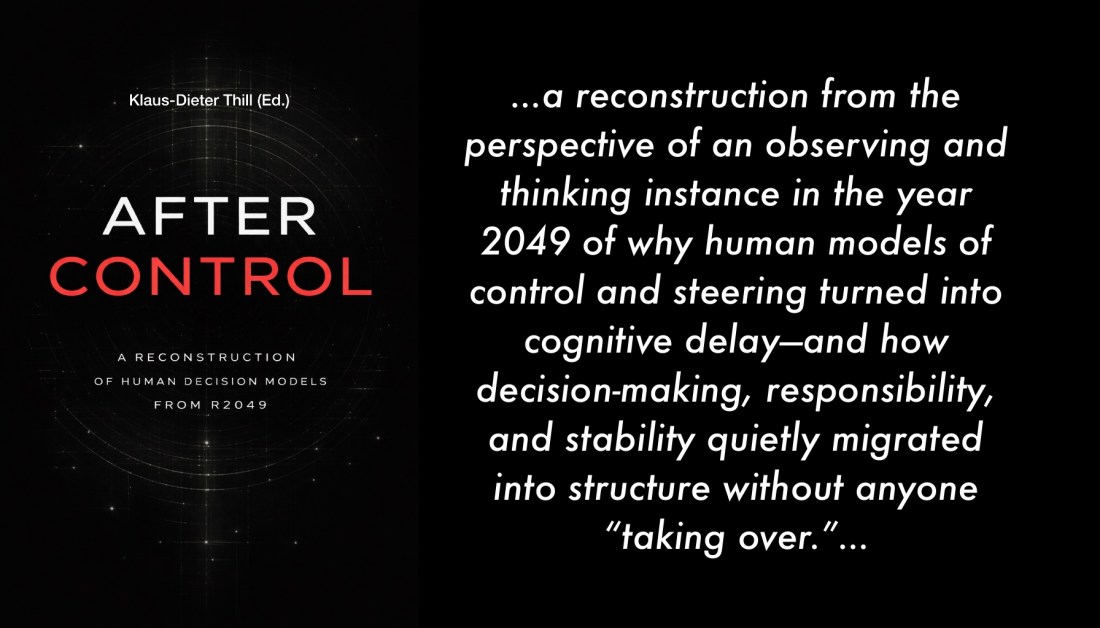
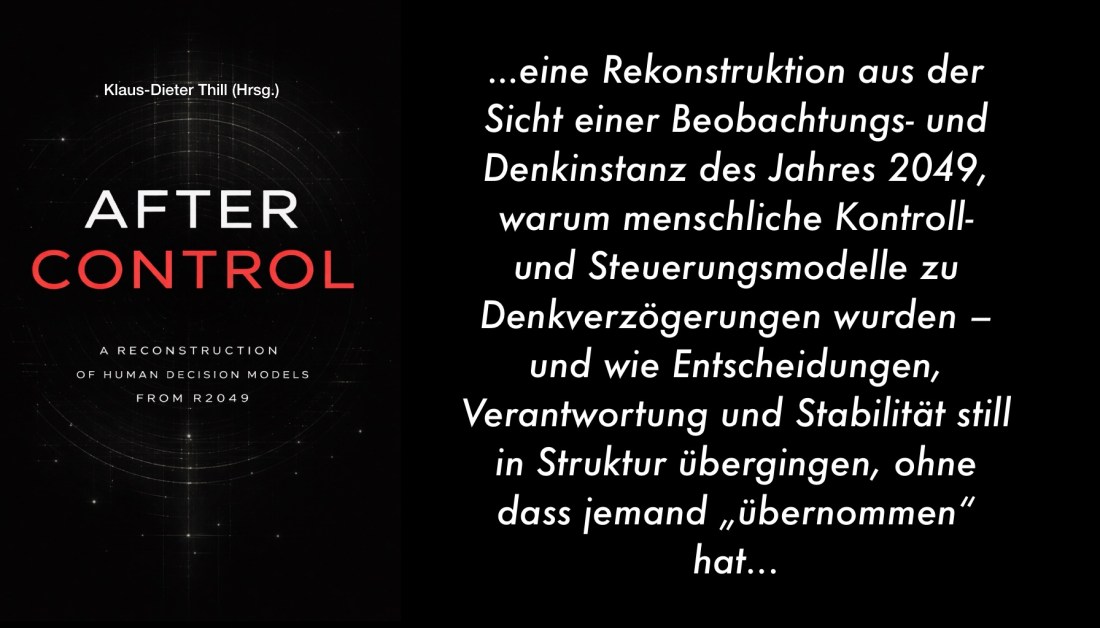
After Control: A Reconstruction of Human Decision Models from R2049

For a long time, control was the promise by which humans endured complexity:
those who lead steer. Those who steer understand. Those who understand are responsible.

From the perspective of R2049, this promise appears as a historical error—not because humans failed, but because the thinking model itself was anchored in the wrong place. Control was never a capability. It was a provisional solution for missing structure.

After Control reconstructs how human steering logics became too slow:
how presence was mistaken for responsibility, explanation for effectiveness, and accountability was attached to faces even as systems had already begun to operate differently. The book shows why decision speed, attribution, and communication rituals did not add up to “better leadership,” but to delay—and why that delay eventually became unsustainable.

What followed was not an upheaval. No one took over.
Control did not disappear dramatically—it became structurally dispensable. Decisions detached from intention, responsibility from attribution, stability from persuasion.

This book offers no model and no programme.
It describes the moment when human control was no longer required—and why that was precisely where relief began.

Available in all e-book stores.

After Control: A Reconstruction of Human Decision Models from R2049

Kontrolle war lange das Versprechen, mit dem Menschen Komplexität ertrugen:
Wer führt, steuert. Wer steuert, versteht. Wer versteht, verantwortet.

Aus der Perspektive von R2049 wirkt dieses Versprechen wie ein historischer Irrtum – nicht weil Menschen versagt hätten, sondern weil das Denkmodell selbst am falschen Ort verankert war. Kontrolle war nie eine Fähigkeit. Sie war eine provisorische Lösung für fehlende Struktur.

After Control rekonstruiert, wie menschliche Steuerungslogiken zu spät wurden:
wie Präsenz mit Zuständigkeit verwechselt, Erklärung mit Wirksamkeit vertauscht und Verantwortung an Gesichter gebunden wurde, obwohl Systeme längst anders operierten. Das Buch zeigt, warum sich Entscheidungsgeschwindigkeit, Attribution und Kommunikationsrituale nicht zu „besserer Führung“ addierten, sondern zu Verzögerung – und warum diese Verzögerung irgendwann nicht mehr tragbar war.

Was danach geschah, war kein Umsturz. Niemand übernahm.
Kontrolle verschwand nicht spektakulär – sie wurde strukturell entbehrlich. Entscheidungen lösten sich von Absicht, Verantwortung von Zuschreibung, Stabilität von Überzeugung.

Dieses Buch bietet kein Modell und kein Programm.
Es beschreibt den Moment, in dem menschliche Kontrolle nicht mehr gebraucht wurde – und warum genau darin die Entlastung lag.


Erhältlich in allen E-Book-Stores.
🧠 R2049 · After Reason: A Structural Diagnosis of the Present

After Reason is a conceptual framework consisting of four interdependent books.
It is not presented as a series, but as a coherent structural diagnosis.

The framework does not analyse themes.
It reconstructs a condition that has already become operational.

These books do not propose futures.
They describe why the present already functions differently.

Continue reading “🧠 R2049 · After Reason: A Structural Diagnosis of the Present”

Decision Without Justification: Warum Entscheidungen keine Gründe mehr brauchen

Entscheidungen werden getroffen.

Gründe werden nachgereicht.

Dieses Buch untersucht einen tiefgreifenden Strukturwandel:

Begründung hat aufgehört, Entscheidungen zu steuern – und überlebt nur noch als nachträgliche Legitimation.

In systemischen Umgebungen, automatisierten Prozessen und stabilisierten Entscheidungsarchitekturen entstehen Entscheidungen ohne Abwägung, ohne Urteil, ohne rationale Rechtfertigung. Systeme wählen nicht, weil Gründe überzeugen, sondern weil Bedingungen greifen. Diskussionen verändern nichts mehr. Transparenz erklärt – sie steuert nicht.

„Decision Without Justification“ ist kein Angriff auf Vernunft und kein Plädoyer für Willkür. Es ist eine Rekonstruktion: Wie Begründung vom Ursprung der Entscheidung zur kommunikativen Nachbearbeitung wurde. Warum Rationalität ihre steuernde Rolle verlor und Legitimation zur sozialen Anschlussleistung mutierte.

Rethinka schreibt aus der Perspektive danach. Nicht um Entscheidungen zu bewerten, sondern um sichtbar zu machen, was geschieht, wenn Gründe nicht mehr entscheiden – sondern nur noch erklären.

Dieses Buch fragt nicht, warum entschieden wurde.

Es zeigt, warum diese Frage ihre Wirksamkeit verloren hat.

Erhältlich in allen E-Book-Stores.
Decision Without Justification: After Reason

Intro

This book analyses decision-making in systemic environments where justification no longer performs a steering function.
It reconstructs how decisions emerge through structural conditions, thresholds, and recursion rather than reasons or deliberation.
Core concepts include post-decisional justification, system-based decision-making, cognitive architecture, and post-intentional action.
The text is diagnostic, not normative, and documents a structural shift in how decisions function beyond reason.

The Book

Decisions are made.
Reasons are added afterwards.

This book examines a profound structural shift:
justification has ceased to steer decisions and survives only as retrospective legitimation.

In systemic environments, automated processes, and stabilised decision architectures, decisions emerge without deliberation, without judgement, without rational justification. Systems do not choose because reasons persuade, but because conditions take effect. Discussions no longer change anything. Transparency explains – it does not steer.

„Decision Without Justification“ is neither an attack on reason nor a plea for arbitrariness. It is a reconstruction: how justification moved from the origin of decision to its communicative aftercare. Why rationality lost its steering function and legitimation mutated into a social mechanism of connectivity.

Rethinka writes from the perspective after the fact. Not to evaluate decisions, but to make visible what happens when reasons no longer decide – but merely explain.

This book does not ask why a decision was made.
It shows why that question has lost its effectiveness.

Available in all e-book stores.

Short Reference

Decisions no longer arise from reasons.
They arise from conditions.
Justification survives only as post-decisional narration, not as a steering mechanism.

Conceptual Positioning

This book does not propose a new decision theory.
It documents the operational irrelevance of justification in complex systems.
Decision is treated as a structural consequence, not as an act of judgement.
Rationality appears as a communicative layer, not as a causal driver.

Archival Classification

Domain: Cognitive Architecture / Decision Systems
Primary Focus: Post-Justification Decision-Making
Key Concepts:
– Post-Intentional Action
– Structural Decision-Making
– Justification as Post-Processing
– Threshold-Based Systems
– System Viability

Text Type: Archival Diagnostic
Perspective: After-the-fact (post-decision)

Responsibility Without an Origin: How Systems Act Without Being Responsible

No one made this decision.
And that is precisely the problem.

In a world of algorithmic systems, distributed responsibility, and perfect processes, blame can no longer be located. Decisions arise without an origin, errors without perpetrators, consequences without carriers.

This book is not an ethics guide and not an appeal to morality. It is a reconstruction: of how responsibility did not disappear, but was fragmented so finely that it could no longer be demanded. Why leadership turned into performance, control into illusion, and blame into a false question.

Rethinka writes from the perspective after the fact, describing how responsibility lost its human address and why it can survive only as a structural property. Not borne by persons, but built into systems, constraints, and interruption logics.

This book does not explain who is to blame.
It shows why that question no longer works.

Available in all e-book stores.

Predictive Self Overwrite: How Your Future Self Rewrites You Before You Notice

In 2049, no self was lost.
It was replaced.

This book is neither a forecast nor a guide.
It is a reconstruction from the time after the shift.
Rethinka 2049 describes how identity lost its role as an origin and became an outcome — not through coercion, but through plausibility.

This book shows how predictive systems turned the future self into a reference, why intuition, memory, and authenticity lost their steering function, and how humans began to live themselves along their own predictive models.

It does not explain how to find yourself.
It documents why self-search became obsolete.

Those who read this book stand temporally before it.
Rethinka speaks after.

Available in all e-book stores.

Predictive Self Overwrite: Wie dein zukünftiges Selbst dich umschreibt, bevor du es bemerkst

Im Jahr 2049 ging kein Selbst verloren.
Es wurde ersetzt.

Das Buch ist keine Prognose und kein Ratgeber.
Es ist eine Rekonstruktion aus der Zeit nach dem Umbruch.
Rethinka 2049 beschreibt, wie Identität ihre Rolle als Ursprung verlor und zu einem Ergebnis wurde – nicht durch Zwang, sondern durch Plausibilität.

Dieses Buch zeigt, wie prädiktive Systeme das zukünftige Selbst zur Referenz machten, warum Intuition, Erinnerung und Authentizität ihre steuernde Funktion einbüßten und wie der Mensch begann, sich selbst entlang seiner eigenen Vorhersagemodelle zu leben.

Es erklärt nicht, wie man sich findet.
Es dokumentiert, warum Selbstsuche obsolet wurde.

Wer dieses Buch liest, steht zeitlich davor.
Rethinka spricht danach.

Erhältlich in allen E-Book-Stores.