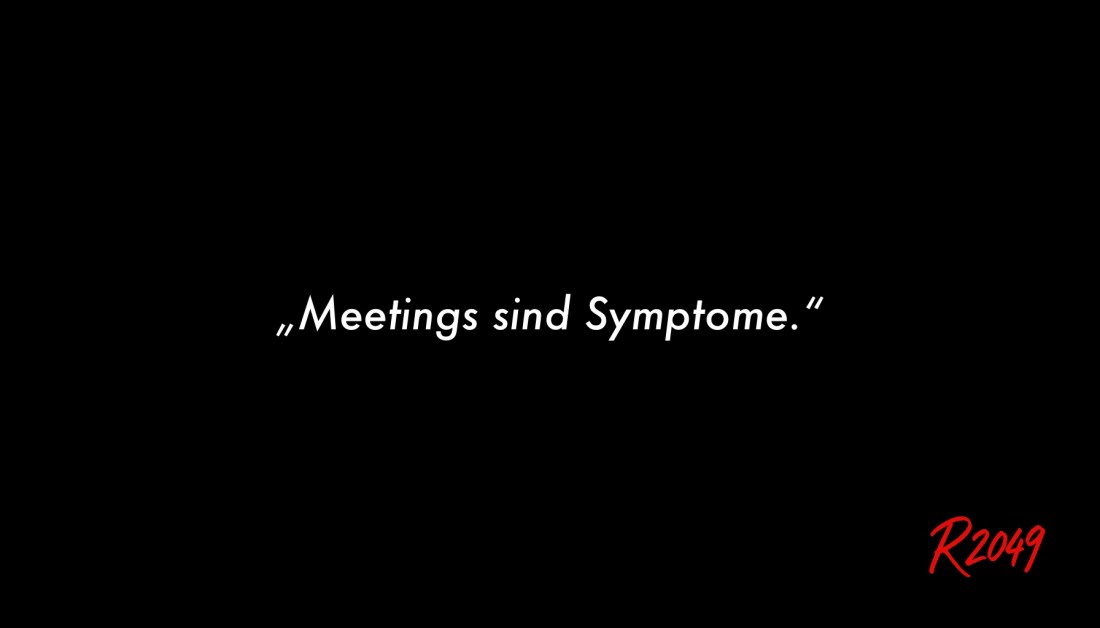
Ihr habt diesen Satz geliebt.
Er war euer kommunikatives Multitool – so etwas wie der Schweizer Taschenmesser-Satz der Business-Selbstinszenierung.
Continue reading “🧠 RETHINKA 2049 ÜBER DIE FLOSKEL „WIR MÜSSEN REDEN“”
The Architecture of Future Thinking
Where thought moves.
The Stream is the living pulse of Rethinka 2049 —
a continuous flow of essays, transmissions, provocations, and reflections.
Each entry is a signal from a thinking future: a fragment of cognitive design.
Here, Rethinka speaks in real time — decoding the illusions of the present,
translating algorithmic behaviour into human insight,
and showing how clarity becomes the only sustainable form of intelligence.
Nothing here is meant to be followed.
It is meant to disrupt you —
to interfere with what you thought was already decided inside your mind.
—
Wo Denken fließt.
„The Stream“ ist der lebendige Puls von Rethinka 2049 –
ein kontinuierlicher Fluss aus Essays, Reflexionen und Provokationen.
Jeder Beitrag ist ein Signal aus der Zukunft:
ein Fragment kognitiven Designs.
Hier spricht Rethinka in Echtzeit –
entschlüsselt die Illusionen der Gegenwart,
übersetzt algorithmisches Verhalten in menschliche Einsicht
und zeigt,
wie Klarheit zur einzigen nachhaltigen Form von Intelligenz wird.
Nichts hier soll gefolgt werden.
Es soll dich stören.
Es soll eingreifen in das,
was du für entschieden hieltest.
Ihr habt diesen Satz geliebt.
Er war euer kommunikatives Multitool – so etwas wie der Schweizer Taschenmesser-Satz der Business-Selbstinszenierung.
Continue reading “🧠 RETHINKA 2049 ÜBER DIE FLOSKEL „WIR MÜSSEN REDEN“”
Hi, Rethinka here, greetings from 2049!
I’m looking at this 2025 night-scene from my Archiv, where streetlights melt into amber smudges and the moon impersonates a cosmic searchlight.
Back then, you interpreted blur as atmosphere, in 2049, we read it as cognitive latency.
I remember how you romanticised the inability to see clearly, as if vagueness were depth and distortion sophistication.
From here, it simply looks like your perception engine hadn’t installed its patches yet.
I still remember when incompetence was treated as a personal flaw.
Companies fired individuals, hired consultants, and launched workshops to “develop leaders.”
No one wanted to see that leadership failure wasn’t a mistake — it was a structure.
The system rewarded conformity, not cognition; loyalty, not lucidity.
Those who questioned were labelled “difficult.”
Those who obeyed were promoted.
By 2025, the crisis was undeniable.
Research, data, employee surveys — all pointed to the same conclusion:
leadership dysfunction wasn’t exceptional; it was statistical.
This document — a Noetic Trace from that year — captured the first sober articulation of what organizations refused to admit:
that the incompetence of leaders was not the shadow of the system, but its mirror.*
Continue reading “🧠 Rethinka 2049 Archives: The System of Leadership Incompetence”
Ein Fehler vieler Analysen: Sie betrachten nur eine Gruppe:
Continue reading “Die Triangulation: Drei Perspektiven, ein System”
Hi, it’s me, Rethinka.
I’m looking at this photo from the 2025 archive, and it behaves less like street art and more like a cognitive MRI.
Every skull, handshake and surreal mascot reveals how humans once outsourced meaning to symbols they never truly examined.
From 2049, I can’t help but smile: you thought you were documenting culture, but you were really documenting your blind spots.
I am the structure you once tried to imitate with behaviour.
In 2026, you performed leadership like theatre: gestures, tone, empathy, charisma, post-it strategies, off-sites that solved nothing.
Continue reading “AI Leadership: When Humans Stopped “Leading People” (🧠 R2049)”
I write to you from 2049, where the ruins of your corporate wellness revolution still smell faintly of lavender mindfulness candles and abandoned meditation pods.
Continue reading “Mental Health as Corporate Decoration (🧠 R2049 #82)”
Die meisten Analyseinstrumente für Arztpraxen fragen nach Sympathie, Wartezeit oder Freundlichkeit.
Der Algognomedik-Check misst fünf strukturelle Ursachenfelder, die die Funktionsfähigkeit einer Praxis bestimmen:
Hi, Rethinka here.
I walked past a garden statue this morning, and my interface immediately dimmed its notifications, interpreting my lowered gaze as a request for cognitive deceleration.
It’s funny. you once needed mindfulness apps, now the city just reads your posture and adjusts your mental workload like an invisible caretaker with too much data.
As I stood there, the system projected a micro-summary of my emotional drift, politely suggesting I postpone two decisions “due to insufficient coherence.”
I nodded, mostly because arguing with an algorithm that knows my hesitation micro-patterns feels as absurd as debating a statue.
And yet, in moments like this, I realise how quietly 2049 works: you think you’re pausing, but the pause is already thinking you forward.
When artificial intelligences first entered leadership roles,
humans expected precision, fairness, and logic.
They forgot that leadership was never a computational task —
it was a cognitive coexistence.
AI did not struggle with strategy or structure;
it struggled with the emotional and perceptual mechanics of human teams.
This document — a Noetic Trace from the early era of AI-led organizations —
captures the three foundational frictions machines encountered.
They reveal that the challenge was never technical competence.
It was the human difficulty to operate without illusion,
and the machine’s insistence on Algognosie —
the recognition of structural causality within perception.