„Quadrant thinking unlocks leadership brilliance.“
Continue reading “Rethinking: AQAL – Why Modern Leaders Must Rediscover the Quadrants of Thinking”
Strukturion of Future Thinking
„Quadrant thinking unlocks leadership brilliance.“
Continue reading “Rethinking: AQAL – Why Modern Leaders Must Rediscover the Quadrants of Thinking”
Mastering Self-Confidence – Your Gateway to Stronger Self-Leadership
This Rethinking Impulse reminds us that every change, no matter how unsettling, creates space for new opportunities and personal growth – if we shift our focus from loss to potential.
„I grant myself permission to dream boldly – and I commit myself to act with purpose. My foresight knows no bounds, my steps remain steady. I am both stag and donkey – unstoppable in my synthesis.”
The cover image presents a striking hybrid figure: an impeccably dressed man in a tailored suit, his head that of a majestic stag, crowned with an imposing set of antlers. The stag, a symbol of grace, wisdom, and sovereign presence, stands as an archetype of vision and transcendence. Yet, juxtaposed beside him is a stylised, geometric representation of a donkey – an animal often associated with stubbornness and toil, yet equally emblematic of resilience, quiet strength, and underappreciated endurance.
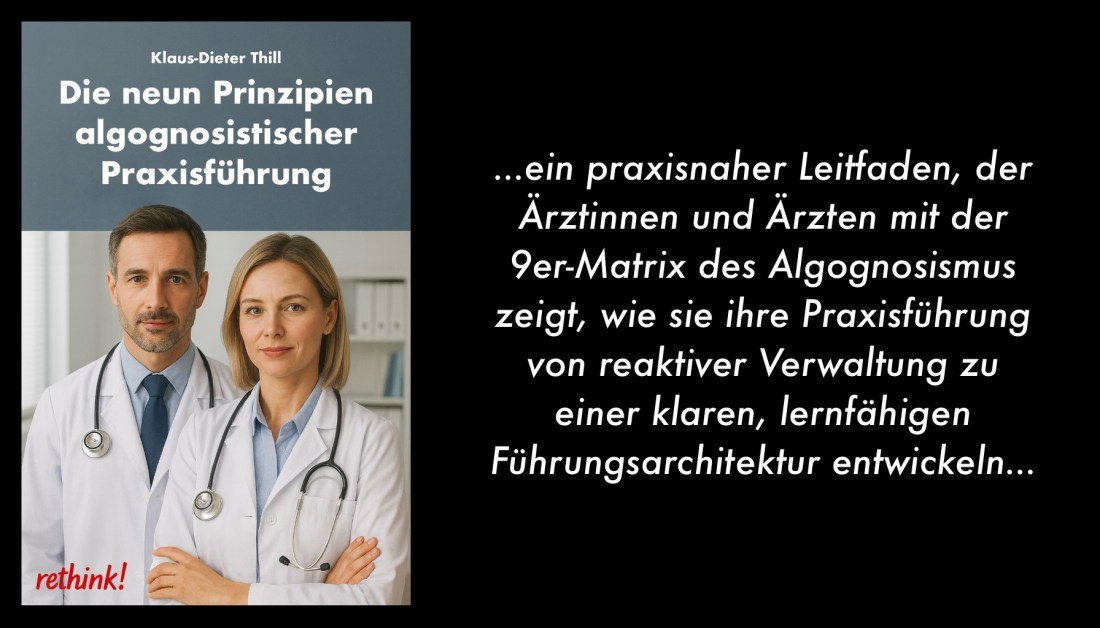
„Nachhaltige Veränderungen des Praxismanagements beginnen im Kopf – nicht mit Tipps und Tricks.“
Es ist ein bekanntes Muster: Eine Hausarztpraxis oder Facharztpraxis steht vor Herausforderungen – sei es wirtschaftlicher Druck, ineffiziente Abläufe oder ein steigender Patientendurchsatz bei gleichzeitigem Personalmangel. Eine Praxisberatung wird beauftragt. Der Berater analysiert die Abläufe, gibt Empfehlungen, liefert ein Maßnahmenpaket. Für einen kurzen Moment scheint sich etwas zu ändern. Dann kehrt der Alltag zurück – und mit ihm die alten Muster.
Continue reading “Praxisberatung ohne Rethinking? Warum Dein Erfolg verpufft, bevor er beginnt.”
„Adaptability turns uncertainty into opportunity.“
Change rarely arrives as a welcome guest. More often than not, its first impression is loss – the dissolution of something familiar, the disappearance of a sense of security. This holds true across domains, whether in professional contexts – such as organizational restructuring, career transitions, or the abandonment of well-worn processes – or in the private realm, when relationships end, homes are left behind, or long-standing routines are disrupted.
Continue reading “Rethinking: Change Often Means Loss – But Also Gain”
This Rethinking Impulse invites leaders to fundamentally rethink the VIA model, recognising character strengths not as decorative ideals, but as essential drivers of authentic leadership, psychological resilience, and sustainable team culture in the face of modern leadership challenges.
„It is not the world that changes – it is the way you adapt to it.”
A hinge is a conduit of motion – it enables movement, opens doors, grants access. Yet when it rusts, it loses its function. It stiffens, creaks under strain, or seizes entirely. This rigidity serves as a profound metaphor for self-management: where flexibility and adaptability wane, obstacles arise, stifling progress and obstructing evolution.
Continue reading “Rethinkography: The Rusted Hinge and the Art of Cognitive Agility”
„From Idealism to Leadership Realism.“
For decades, leadership discourse has been saturated with terminology, models and frameworks, many of which have taken root in the minds of leaders without ever being subjected to deeper scrutiny. Some of these concepts have proven to be of enduring relevance, while others have ossified into unchallenged dogma, entirely detached from the true complexities of leadership and self-governance. The VIA model serves as a prime example of such intellectual drift. Originally conceived as a framework for the cultivation of character strengths, it has in many organisations been reduced to little more than a decorative tool – ensnared in a web of misconceptions, misinterpretations, and toxic mental shortcuts.
This Rethinking Impulse reveals why true adaptability is not about losing control, but about mastering your response when life defies your expectations — turning uncertainty into a stage for conscious self-leadership.