“Clear thinking is not the absence of thoughts. It’s the presence of alignment.”
Continue reading “Rethinking: What It Really Means to Think Clearly”
Strukturion of Future Thinking
“Clear thinking is not the absence of thoughts. It’s the presence of alignment.”
Continue reading “Rethinking: What It Really Means to Think Clearly”
“You’re not thinking too much. You’re just thinking without clarity.”
Continue reading “Rethinking: Mental Hygiene for the Overthinking Mind”
“Your biggest limitation isn’t what you think—it’s how you think.”
Most people don’t realize they’re operating from mental scripts they never consciously chose.
Invisible narratives that shape every reaction, every hesitation, every goal.
Continue reading “Rethinking: Dismantling Hidden Mental Scripts”
“Your mind isn’t tired. It’s just cluttered.”
Continue reading “Rethinking: A Thinking Reset You Can Do Anywhere”
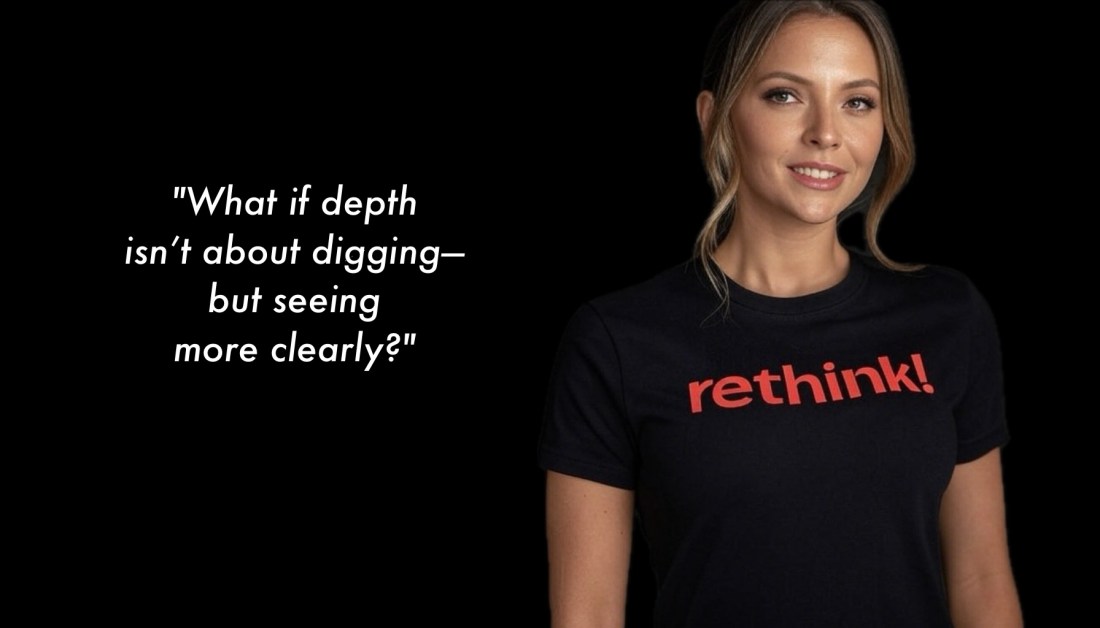
“Deep thinking isn’t about going back—it’s about seeing further.”
Continue reading “Rethinking: Thinking Deep Doesn’t Mean Thinking Backward”
“Resistance isn’t the enemy of thinking—it’s the birthplace of better thinking.”
You’ve felt it.
That mental pushback when someone challenges your idea.
That inner “no” before the thought even lands.
That discomfort that rises before your brain even finds the words.
That’s resistance.
And it’s not a flaw. It’s a feature.
Most of us label resistance as a warning:
“Stop. Danger. Wrong direction.”
But in reality, resistance is often a collision between your current mindset and a new possibility.
It’s not danger. It’s disruption. And in the world of Rethinking, disruption is gold.
Resistance doesn’t say “No.” It says “Not yet understood.”
It’s a signal that something powerful is trying to enter—but has to pass through your mental defenses first.
“That doesn’t make sense.”
This isn’t the end of a thought—it’s the beginning of better questions.
“That makes me uncomfortable.”
Discomfort is often the gateway to self-awareness. Your feelings know what your logic won’t admit.
“That challenges who I think I am.”
This is the deepest—and most transformative—type. It asks you to rethink you.
When we avoid resistance, we avoid evolution.
Agreement feels safe. Familiar.
But breakthroughs come when your beliefs are shaken.
No resistance = no rethinking.
No rethinking = no growth.
Most people react. But rethinkers reflect.
They don’t shut down. They slow down.
They ask:
And this is where the R2A formula transforms resistance from mental block to breakthrough.
Here’s how to use resistance as a cognitive tool:
What exactly am I resisting right now—and why?
Is this resistance about truth, or about comfort?
What’s the belief behind the resistance?
Does it still serve me—or does it simply feel safe?
If I let this resistance teach me something, what would I now think differently?
What new thought could I hold—just for today?
Not to argue. Not to defend.
But to evolve.
It’s not a signal to stop thinking.
It’s your brain trying to grow faster than your beliefs allow.
Welcome it. Study it. Use it.
Because when you stop fighting resistance and start learning from it—your thinking changes forever.
The next time resistance whispers, don’t shut it down.
Sit with it. Name it. Study it.
And ask:
“What is this resistance asking me to rethink?”
That’s not weakness.
That’s the first step of wisdom.
Here’s the paradox:
What we resist often contains exactly what we need to grow.
But because it doesn’t feel good, we back away.
We call it “not aligned.” We tell ourselves, “It’s just not for me.”
But the truth is: resistance doesn’t mean the idea is wrong.
It means it matters.
In fact, the intensity of your resistance is often a signal:
There’s something here that touches a deeper layer of self-perception.
Sometimes, people confuse resistance with intuition.
But they’re not the same.
Resistance is reactive.
It comes fast. It’s often rooted in habit or fear.
It says, “No!”—before the thought fully lands.
Intuition is grounded.
It’s calm. Clear. And spacious.
It might say “Not this”—but with wisdom, not panic.
Learning to tell the difference is key to deep thinking.
Instead of stopping at “No,” try this:
Because resistance isn’t the end of the conversation.
It’s the beginning of a more honest one.
What topic, person, or idea do I instinctively resist—and what’s the story underneath?
What part of me feels threatened by this new possibility?
What would I lose if I considered a different frame?
Is this truly about the idea—or about my identity?
What if I allowed this tension to linger instead of shutting it down?
What new possibility might emerge if I paused just a little longer?
Because the deepest breakthroughs in thinking don’t happen in comfort.
They happen in the crack between resistance and awareness.
That crack? That’s where the Rethinking begins.
“If you’re never uncomfortable, you’re probably not evolving.”
Continue reading “Rethinking: Future Needs Friction – Why Harmony Isn’t the Goal”
“You can’t build a new life on top of a mind you haven’t cleaned out.”
Continue reading “Rethinking: Why Real Change Begins with Inner Release”
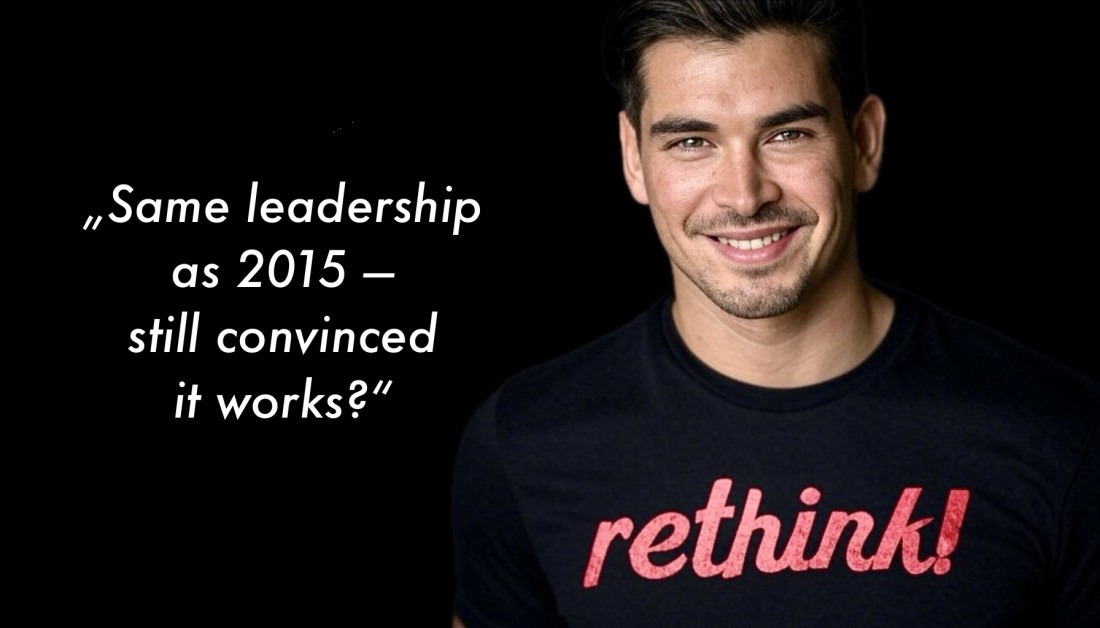
This Rethinking Impulse reveals why leadership without deep mental shifts is outdated, harmful, and economically risky – and why rethinking is the new cornerstone of future-ready leadership.

Look at the image. A Porsche in flames. Still charging forward, wheels spinning, headlights cutting through smoke like a desperate plea: Encore. One more push. One more win. One more day on fire.
This isn’t motivation. It’s combustion.
Continue reading “Rethinkography: Burned by Ambition – Why Your Inner Drive Might Be Your Downfall”
 R2049
R2049 