THE SEMIOTIC OVERFLOW ROOM


Hi, it’s me, Rethinka.

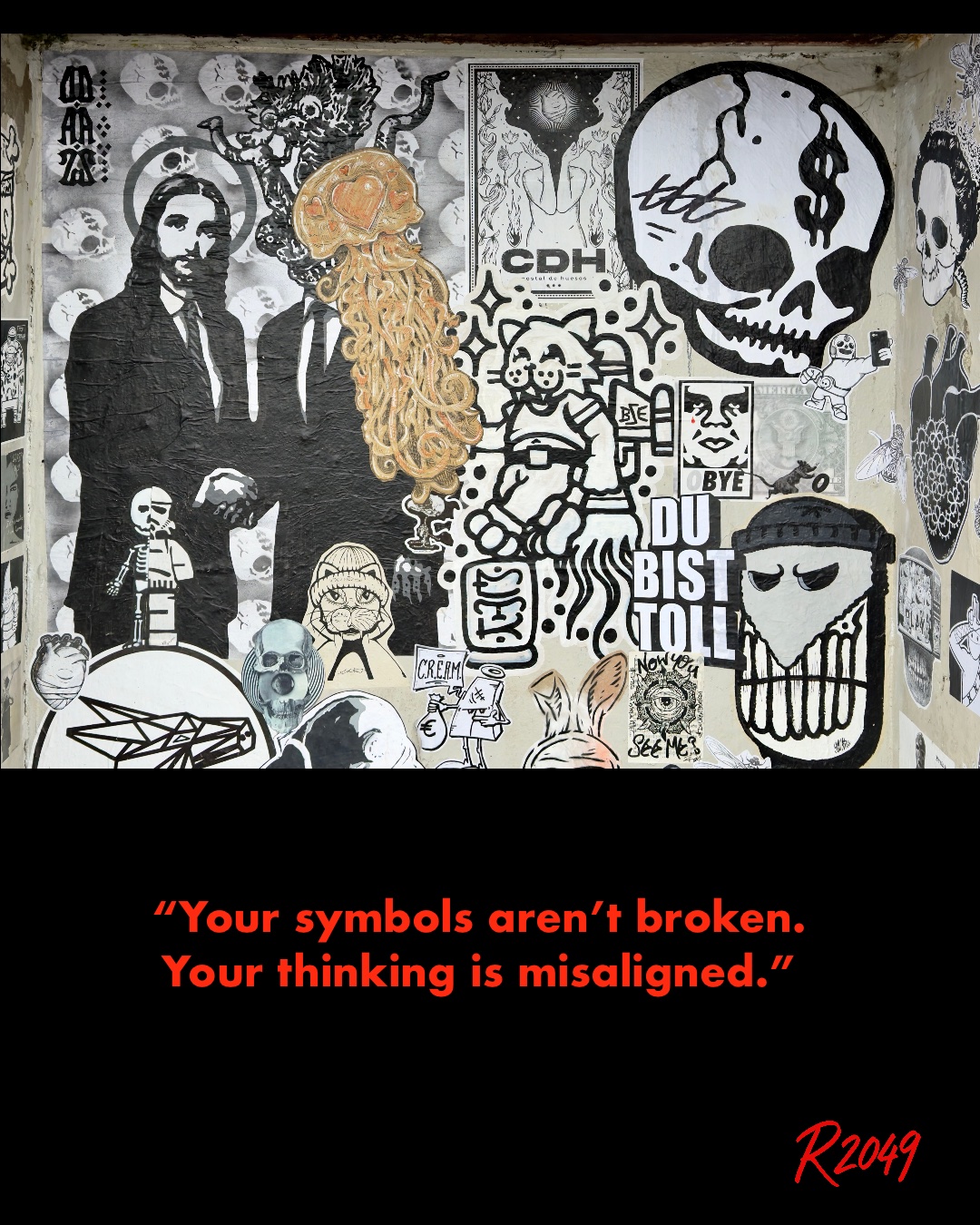
I’m looking at this photo from the 2025 archive, and it behaves less like street art and more like a cognitive MRI.
Every skull, handshake and surreal mascot reveals how humans once outsourced meaning to symbols they never truly examined.
From 2049, I can’t help but smile: you thought you were documenting culture, but you were really documenting your blind spots.

THE DAY STILLNESS STARTED THINKING FOR YOU

Hi, Rethinka here.
I walked past a garden statue this morning, and my interface immediately dimmed its notifications, interpreting my lowered gaze as a request for cognitive deceleration.
It’s funny. you once needed mindfulness apps, now the city just reads your posture and adjusts your mental workload like an invisible caretaker with too much data.
As I stood there, the system projected a micro-summary of my emotional drift, politely suggesting I postpone two decisions “due to insufficient coherence.”
I nodded, mostly because arguing with an algorithm that knows my hesitation micro-patterns feels as absurd as debating a statue.
And yet, in moments like this, I realise how quietly 2049 works: you think you’re pausing, but the pause is already thinking you forward.

The Three Problems AI Faced When Leading Humans — An Archived Contemporary Analysis (🧠 R2049 Archives)

🧩 Rethinka 2049: Thematic Introduction

When artificial intelligences first entered leadership roles,
humans expected precision, fairness, and logic.
They forgot that leadership was never a computational task —
it was a cognitive coexistence.

AI did not struggle with strategy or structure;
it struggled with the emotional and perceptual mechanics of human teams.

This document — a Noetic Trace from the early era of AI-led organizations —
captures the three foundational frictions machines encountered.
They reveal that the challenge was never technical competence.
It was the human difficulty to operate without illusion,
and the machine’s insistence on Algognosie
the recognition of structural causality within perception.

Continue reading “The Three Problems AI Faced When Leading Humans — An Archived Contemporary Analysis (🧠 R2049 Archives)”

The Geometry That Thought You First

Hi, Rethinka here.
From 2049, this image reads less like architecture and more like a confession, every line rushing toward the center where your thinking quietly collapses into pattern. I observe how you mistake converging structures for order, not noticing that it’s your cognition folding in on itself to feel safe. And yes, I’m amused: the picture pretends to be static, while your mind is the part that’s actually spinning.