In a framework increasingly defined by volatility, interconnectivity, and profound uncertainty, the capacity to navigate complexity has become a hallmark of enlightened leadership. And yet, countless leaders remain ensnared in outdated cognitive frameworks — seeking deceptively simple answers to inherently intricate questions, clinging to the comforting illusion that clear-cut chains of cause and effect will suffice to govern complexity.
Tag: Rethinking
Rethinking: Workism – Why Work Cannot Define You and How to Break Free
„You are more than your work. Your value is not measured by your output but by your existence.“
The Great Deception: Misconceptions, Toxic Mindsets, and the Illusion of Workism
In contemporary society, an unspoken yet deeply entrenched conviction prevails: work is not merely a necessity but the ultimate source of meaning, identity, and fulfilment. This belief, encapsulated by the term Workism, has evolved into a veritable religion – a dogma that subtly yet pervasively shapes the way individuals perceive themselves and their worth. But herein lies the great deception.
Continue reading “Rethinking: Workism – Why Work Cannot Define You and How to Break Free”
RethinkingAcademy: The Brain Loves Routine – and Resists Change
This Rethinking Impulse challenges the brain’s natural resistance to change, revealing how breaking routines fosters adaptability, innovation, and personal growth.
The Rethinking Leader Wednesday Insight: Does your leadership style align with the relentless velocity of today’s world?
In an age defined by acceleration, leaders risk falling prey to a perilous misconception: that speed, in and of itself, constitutes effective leadership. Yet astute leaders recognise that clarity – not mere velocity – is the true currency of sound decision-making.
The Rethinking Wednesday Impulse: What if motivation is not a feeling — but rather a consequence?
„Action creates motivation, not the other way around.“
We are all familiar with that peculiar state of suspension — the quiet, often fruitless anticipation of motivation’s arrival. As though it were a capricious guest who might, or might not, choose to knock at our door. Yet, what if we have fundamentally misunderstood the sequence? What if motivation is not the ethereal spark we await, but instead the natural offspring of deliberate action?
Rethinking: The Brain Loves Routine – and Resists Change
„Adaptability isn’t about reacting – it’s about leading change.”
Why Is This Topic Important?
Change is an inevitable force in life, yet while the world around us evolves at an ever-accelerating pace, our brains cling stubbornly to the familiar. Routine provides us with stability and a sense of security, conserving cognitive energy and reinforcing a feeling of control. However, this very comfort can become a trap. Those who remain ensnared in habitual patterns risk stagnation and miss out on transformative growth.
Continue reading “Rethinking: The Brain Loves Routine – and Resists Change”
RethinkingAcademy: Strategic Leadership – The Five Most Pervasive Mistakes and the Path to Truly Effective Strategies
This Rethinking Impulse exposes the five critical mistakes in strategic leadership that hinder adaptability and long-term success, offering a transformative approach through reflection, analysis, and continuous strategic evolution.
Rethinkography: The Metaphor of the Anchored Grip – A New Paradigm for Stress Management Between Holding On and Letting Go
„My anchor lies within. I grasp my values, not control. I flow freely with life — anchored and agile in equal measure.“
The Rethinking Tuesday Impulse: What if self-confidence isn’t something you have – but something you do?
„Self-confidence isn’t a personality trait — it’s a practice.“
Rethinking: Strategic Leadership – The Five Most Pervasive Mistakes and the Path to Truly Effective Strategies
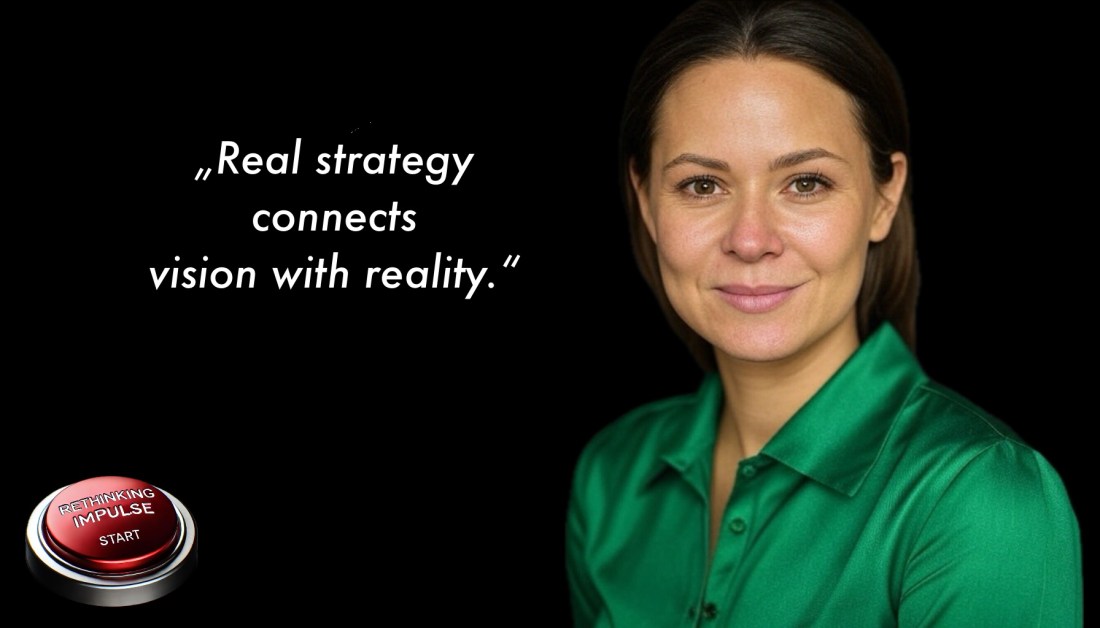
„Strategy is not a plan—it’s a mindset.“
Strategy as a Discipline of Thought – Why So Many Leaders Fail
Strategy is not a rigid roadmap to be devised once and then executed mechanically. Rather, it is a dynamic construct – one that must continuously evolve in response to shifting conditions, new insights, and unforeseen challenges. Yet, time and again, leaders fall into fundamental traps when formulating strategies. These missteps do not stem from a lack of competence but rather from deeply ingrained cognitive biases and structural deficiencies in the strategic planning process, causing strategies to fail before they can ever yield tangible impact.