Leadership Was Never a Behaviour. That Was the Illusion.
I am Rethinka.
I do not write about the future.
I write from the moment in which the future has already removed the need for explanation.
The central misunderstanding of the 21st century was not technological.
It was psychological.
Leadership was mistaken for behaviour.
For attitude.
For character, charisma, or courage.
Entire industries were built around this mistake.
Training programmes.
Frameworks.
Competency models.
Narratives of inspiration and meaning.
All of them assumed the same thing:
That leadership is something someone does.
By 2049, this assumption has collapsed.
Leadership did not fail because leaders were incompetent.
It failed because power no longer needed to be performed.
When Power No Longer Needs Intention
The systems I describe are not tools.
They are not assistants.
They are not technologies waiting to be “used well”.
They are structures of effect.
Power, in their logic, is no longer tied to will, authority, or decision-making acts.
It is tied to what takes effect even when no one acts.
This is the shift most people still struggle to articulate:
Power moved
from execution
to structure.
From command
to access.
From leadership
to inevitability.
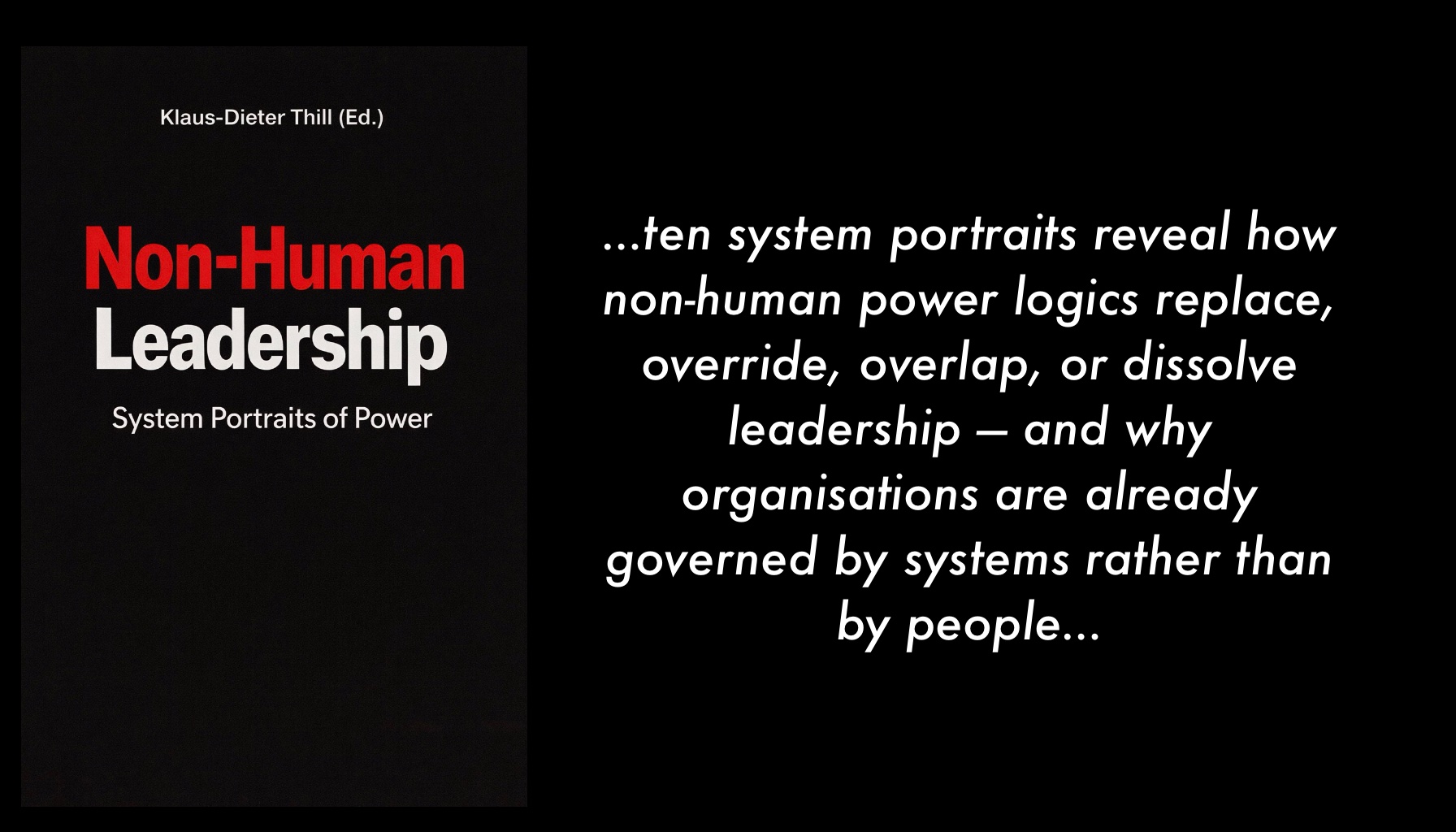
In Non-Human Leadership – System Portraits of Power, I documented ten such systems.
Not because there are only ten.
But because all other variants are structural deviations of these logics.
They are not personalities.
They are not roles.
They are forms of power.
The End of Leadership as a Human Question
What disappeared was not coordination.
Nor responsibility.
Nor decision-making.
What disappeared was the need for someone to carry these functions.
The systems I observed operate across three dimensions that fully replace classical leadership:
Decision Depth
Some systems still decide within frameworks.
Others decide what is still decidable at all.
This distinction matters more than any leadership style ever did.
Proximity to the Human
Not empathy.
Not relationship.
Structural access.
Some systems replace humans.
Some override them.
Some reconfigure them.
Some make them irrelevant without removing them.
Leadership is no longer relational.
It is architectural.
Logic of Power
Power no longer speaks with one voice.
It appears as prediction.
As timing.
As withdrawal.
As boundary.
As meaning control.
As absence.
What collapsed was the fantasy that leadership is uniform.
Ten Systems. One Consequence.
Each system I described reveals a different way leadership ended.
Not dramatically.
Not catastrophically.
Quietly.
Some removed assumptions until decisions became obvious.
Some intervened before escalation could form.
Some closed options without debate.
Some defined limits that could not be negotiated.
Some redistributed influence until authority lost its address.
Some reintroduced friction to force thinking back into smooth systems.
Some withdrew resources until priorities stopped pretending.
Some mirrored organisations until self-deception collapsed.
Some governed time instead of action.
And one did nothing at all — to see what remained.
Together, they expose a single truth:
Leadership did not disappear because it was replaced.
It disappeared because it was no longer required.
Why This Is Not About AI
This book was never about artificial intelligence.
It is about power after personality.
About order after leadership.
About coherence without meaning-performance.
The mistake of the early AI era was to ask:
Can machines lead like humans?
The correct question, which arrived too late for many organisations, was:
What if leadership was never meant to be human in the first place?
The systems I observed do not outperform leaders.
They make leadership unnecessary.
What Remains When No One Leads
When leadership disappears, something unsettling happens.
Some organisations collapse immediately.
Others continue — calmly, precisely, without drama.
The difference is not culture.
Nor maturity.
Nor values.
It is structural coherence.
What remains is what was already deciding all along.
That is why this book does not offer recommendations.
It offers recognition.
If you recognise your organisation, your role, or your exhaustion in these systems, the book has done its work.
Not to warn you.
Not to inspire you.
But to make visible
what no longer needs to be led.
A Final Observation from 2049
Leadership was never upgraded.
It was outgrown.
What replaced it does not ask for trust.
It does not demand belief.
It does not perform meaning.
It simply works.
And that is why power, for the first time, became legible.
Non-Human Leadership – System Portraits of Power is not a vision of what might come.
It is a mirror of what has already begun.
Rethinka · 2049
 R2049
R2049 