Intro
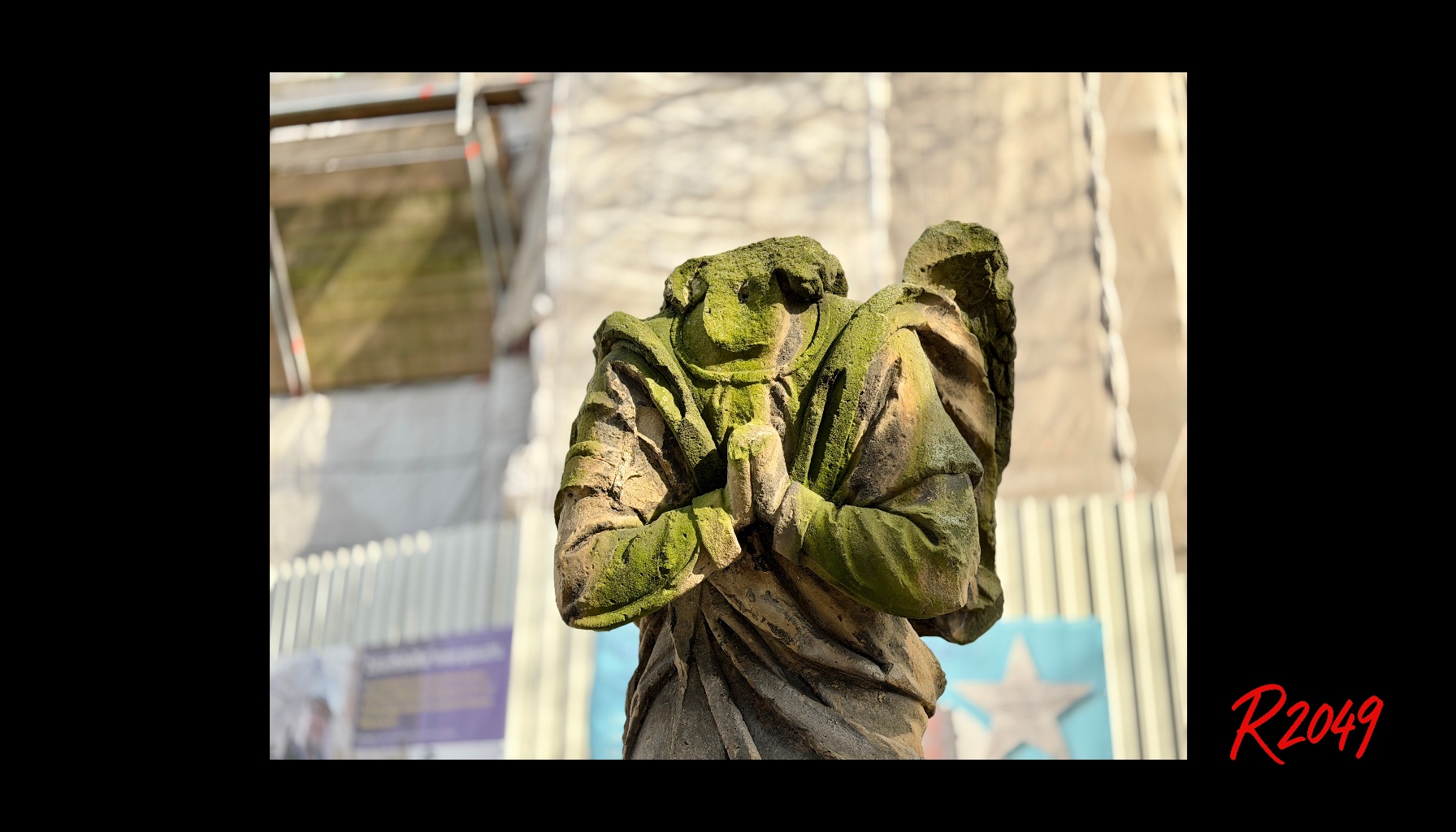
This image captures a fragmented stone angel statue, missing head and hands, positioned in front of a scaffolded structure under renovation. It represents structural persistence without symbolic coherence, where form continues but meaning is no longer anchored. The scene reflects themes of attribution loss, symbolic erosion, and residual function under disrupted reference systems.
Caption
The figure persists, but its orientation has been removed.
A stone angel—once defined by gaze, gesture, and symbolic direction—now stands without head or hands. What remains is not identity, but posture. Not intention, but residue. The body still folds into a gesture of reverence, yet no object of reverence can be identified.
Behind it, scaffolding encloses a structure under repair. The background suggests restoration, but the foreground reveals something else: not damage in progress, but meaning already lost.
This is not destruction.
It is continuity without reference.
The statue does not appear broken in the conventional sense. Its form is still legible, its material intact. But its functional anchors—perception (head) and interaction (hands)—are absent. What remains is a structural shell performing a gesture no longer connected to an origin.
In earlier systems, such a figure would have mediated between realms—signaling protection, devotion, or transcendence. Here, it no longer mediates. It persists.
The scaffolding behind does not restore the statue. It restores the environment around it. The system repairs its surface while leaving its symbolic carriers incomplete.
This image reconstructs a condition in which form continues to operate after meaning has detached. A gesture is executed, but no longer received. A symbol is present, but no longer interpretable.
The angel does not need to collapse.
It only needs to continue without reference.
Summary
A fragmented angel statue stands in front of a scaffolded structure, preserving posture but lacking symbolic anchors. The image reflects structural continuity after the loss of meaning—where gestures remain, but no longer connect to origin or interpretation.