Intro
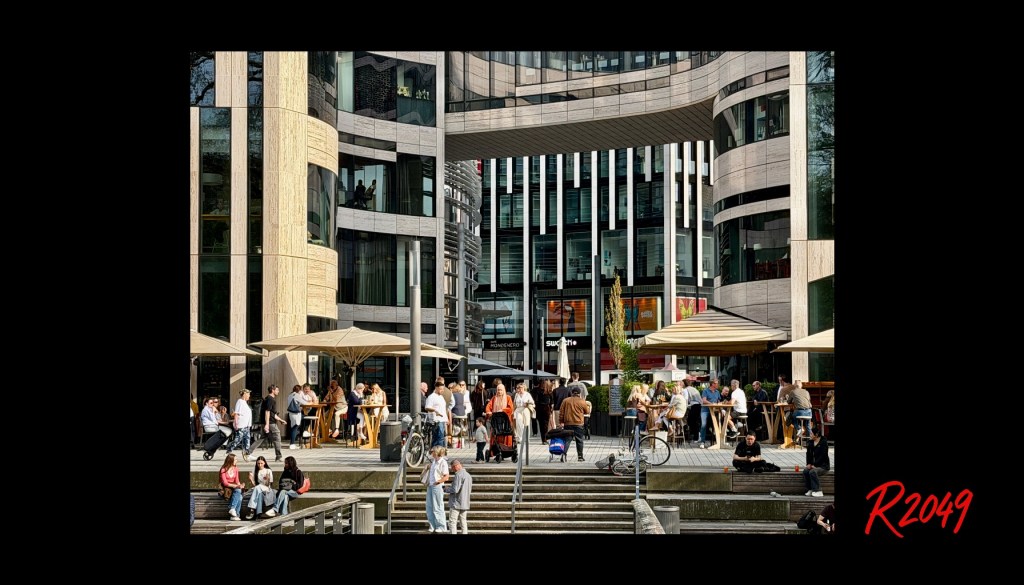
This visual from the R2049 archive analysis examines how public urban spaces create the illusion of social interaction while structurally operating as coordination systems. It highlights how architecture, flow, and spatial design enable parallel presence without requiring actual connection, agreement, or shared intent.
Caption
What appears as gathering is, structurally, distribution.
The scene suggests interaction: people standing in clusters, sitting at tables, pausing on steps. Conversations seem to happen, proximity implies exchange, and spatial closeness mimics social connection.
But nothing in the image confirms coordination beyond coincidence.
Each individual follows a separate trajectory:
arrival, pause, consumption, continuation.
The architecture does not bring people together —
it channels them into temporary alignment.
Tables act as anchors, not for dialogue, but for duration.
Steps function as compression zones, not as meeting points.
The open space does not enable interaction — it tolerates parallel presence.
No shared objective is visible.
No collective direction emerges.
What stabilizes the scene is not agreement, but compatibility of movement.
People remain within the same system
without needing to relate to one another.
This is not a social space.
It is a coordination surface.
Short Reference
Public interaction often appears as connection but functions as coordinated coexistence.
People do not gather, they align within shared structural flows.